December 2007 cool, humid, cloudy, rainy

The daily weather logWeather log December 2007
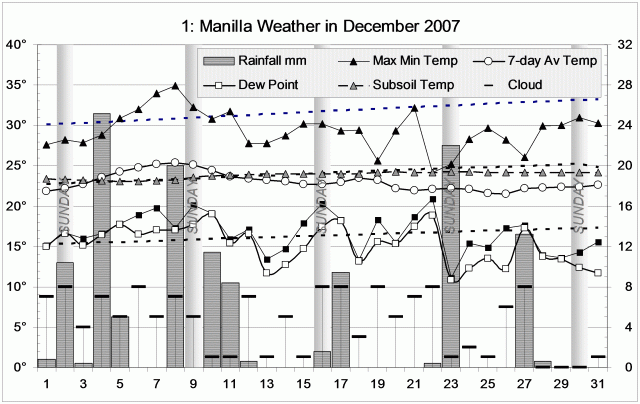
Only four days, early in the month, had daily maximum temperatures warmer than normal. Decembers average five days over 35°, but there were none this month. The 22nd was nine degrees cooler than normal, at 24.2°. Daily minimum temperatures varied around the normal values (16°). The 7-day daily average temperature stayed below normal most of the time.

The graphs include the humidity of the air, using the Dew Point idea. All air contains moisture. If it cools to its Dew Point temperature, it gets so moist that cloud or fog forms, and dew appears. On humid days when the Dew Point is above 17°, most people find the weather unpleasantly sultry or sweaty. They find air with a low Dew Point, such as 5° or 10°, very pleasant and refreshing. The Dew Points shown on this graph are the early morning minimum values. Morning Dew Points this December were often between 15° and 18°: too humid for comfort. They never came below 10°.
Many mornings this month were overcast, and there were never two fine mornings together until the 29th.
There were fourteen rain days, with a total rainfall of 129.4 mm. The wettest day was the 4th, with 25.2 mm. There were only two runs of four days without rain, beginning on the 18th and 28th.

 Comparing December monthsClimate December 2007
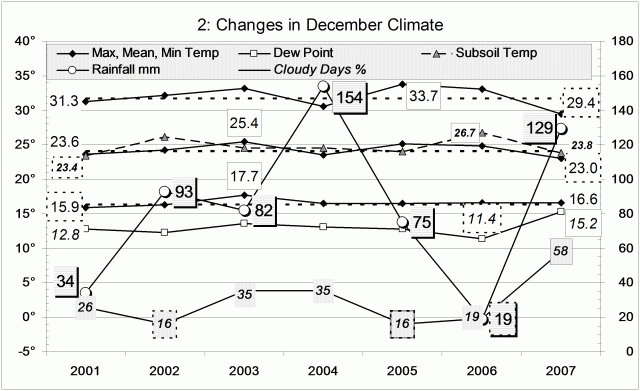
The average daily maximum temperature this month, 29.4°, was far below the average for the last nine Decembers (31.7°). Only December 1999 had a slightly lower value (29.2°). The daily mean temperature (23.0°) was below average (24.0°), and the daily minimum temperature (16.6°) was near average (16.4°). As a result, the daily temperature range this month was only 12.8°.

The mean morning Dew Point for December 2007 is 14.2°. This high value, (meaning high humidity) seems to be about 2° above normal, but my record is short.
This was one of the three cloudiest months in nine years. The other two were also in 2007: November (50%) and June (60%).
The rainfall total of 129 mm makes this a very wet month. Only 14 Decembers since 1884 were wetter.
The year 2007 was wet: the total rainfall amounted to 741 mm. This is on the 68th percentile, meaning that higher rainfall has occurred roughly one year in three. The rainfall was 90 mm above the average (651 mm). It was the highest total since the strange wet year of 1998 (919 mm). That year nearly 400 mm more rain than usual fell in the six months that are normally the driest: from April to September.


Data. Rainfall data is from Manilla Post Office, courtesy of Phil Pinch. Dew point values before August 2005 are from Tamworth Airport 6 am data supplied by the Bureau of Meteorology. Temperature and other data are from 3 Monash Street, Manilla.
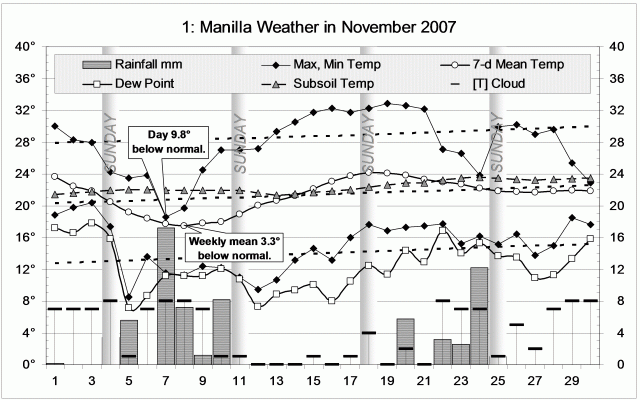
 

Very cloudy November 2007

The daily weather logWeather log November 2007

Warm humid weather, including one night 8° above normal, continued into early November. This developed into a cool rainy week. The coldest day (the 7th), registering 18.6° (9.8° below normal!), followed the wettest day, which had 17.2 mm of rain.

Eight sunny days followed, (Good luck for the NSW Gliding Championships at Lake Keepit!) ending with a storm on the 19th. Four more cool wet days brought the rain total to 67.8 mm. The last days of the month were overcast with very little rain (0.4 mm).
This was an average November for rainfall and mean temperature. Generally, days were cooler than normal, and nights were warmer, making the daily temperature range (12.8°) the lowest by far in nine Novembers. It was also the cloudiest of those months, with 50% cloudy mornings. Typically, November has about two days hotter than 35°, but there were none this time.

 Comparing November monthsClimate November 2007

November 2007 was not a drought month. The total rainfall was near average, not only for the month itself, but also for the last 2, 3, 4…months up to 60 months. Beyond that, total rainfalls for the last 6 to 9 years were rather low, because they included the extreme drought of 2002.

Since 2002 there has been only one extreme drought event: May 2006 had no rain. A less extreme, but still severe event was the two to five month drought peaking in May 2005.


Data. Rainfall data is from Manilla Post Office, courtesy of Phil Pinch. Dew point values before August 2005 are from Tamworth Airport 6 am data supplied by the Bureau of Meteorology. Temperature and other data are from 3 Monash Street, Manilla.
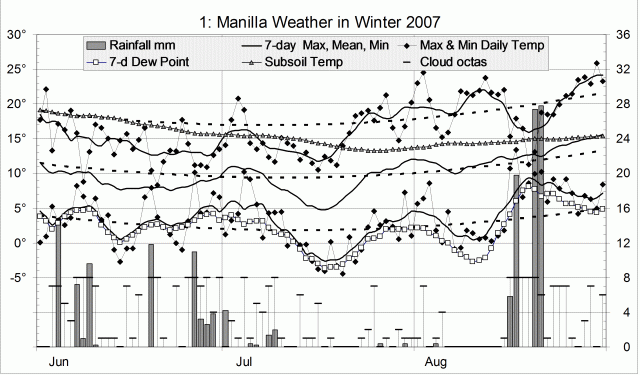
 

Cold days in 2007 winter

Weather log winter 2007

The daily weather log

The temperature trends this winter look like a roller-coaster.
June had daily maximum temperatures about four degrees below normal. Two miserable days had maxima eight degrees below. Meanwhile, minimum temperatures were normal.
Maxima returned to normal in early July but, by that time, nightly minimum temperatures were well above normal. All temperatures then plummeted, losing 8°: by mid-July both maxima and minima were about 5° below normal.
By the end of July and early August maxima and minima had shot up again to well above normal. Next, maxima went up while minima went down, making the daily temperature range very large. This temperature range then collapsed to become very small. The winter ended with temperatures near normal.
The high ground in Manilla had 38 frosts* in June, July, and August. The nine-year average is 45. Seventeen nights went below zero and two nights below -4°.
There was quite a lot of rain, but not much fell in July. The amounts were 65 mm in June, 9 in July, and 81 in August. June was above average, July in the second decile, and August in the ninth decile.
There were ten rain days in June, seven in July, and five in August. One event was remarkable: rain fell continuously for more than 36 hours from the morning of 19th August, to a total of 55 mm.
Skies were overcast (8/8) around the periods of rain. In contrast, there were long sunny spells (0/8 or 1/8) in mid-July and the first half of August.

Comparing winter seasons

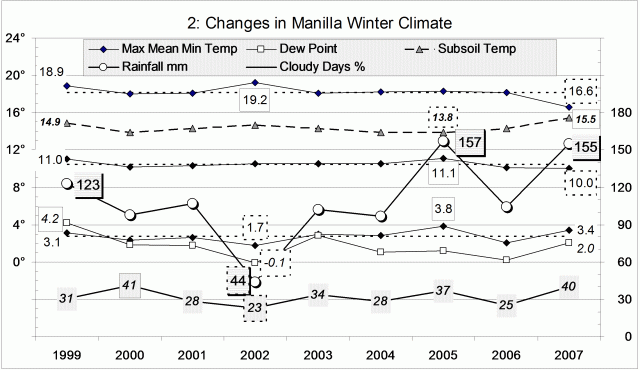
The average daily maximum temperature was the coldest in the last nine winters. At 16.6°, it was 1.6° below average.
Although the nights of 2005 were warmer, this winter also had warm nights. At 3.4°, they raised the daily mean temperature up to 10.0°, close to normal.
The daily temperature range in winter in Manilla is usually 15.4°. This winter’s cool days and warm nights made its daily range the lowest in these years. It was only 13.2°, typical of places nearer to the coast, such as Singleton.
The winter that stands out is 2002. With the warmest daily maxima (19.2°) and the coldest daily minima (1.7°) it had the remarkably high daily range of 17.5°. Such a range is found mainly in desert areas – which Manilla was at the time!.

Winter is the driest season in Manilla. The average winter rainfall, 125 mm, is just over half the average summer rainfall (227 mm).
This year’s winter rainfall (155 mm) was above average, and near that of 2005 (157 mm). None of the winters on the graph is far from the average except 2002.
The very dry winter of 2002, at 44 mm, was the ninth driest on the 124-year record. It was the driest since 1982 and 1972 (both 32 mm).
The graph just misses the very wet winter of 1998, nine years ago. Split Rock Dam suddenly filled up for the first time. At 304 mm, that was the second wettest winter on record. Only the winter of 1920 was wetter, with 318 mm.
The graph shows the peracentage of mornings with more than four octas of cloud. The winter average is 31%.
This winter, and winter 2000 were the cloudiest. The insulating blanket of cloud stopped the days from getting warm, and the nights from getting cold.
The winter of 2002 had the fewest cloudy days, another sign of how like a desert it was then.

Climate winter 2007

*Frost: A frost occurs when the temperature on the grass is below zero, causing water to freeze in the leaves. Not many stations measure grass temperature. My rule-of-thumb is to declare a frost if the temperature in the thermometer screen (at 1.5 metres) is below +2.2°.

Data. Rainfall data is from Manilla Post Office, courtesy of Phil Pinch. Dew Point values before August 2005 are from Tamworth Airport 6 am data supplied by the Bureau of Meteorology. Temperatures, including subsoil at 750 mm, and other data are from 3 Monash Street, Manilla.
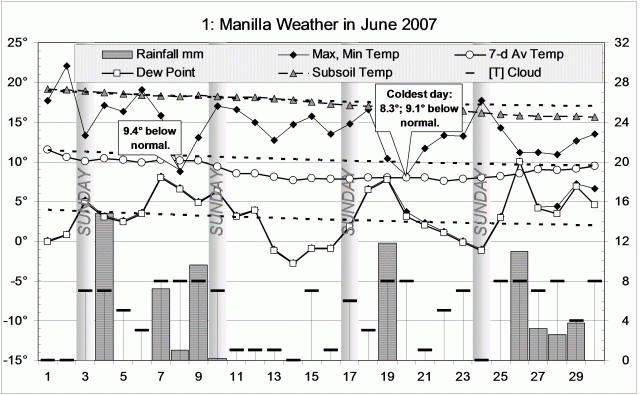
June 2007 had two very cold days

The daily weather logWeather log June 2007

This month had two remarkably cold days: 8.8° on Friday the 8th, just before Queen’s Birthday, and 8.3° on Wednesday the 20th. (Note added: in 2014 these stand as the coldest on the record from 1999.) Nearly all days were cooler than normal. Nights varied, with one above 10 degrees and 10 frosts. The weekly mean temperature was below normal except on the first and last days.
Nine days were completely overcast, and rain fell on 10 days (usually 6) with the highest reading 14.8 mm on the 4th.

The first very cold day was related to a severe “East Coast Low” (990 hPa) that caused widespread damage and major flooding in the Hunter region. Gales and high seas caused the freighter “Pasha Bulker” to run aground.

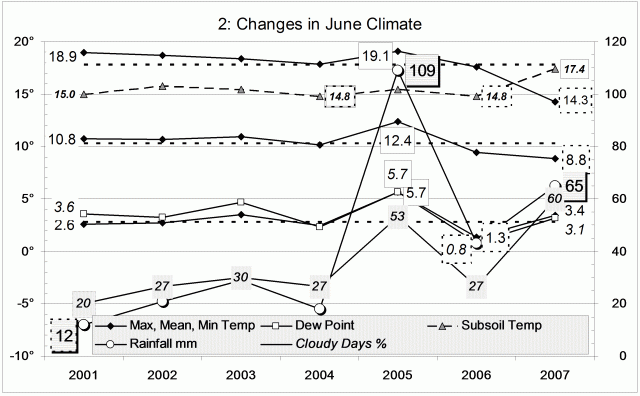
 Comparing June monthsClimate June 2007

The mean daily maximum (14.3°) and mean (8.8°) temperatures this month were much lower than in the previous six June months. The daily minimum (3.4°), however, was higher than last year (1.3°). (Note added. The maximum and mean temperatures stand in 2014 as record low values for June.)

The mean daily temperature range this June month (normally 15.0°) was extremely narrow: only 10.9°. (Note added. In September 2014, this stands as a record for any calendar month. The only other months with a mean daily temperature range narrower than 13° were all in late 2010 (expressing that La Niña event): July 2010, 12.3°; August 2010, 11.9°; November 2010, 12.4°; December 2010, 11.8°.)
With 60% of mornings having more than 4 octas of cloud, this was a very cloudy month. (Note added. The only month much more cloudy than this has been June 2013, with 75% cloudy mornings.)
The total rainfall of 65 mm is in the 78th percentile for June (June 2005, with 109 mm, was in the 96th percentile). Rainfall totals for more than one month show no shortages.


Note: Although there were brief reports in the “Manilla Express” dated 10/7/07 and 17/7/07, this report in standard format was written in 2014, with the benefit of hindsight. In particular, it uses normal curves that are based on data for the decade from March 1999 to February 2009.

Data. Rainfall data is from Manilla Post Office, courtesy of Phil Pinch. Dew point values before August 2005 are from Tamworth Airport 6 am data supplied by the Bureau of Meteorology. Temperature and other data are from 3 Monash Street, Manilla.