
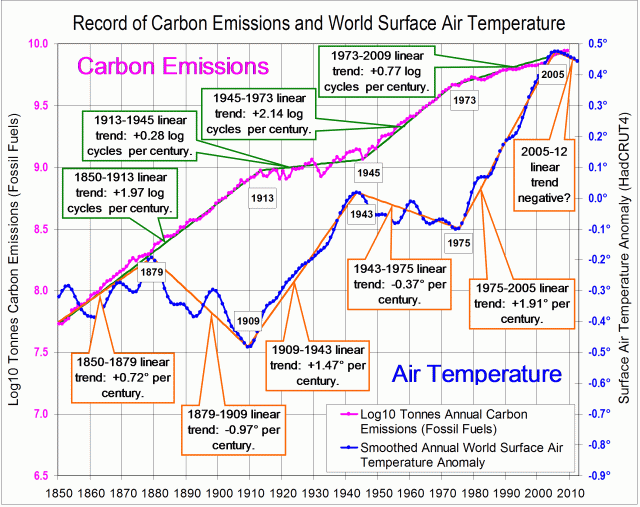
Trends in global temperature and in carbon emissions changed sharply several times during the last 160 years.
One question is at the heart of concern about human influence on climate: how does global temperature relate to human-caused emissions of carbon dioxide?
This graph shows that relation: it does not explain it.
[This post published 9/05/2014 was made “sticky” during early April 2018 to show the inclusion of Gail Tverberg’s recent graph of world energy consumption.]
Data
I display two well-established data sets:
1. The HadCRUT4 record of estimated global surface air temperature. Values are expressed as the anomaly from 1961-1990 mean values in degrees celsius.(See Note 1. below.)
2. Global Fossil Fuel Carbon Dioxide Emissions, tabulated and graphed as tonnes of carbon (See Note 2. below.)) by the Carbon Dioxide Information Analysis Center, Oak Ridge.(See Note 3. below.)
The format of the data is given in Note 4. below.
Multi-decadal linear trends
Trends in carbon emissions
Throughout this time, the rate of carbon emissions increased exponentially, but at rates that changed abruptly at certain dates. In units of log-cycles per century, the rates were:
From 1850: 1.97 units;
From 1913: 0.28 units;
From 1945: 2.14 units;
From 1973: 0.77 units.
 Note added April 2018.
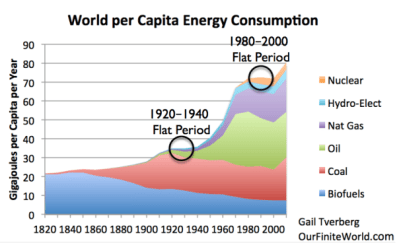
The two episodes of low rate of growth of carbon emissions, from 1913 to 1945 and from 1973 to 2009, relate to times of low growth in world energy consumption. This graph by Gail Tverberg shows that world energy consumption grew so slowly from 1920 to 1940 and from 1980 to 2000 that it did not keep up with the growth of population. Continue reading
 climate by surly