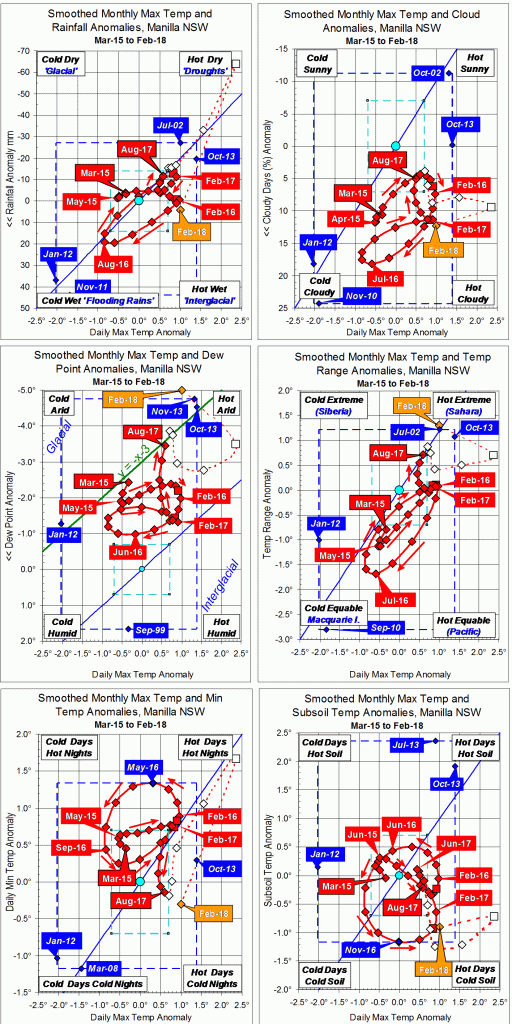
3-year trends to February 2018

Warm

3-year trends to February 2018

February raw anomaly data (orange)

February 2018, unlike January, had days that were not very hot and nights with normal temperature. Rainfall rose to a normal value. Continuing low moisture was shown only by a very low dew point and a wide daily temperature range.

 Fully smoothed data (red)

Data for winter (JJA) 2017

These latest of the fully-smoothed data points showed that last winter was near-normal and changing little in most respects. Both dew point and temperature range were moving up their graphs towards aridity. Daily minimum temperature and subsoil temperature were cooling.

Main patterns of fully-smoothed data

In this period, the only major departure from normal climate was the cool moist winter (JJA) of 2016. Loops in the top four graphs show that more moisture preceded lower temperature. Minima in daily minimum temperature and in subsoil temperature came several months later, at the end of spring.


Note:

Fully smoothed data – Gaussian smoothing with half-width 6 months – are plotted in red, partly smoothed data uncoloured, and raw data for the last data point in orange. January data points are marked by squares.
Blue diamonds and the dashed blue rectangle show the extreme values in the fully smoothed data record since September 1999.

Normal values are based on averages for the decade from March 1999.* They appear on these graphs as a turquoise (turquoise) circle at the origin (0,0). A range of anomalies called “normal” is shown by a dashed rectangle in aqua (aqua). For values in degrees, the assigned normal range is +/-0.7°; for cloudiness, +/-7%; for monthly rainfall, +/-14 mm.

 * Normal values for rainfall are based on averages for the 125 years beginning 1883.

3-year trends to January 2018

Hot and dry

3-year trends to January 2018

January raw anomaly data (orange)

January 2018, like December, had hot days and hot nights, but had even lower rainfall.

 Fully smoothed data (red)

The latest fully-smoothed data point is for July 2017.
Most variables were normal and static at that time. Dew point was low and falling, while daily temperature range was rather high and rising.


Note:

Fully smoothed data – Gaussian smoothing with half-width 6 months – are plotted in red, partly smoothed data uncoloured, and raw data for the last data point in orange. January data points are marked by squares.
Blue diamonds and the dashed blue rectangle show the extreme values in the fully smoothed data record since September 1999.

Normal values are based on averages for the decade from March 1999.* They appear on these graphs as a turquoise (turquoise) circle at the origin (0,0). A range of anomalies called “normal” is shown by a dashed rectangle in aqua (aqua). For values in degrees, the assigned normal range is +/-0.7°; for cloudiness, +/-7%; for monthly rainfall, +/-14 mm.

 * Normal values for rainfall are based on averages for the 125 years beginning 1883.

3-year trends to December 2017

Hot days and nights

3-year trends to December 2017

December raw anomaly data (orange)

December 2017 had hot days and hot nights, but the subsoil remained cold. Rainfall was low, while other measures of moisture were near normal.

 Fully smoothed data (red)

The latest fully-smoothed data point is for June 2017. By that time, all variables were within the normal range except for dew point. Even dew point was in the centre of the range of low values that has become “normal” since 2010. Three variables were static: daily maximum temperature, subsoil temperature, and rainfall. Cloudiness, dew point, and daily temperature range. were moving towards aridity. Daily minimum temperature was falling.


Note:

Fully smoothed data – Gaussian smoothing with half-width 6 months – are plotted in red, partly smoothed data uncoloured, and raw data for the last data point in orange. January data points are marked by squares.
Blue diamonds and the dashed blue rectangle show the extreme values in the fully smoothed data record since September 1999.

Normal values are based on averages for the decade from March 1999.* They appear on these graphs as a turquoise (turquoise) circle at the origin (0,0). A range of anomalies called “normal” is shown by a dashed rectangle in aqua (aqua). For values in degrees, the assigned normal range is +/-0.7°; for cloudiness, +/-7%; for monthly rainfall, +/-14 mm.

 * Normal values for rainfall are based on averages for the 125 years beginning 1883.
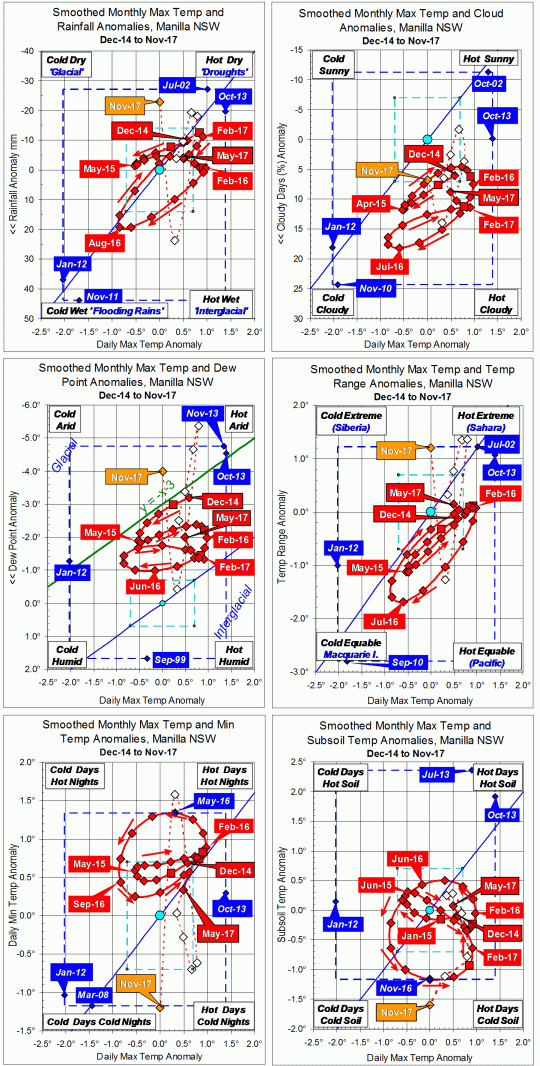
3-year trends to November 2017

Dry with cold nights

3-year trends to November 2017

November raw anomaly data (orange)

November 2017 reverted to the anomalies of August and September: low moisture (top four graphs) and cold nights (bottom left), with continuing cold subsoil (bottom right). Day temperature (x-axes)had cooled to normal since September.

 Fully smoothed data (red)

Anomaly data for autumn 2017 (MAM) are now fully-smoothed, plotted in red. That season was near the centre for the last three years, but day temperatures fell from high towards normal (seen best on the top right graph). Meanwhile, moisture measures disagreed somewhat. Rainfall rose towards normal, cloudiness decreased towards normal, dew point fell through low values, and daily temperature range was static near normal.
Daily minimum temperature fell towards normal, and subsoil temperature rose to normal.


Note:

Fully smoothed data – Gaussian smoothing with half-width 6 months – are plotted in red, partly smoothed data uncoloured, and raw data for the last data point in orange. January data points are marked by squares.
Blue diamonds and the dashed blue rectangle show the extreme values in the fully smoothed data record since September 1999.

Normal values are based on averages for the decade from March 1999.* They appear on these graphs as a turquoise (turquoise) circle at the origin (0,0). A range of anomalies called “normal” is shown by a dashed rectangle in aqua (aqua). For values in degrees, the assigned normal range is +/-0.7°; for cloudiness, +/-7%; for monthly rainfall, +/-14 mm.

 * Normal values for rainfall are based on averages for the 125 years beginning 1883.

3-year trends to October 2017

Avoiding drought

3-year trends to October 2017

October raw anomaly data (orange)

October 2017 was moist: all moisture indicators had dropped sharply down the graphs, retreating from the aridity of August and September. Daily maximum temperature anomaly (x-axis in all graphs) fell towards normal, while that of the subsoil (lower right graph) remained low. Daily minimum temperature anomaly (lower left graph) jumped from extremely low to extremely high.

 Fully smoothed data (red)

The latest fully-smoothed data point is that for April 2017.
At that time, the climate was warm and almost static. There was a pause in a drift towards aridity.


Note:

Fully smoothed data – Gaussian smoothing with half-width 6 months – are plotted in red, partly smoothed data uncoloured, and raw data for the last data point in orange. January data points are marked by squares.
Blue diamonds and the dashed blue rectangle show the extreme values in the fully smoothed data record since September 1999.

Normal values are based on averages for the decade from March 1999.* They appear on these graphs as a turquoise (turquoise) circle at the origin (0,0). A range of anomalies called “normal” is shown by a dashed rectangle in aqua (aqua). For values in degrees, the assigned normal range is +/-0.7°; for cloudiness, +/-7%; for monthly rainfall, +/-14 mm.

 * Normal values for rainfall are based on averages for the 125 years beginning 1883.