3-year trends to June 2019

June warm and dry

3-yeqr climate trends to June 2019

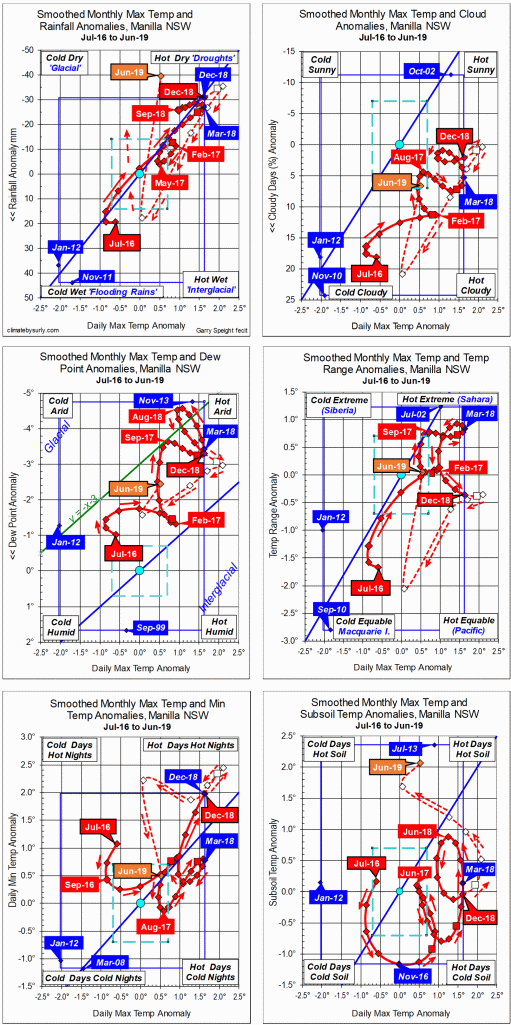
June raw anomaly data (orange)

Temperatures

Daily maximum temperature anomaly (all x-axes): near the upper limit of normal values.
Daily minimum temperature anomaly (lower left): near the upper limit of normal values.
Subsoil temperature anomaly (lower right): very high.

Moistures (moist is at the bottom)

Rainfall anomaly (upper left): very low.
Cloudiness anomaly (upper right): normal.
Dew point anomaly (middle left): low, like the other recent values.
Daily temperature range anomaly (middle right): normal.

 Latest fully smoothed data (red), December 2018

Temperatures

Daily maximum temperature equaled the record positive value of +1.62° set in March 2018.
Daily minimum temperature set a new record of +1.98°, beating +1.65° set the previous month.
Subsoil was normal due to phase lag.

Moistures (moist is at the bottom)

Rainfall smoothed anomaly was a new 136-year record value of -30.8 mm per month, breaking the record of -29.7 mm set the previous month.
Cloudiness was normal.
Dew point was low.
Daily temperature range was normal.


Notes:

January data points are marked by squares.

Smoothing

Smoothing uses Gaussian functions.
For fully smoothed data the function has a Standard Deviation of 2.5 months, it spans 13 monthly data points, and has a half-width of 6 months, which suppresses cycles shorter than 12 months. For partly smoothed data, the span of the function is reduced to 11 months, 9 months and so on.
Continue reading
June breaks more drought records

Rainfall status May-June 2019

Graph of Rainfall Shortages

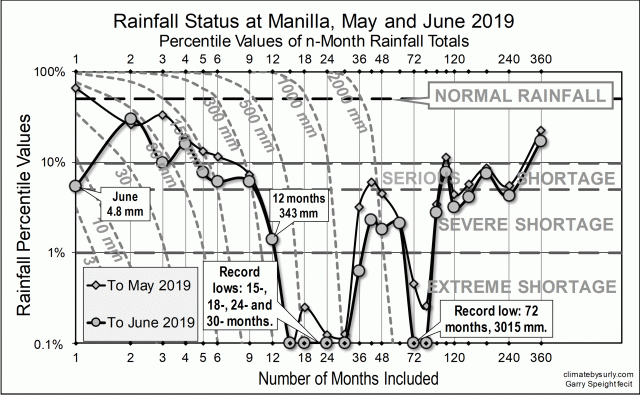
This graph shows all the present rainfall shortages at Manilla, short term and long term, as percentile values. The latest values, as at the end of June, are shown by a thick black line with large circles. Those from one month earlier are shown by a thinner line with small diamonds. [The method is described in “Further Explanation” below.]

Changes from May to June

The June rainfall of only 4.8 mm took Manilla’s rainfall status curve back to where it was in April.
Five records for low rainfall totals have been broken yet again: the totals for 15-, 18-, 24-, 30-and 72-months. The 84-month total at June (3660 mm) is also extremely low, but ranks second-driest to April 2019.
The record for a 15-month dry spell, which had stood at 404 mm since 1912, has been broken four times in this drought, and now stands at 367 mm. That is down by 37 mm, or nearly 10% below the 1912 figure. The 24-month record had stood at 766 mm since 1966 when it was broken this April, May, and June. It now stands 73 mm lower, at 693 mm.


Further Explanation

The following notes explain aspects of this work under these listed headings:

Data analysis

Cumulative rainfall totals
Percentile values
Severity of rainfall shortages

Limitations of this analysis

Monthly rainfalls form a single population
Observations are not retrospective
The rain gauge failed

Data analysis

Continue reading

May 2019 had the warmest nights

Keepit Dam boom, May 2019

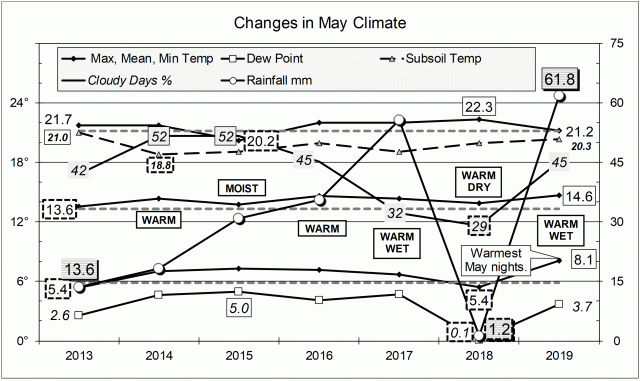
The month began warm, with the night of the 2nd being, at 18.0°, the warmest May night of the new century. There was a second warm spell nearly four degrees above normal about the 20th.
The first frost (by my reading) came on the 12th of May this year, and on the 15th of May last year. The middle date of first frost is May 13th.
There were three rain days (usually four) but nearly all the rain (61 mm) was recorded on the 4th.

Weather log May 2019

Comparing May months

The mean temperature this month (14.6°) was high, but not as high as in May 2007 (15.1°). However, the mean daily minimum temperature (8.1°) was the warmest for May in the new century: above normal by 2.3°.
A rather narrow daily temperature range (13.1°) and high percentage of cloudy days (45%) showed moisture above normal.
The (estimated) rainfall total of 61.8 mm was very high, in the 75th percentile. Because no rain at all had fallen in April, the total for the two months together reached only to the 26th percentile.

Climate for May 2019

Drought

The on-going unprecedented drought is reported in another post.


Data. A Bureau of Meteorology automatic rain gauge operates in the museum yard. From 17 March 2017, 9 am daily readings are published as Manilla Museum, Station 55312.  These reports use that rainfall data when it is available.  Since no 9 am readings have been recorded since August 2018, I have substituted my non-standard gauge readings for all days.
All other data, including subsoil at 750 mm, are from 3 Monash Street, Manilla.

May 2019 rain gives some relief

Rainfall status Apr-May 2019

Graph of Rainfall Shortages

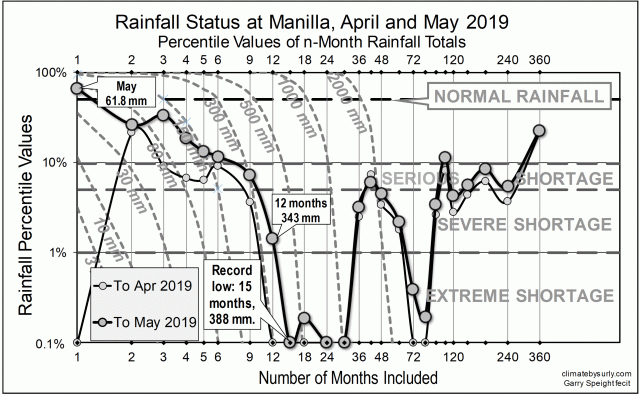
This graph shows all the present rainfall shortages at Manilla, short term and long term, as percentile values. The latest values, as at the end of May, are shown by a thick black line with large circles. Those from one month earlier are shown by a thinner line with smaller circles. [The method is described in “Further Explanation” below.]

Changes from April to May

Above-average rainfall in May relieved the drought situation in some ways. Rainfall shortages of 3-, 4-, 5-, and 6-month duration are no longer serious. The 9-month shortage is reduced from severe to serious, and the 12-month shortage from extreme to severe.

May rain did not prevent the rainfall total for 15 months falling to the record low value of 388 mm. The record, which had been set at 404 mm in 1912, has been broken three times in this drought: to 400 mm in September, 397 mm in April, and 388 mm in May.

Nearly all rainfall shortages at long and very long durations have been reduced to some extent. However, extreme shortages persist not only at 15-months, but also at 18-, 24-, 30-, 72- and 84-months.


Further Explanation

The following notes explain aspects of this work under these listed headings:

Data analysis

Cumulative rainfall totals
Percentile values
Severity of rainfall shortages

Limitations of this analysis

Monthly rainfalls form a single population
Observations are not retrospective
The rain gauge failed

Data analysis

Continue reading

3-year trends to May 2019

May days not warm

3-year trends to May 2019

May raw anomaly data (orange)

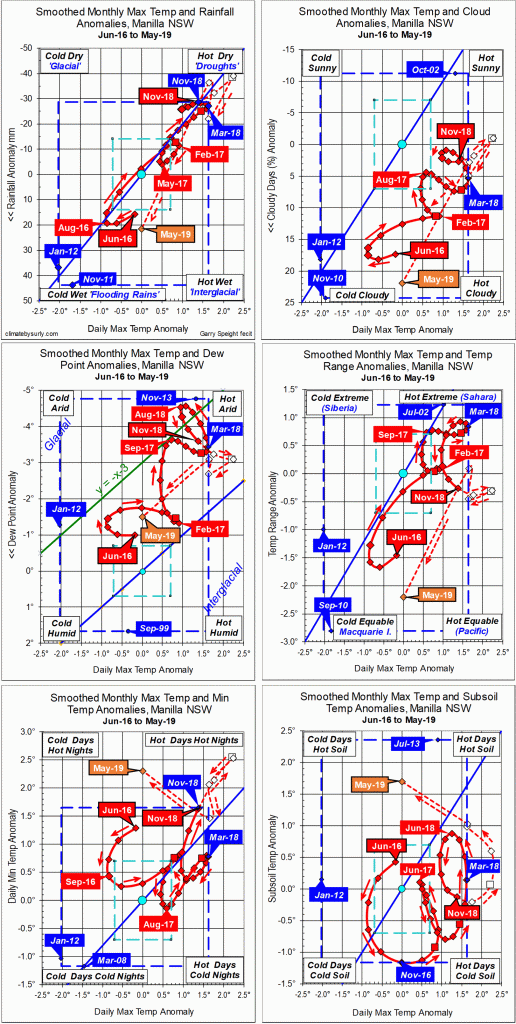
In May 2019, the anomaly of daily maximum temperature returned to zero after years of positive values. Both daily minimum temperature and subsoil temperature anomalies were very high. Moisture anomalies, reflecting the high rainfall value (+21 mm), were low on the graphs (away from drought), but dew point was not as far down as “normal”.

 Fully smoothed data (red)

Fully-smoothed data now include the spring season ending November 2018.
Both daily maximum and daily minimum temperature anomalies were very high and rising. The minimum was rising faster and broke the record of +1.65°. Subsoil temperature anomaly, due to a phase lag, was normal and still slowly falling.
Moisture indicators in this spring were inconsistent. Rainfall anomaly decreased slowly to a new (20th century) record of minus 29.7 mm. The dew point anomaly was also low, but rapidly increasing. Both the cloudiness and the daily temperature range were normal.


Notes:

January data points are marked by squares.

Smoothing

Smoothing uses Gaussian functions.
For fully smoothed data the function has a Standard Deviation of 2.5 months, it spans 13 monthly data points, and has a half-width of 6 months, which suppresses cycles shorter than 12 months. For partly smoothed data, the span of the function is reduced to 11 months, 9 months and so on.
Continue reading