3-year trends to June 2015

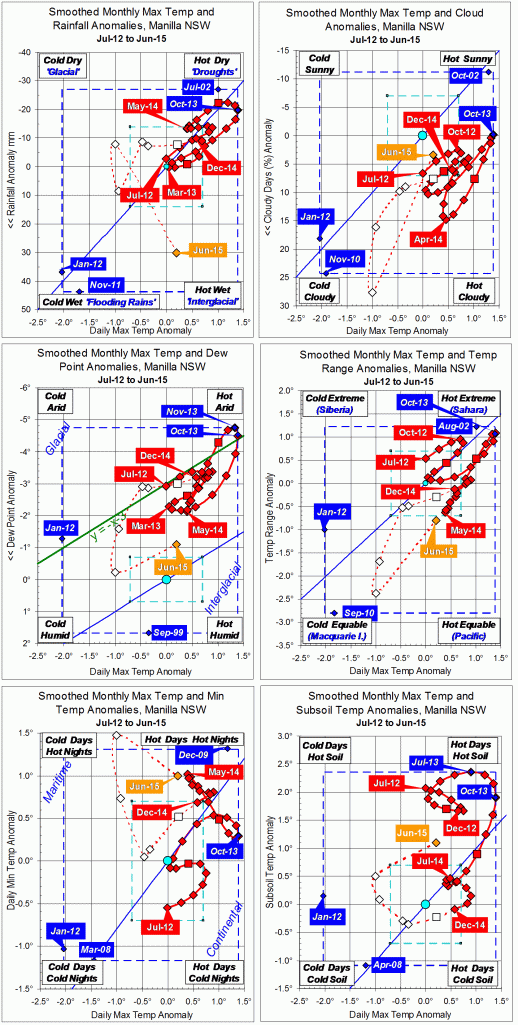
Parametric plots of smoothed climate variables at Manilla
“June 2015: back to normal”
15JunParam

June raw anomaly data (orange)

Nearly all raw anomalies for the latest month are nearer to normal than the partially-smoothed anomalies of the autumn months. They are also quite close to the smoothed values of a year ago. Rainfall stands alone as a high value.

Fully smoothed data (red)

In December 2014, most anomalies were normal, or near normal, and changing only slowly.


Note:

Fully smoothed data – Gaussian smoothing with half-width 6 months – are plotted in red, partly smoothed data uncoloured, and raw data for the last data point in orange. January data points are marked by squares.
Blue diamonds and the dashed blue rectangle show the extreme values in the fully smoothed data record since September 1999.

Normal values are based on averages for the decade from March 1999.* They appear on these graphs as a turquoise (turquoise) circle at the origin (0,0). A range of anomalies called “normal” is shown by a dashed rectangle in aqua (aqua). For values in degrees, the assigned normal range is +/-0.7°; for cloudiness, +/-7%; for monthly rainfall, +/-14 mm.

 * Normal values for rainfall are based on averages for the 125 years beginning 1883.
Cloudy autumn in 2015

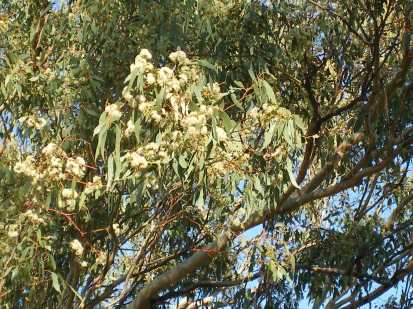
Photo of eucalyptus tree

Eucalyptus albens in bloom

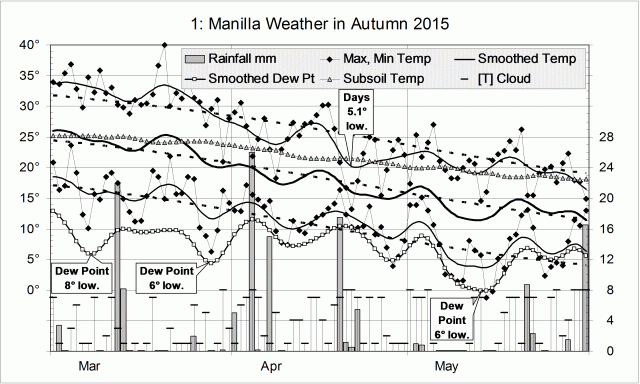
For a time around the 20th of April, days averaged five degrees colder than normal. At that time nights were warm, making the daily temperature range a remarkable eight degrees less than normal. On three occasions the dew point (humidity) was down by six degrees or more: early and late in March, and in mid-May. The sub-soil temperature was low most of the time by up to half a degree, but ended one degree high. Rain fell in each fortnight. The number of rain days (19) was high, but the highest daily reading (26 mm) was normal. Weather log for autumn 2015 This autumn, like the last, was moist. The rainfall, at 137.5 mm, was a little higher (on the 60th percentile) and the mean daily temperature range was a new record narrow value of only 14.0°. The season was very cloudy, with 41% cloudy mornings, but did not beat last year’s record 48%. The early morning dew point, 7.2°, was not even up to normal (8.5°). Warm nights and cool days made the mean temperature normal. Climate for autumn 2015


 Temperature, including subsoil at 750 mm, and other data are from 3 Monash Street, Manilla.

Very cloudy days in May 2015

Photo of a case moth

A case moth

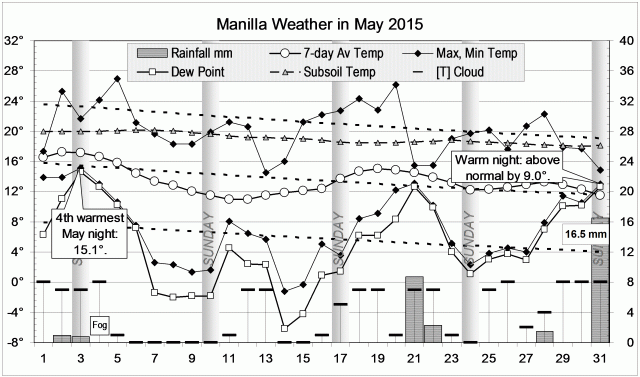
While there were four frosts (usually 6) that came early in the month, a record number of eleven nights were warmer than 10°. Some were very warm. At 15.1°, the night of the 3rd was the 4th warmest May night. Although the night of the 31st was only 13.0°, since it came so late, that was 9.0° above normal for that date. By contrast, most days were cooler than normal.
The frostier times were sunny, but skies later became cloudy. Finally, days were chilly and overcast. Cloud blanketed the hills, but steady rain (16.5 mm) held off until the very end.

Weather log for May 2015

 Comparing May months

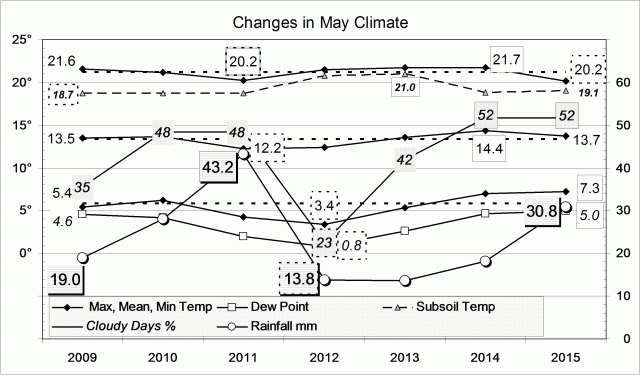
The most remarkable mean value for the month is the daily temperature range: at 12.9°, it is 2.4° below normal. The May months with the narrowest ranges to date, in 2001 and 2014, had ranges of 14.7°, only 0.6° below normal. The narrow temperature range is due to cloudy skies which, at 52%, equal the record for May.
Linked with these figures are a very cool mean daily maximum temperature of 20.2°, and a very warm mean daily minimum temperature of 7.3°. The mean early morning dew point (5.0°) is not high, but higher than in any May month since 2007.
The total rainfall of 30.8 mm is in the 51st percentile. (While the long-term May average is 40 mm, May rainfall in the 21st century has averaged only 21 mm.) Among rainfall totals for more than one month, there are no serious shortages. The lowest percentile value (14th) is for the 24-month total of 1019 mm.

Climate for May 2015


Data. All data, including subsoil at 750 mm, are from 3 Monash Street, Manilla.

3-year trends to May 2015

Parametric plots of smoothed climate variables at Manilla
“May 2015: less moist”

Trends to May 2015

May raw anomaly data (orange)

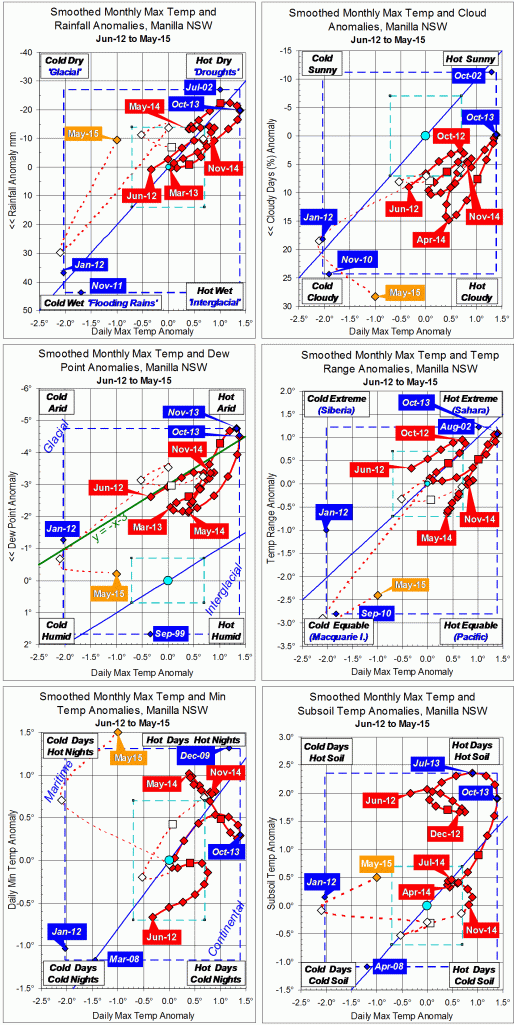
May anomalies moved back towards normal from the cool moist conditions of April for the variables daily maximum temperature, rainfall, and daily temperature range. Cloudiness, however, became extreme, as it had been in the (smoothed data) a year earlier. Daily minimum temperature became very high, keeping the climate in the “Maritime” area. This, again, prevailed just one year ago.

Fully smoothed data (red)

The latest fully-smoothed data anomalies (November 2014) complete the season for spring 2014 (SON). As is most clearly seen in the graph at the bottom right, the daily maximum temperature anomaly (smoothed) reached a minor maximum just above normal in October. Other variables moved little. All were “normal” except the Dew Point anomaly, which had the low value of minus three that has now become normal.

Springtime temperature peaks

Each of the spring seasons of 2012, 2013 and 2014 marked a peak in daily maximum temperature anomalies. Spring 2013 was the hottest, breaking the record for this data set. Spring 2013 also had extreme peaks of lowest rainfall, least cloud, lowest dew point, and highest daily temperature range. This is just what is expected at an extreme El Niño, but there was no El Niño at that time.


Note:

Fully smoothed data – Gaussian smoothing with half-width 6 months – are plotted in red, partly smoothed data uncoloured, and raw data for the last data point in orange. January data points are marked by squares.
Blue diamonds and the dashed blue rectangle show the extreme values in the fully smoothed data record since September 1999.

Normal values are based on averages for the decade from March 1999.* They appear on these graphs as a turquoise (turquoise) circle at the origin (0,0). A range of anomalies called “normal” is shown by a dashed rectangle in aqua (aqua). For values in degrees, the assigned normal range is +/-0.7°; for cloudiness, +/-7%; for monthly rainfall, +/-14 mm.

 * Normal values for rainfall are based on averages for the 125 years beginning 1883.
Cool cloudy days in April 2015

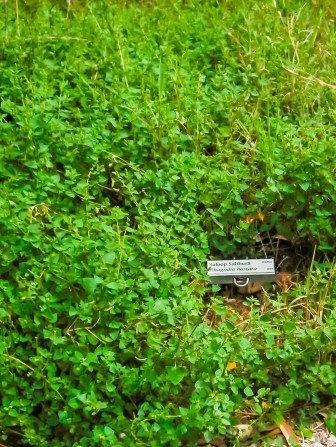
Photo of labelled Saloop saltbush

Flourishing local Saloop saltbush

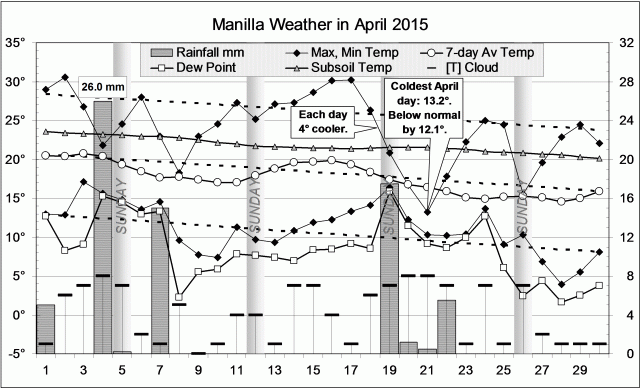
After 5 hot days in March (a record number), there were none in April. In fact, there were six days not reaching 20°, also a record number! On the 21st the temperature reached only 13.2°, making it the coldest April day of the century, 12.1° below normal. To get so cold, the temperature had fallen by 4° each day for four days. Many nights, however, were warm, and on four occasions the night was less than six degrees cooler than the day. As usual, there were no frosts.
There were eight rain days, with the highest reading 26.0 mm on the 4th.

Weather log for April 2015

Comparing April months

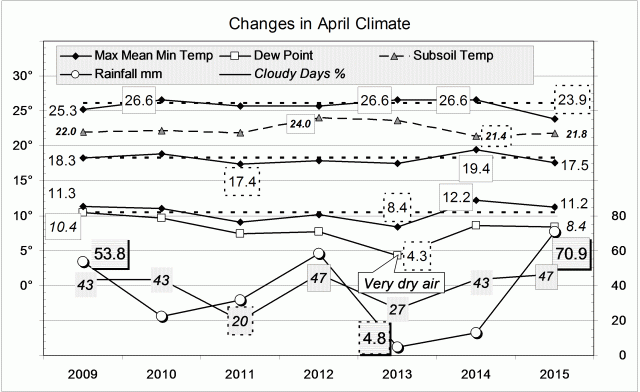
The average daily maximum temperature, at 23.9°, was colder than in any April since 1999 (23.5°). Night temperatures, while lower than last year’s record, were above normal, making the mean daily temperature range (12.7°) the narrowest for an April month, followed by April 2003 (13.6°). The percentage of cloudy mornings (more than 4/8 cloud) was a record 46.7%, equal with April 2012. The cloudiness and narrow daily temperature range, with high rainfall, make the climate this month like that on the coast.
The subsoil temperature (21.8°) and the early morning dew point (8.4°) were normal. (In March, the dew point had been almost the same (8.3°) but that was a record low value: in that month the normal dew point is much higher.)
The total rainfall of 70.9 mm is in the 84th percentile, far above the average of 40 mm. Among rainfall totals for more than one month, there are small increases. Even the 24-month total is now in the 12th percentile: not a serious shortage.

Climate for April 2015


Data. All data, including subsoil at 750 mm, are from 3 Monash Street, Manilla.
After 132 years of continuous record, rainfall readings are no longer taken at Manilla Post Office, Station 055031.