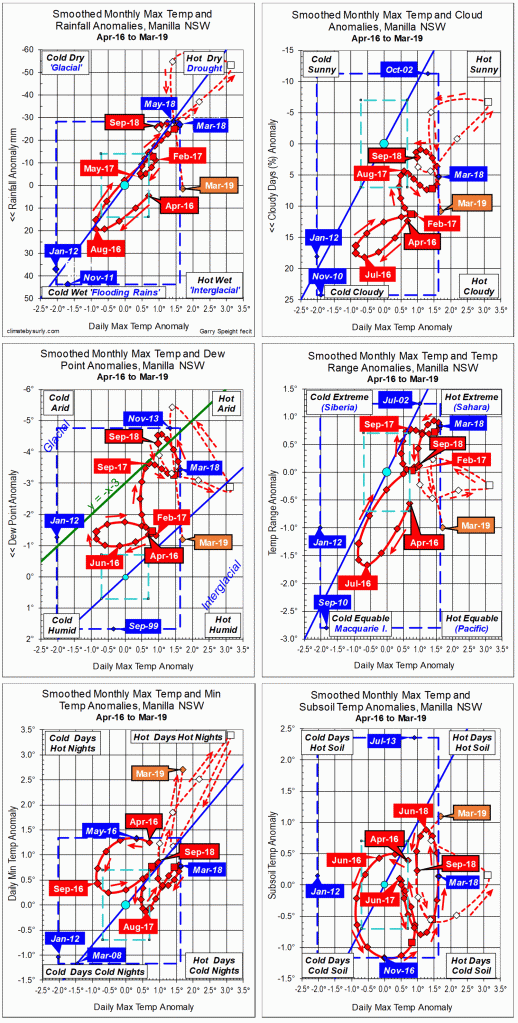
3-year trends to March 2019

March warm

3-year trends to March 2019

March raw anomaly data (orange)

In March 2019, the raw anomaly for daily maximum temperature was near the upper limit for normal. Daily minimum and subsoil temperatures were high. Rainfall and other moisture measures were near normal.

 Fully smoothed data (red)

Fully smoothed data to September 2018 (except daily minimum temperature anomaly) showed a movement away from drought. More recent data, only partially smoothed, suggest that temperatures and rainfall later returned towards drought.


Notes:

January data points are marked by squares.

Smoothing

Smoothing uses Gaussian functions.
For fully smoothed data the function has a Standard Deviation of 2.5 months, it spans 13 monthly data points, and has a half-width of 6 months, which suppresses cycles shorter than 12 months. For partly smoothed data, the span of the function is reduced to 11 months, 9 months and so on.
Continue reading

March rain leaves drought extreme

Above-average rainfall in March reduced the shortage of rainfall in the last 3 months. It did not relieve extreme shortages at durations between 12 months and 7 years.
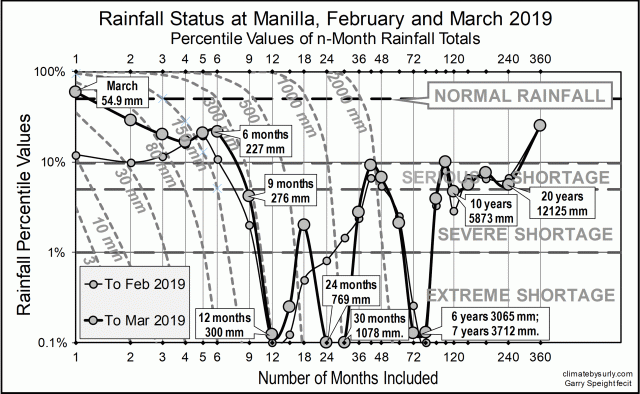
Rainfall status Feb-Mar 2019

Graph of Rainfall Shortages

This graph shows all the present rainfall shortages at Manilla, short term and long term, as percentile values. The latest values, as at the end of March, are shown by a thick black line with large circles. Those from one month earlier are shown by a thinner line with smaller circles. [The method is described in “Further Explanation” below.]

Good rain in March

A rain front at the end of March 2019 that brought about 40 mm took the March total up to the average. This raised the 2-month and 3-month totals nearer to normal. It did nothing to increase longer-duration totals.

Extreme rainfall shortages

By February, six of the eleven rainfall shortages measured over durations from 12 months to 7 years were extreme. (That is, those totals were in the driest one percent in history.)
Despite the high rainfall of March, March figures also record six extreme shortages. The 18-month total is no longer extreme, but the 30-month total has now become extreme.
Two of the rainfall totals (plotted on the 0.1% line) are near-record low values. The 24-month total of 769 mm is the second lowest after July 1966 (766 mm). The 30-month total of 1078 mm is equal lowest with October 1966.
Data for February, plotted on the thinner line, show the record low values for 12 months (271 mm) and for 84 months (3672 mm).

The previous 24 months

The development of this drought through the previous 24 months is shown in the later post “Rainfall Shortage Sequence 03/2019”. A contour graph shows severity of shortage by contoured layer tints, with serial months on the x-axis and duration of shortage on the y-axis.


Further Explanation

[Update 5 April 2019.]

The following notes explain aspects of this work under these listed headings:

Data analysis

Cumulative rainfall totals
Percentile values
Severity of rainfall shortages

Limitations of this analysis

Monthly rainfalls form a single population
Observations are not retrospective
The rain gauge failed

Data analysis

This graph is based on analysis of monthly rainfall totals from 1884. Using the spreadsheet application Excel, I calculate cumulative totals and their percentile values. Using these values, I identify rainfall shortages as serious, severe, or extreme .

Cumulative rainfall totals

I prepare two tables. The rows in each table are serial months, more than 1600 in total. The columns in each table are headed by the selected number of months, n, as specified below. In the first table I cumulate the rainfall totals. First, I add each month’s rainfall total to that of the previous month for a 2-month total. Using the previous two months, I get a 3-month total, and so on. In this way, I get n-month rainfall totals from n = 1 up to n = 360 (30 years). However, I calculate for only the following 25 values of n:

n = 1, 2, 3, 4, 5, 6, 9, 12, 15, 18, 24, 30, 36, 42, 48, 60, 72, 84, 96, 108, 120, 144, 180, 240, 360

Continue reading

2018-19 summer 2nd driest

Cumulonimbus and towering cumulus

Storm at Dusk

This summer had 7 very hot days above 40°, and 11 very hot nights above 24°.
The worst heat waves came in January. Around the 17th, weekly temperatures were more than 6° above normal, with days at about 41°, and nights 24°. Near the 28th, nights were even warmer. Episodes of very low dew point came at times of lower temperature.
Thirteen rain days were scattered through the season, the highest readings being 25.0 mm on 16 December and 18.0 mm on 21 January.

Weather log summer 2018-19

Comparing summer seasons

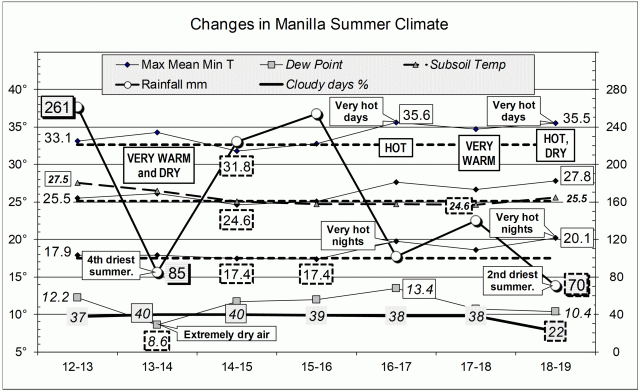
Average temperatures were almost the same as in the hot summer of 2016-17. Days, at 35.5°, were slightly cooler and nights, at 20.1°, slightly warmer. The resulting average, 27.8°, was a new record summer temperature, beating 2016-17 by 0.2°.
Remarkably, the mean subsoil temperature, 25.5°, was not high, but normal.
Similarly, daily temperature range (15.4°) and cloudiness (22%) were normal. (Recent summers have been cloudy.) Dryness was shown only by very low humidity and rainfall.
The mean early morning dew point for this summer (10.4°) was second lowest in the 19-year record. Only that of summer 2013-14 (8.6°) was lower.
The total rainfall for the summer, 70 mm, was equal second driest with 1965, the driest summer being 1930, which had 66 mm.

Climate for summer 2018-19


Data. A Bureau of Meteorology automatic rain gauge operates in the museum yard. From 17 March 2017, 9 am daily readings are published as Manilla Museum, Station 55312.  These reports use that rainfall data when it is available. Station 55312 recorded no readings this summer. I used my own readings for the whole season.

All other data, including subsoil at 750 mm, are from 3 Monash Street, Manilla.

Warm, Dry February 2019

Photo of bushfire smoke at 40 km.

Bushfire at Warrabah

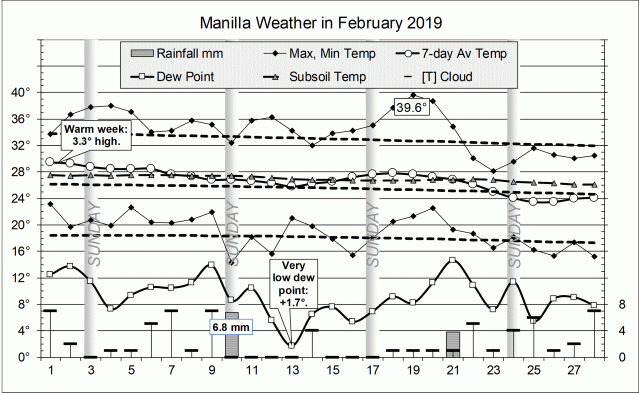
The month began warm, with weekly temperature three degrees above normal, but it ended slightly cool. Day and night temperatures remained near normal. The highest maximum was just under 40°.
The morning of the 13th had very dry air, with a dew point of only 1.7°. (Serious bushfires were burning that day.)
There were only 2 rain days (usually 7). Neither recorded as much as 7 mm.

Graphical log for Feb 2019

Comparing February months

After the extreme heat of January, February was only 1° warmer than normal, by day and by night.
Two indicators of moisture, cloudiness and daily temperature range, were normal. However, the mean early morning dew point, 9.2°, showed the lowest February humidity this century.
The monthly rainfall of 10.6 mm was at the 9th percentile, far below the average (67 mm). This was the 12th driest February, but it had more rain than either February 2017 (6th driest) or February 2015 (ninth driest).
I have reported the on-going drought in another post.

The last 7 February months


Data. A Bureau of Meteorology automatic rain gauge operates in the museum yard. From 17 March 2017, 9 am daily readings are published as Manilla Museum, Station 55312.  These reports use that rainfall data when it is available.  Since no 9 am readings have been recorded since August, I have substituted my non-standard gauge readings for all days.
All other data, including subsoil at 750 mm, are from 3 Monash Street, Manilla.

February: Two Record Droughts

Two rainfall totals to February 2019 were the lowest ever recorded at Manilla: 271 mm in 12 months, and 3672 mm in 7 years.

Rainfall status Jan-Feb 2019

Graph of Rainfall Shortages

This graph shows all the present rainfall shortages at Manilla, short term and long term, as percentile values. The latest values, as at the end of February, are shown by a thick black line with large circles. Those from one month earlier are shown by a thinner line with smaller circles.

The pattern

The very low rainfall of February 2019 (10.6 mm) has driven the rainfall totals lower than they were in January for nearly all the durations that are shown.
The rainfall totals up to 6 months are still not “serious” shortages (below the 10th percentile), but the only other total that is not now a serious shortage, or worse, is that for 30 years (360 months).
In recent months, extreme shortages (below the 1st percentile) have persisted at durations of 12 to 24 months, and at durations of 6 to 7 years.

Record-breaking drought

Two rainfall totals to the end of February are new drought records for Manilla.

The 12-month total of 271 mm beats 288 mm set in October 1965.
The 84-month (7-year) total of 3672 mm beats of 3699 mm set in March 1903.

Earlier, another record had been broken in September. The 15-month total of 400 mm at that date beat 404 mm set in May 1912.


Further Explanation

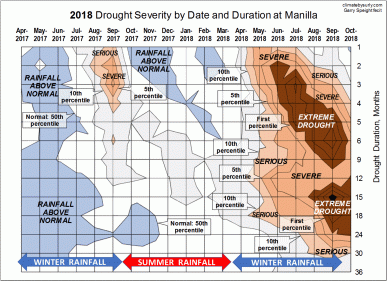
Drought 2018 contour chartMuch more detail was given in the post: “Contours of Manilla’s 2018 Drought” (with data up to October only). Notes include: “Long-term shortages”, “Classes of rainfall shortage”, and “Manilla rainfall records”.