Rain Shortage Jan 2000 – May 2019

Record of rain shortages Jan 2000 May 2019

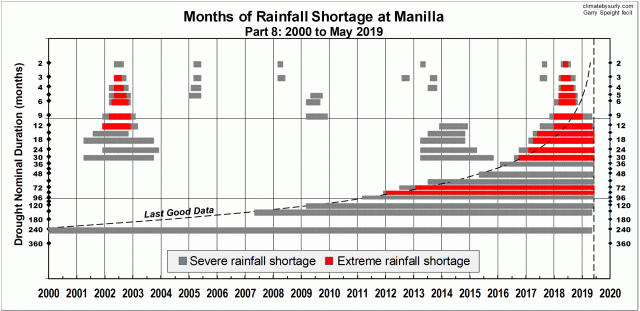
The current drought now has a severe rainfall shortage of 240 months duration that must have commenced in 1999.

[For explanation of this graph, see below: “About drought duration graphs”.]

[These graphs have been updated to October 2019, showing much worse shortages.]

Shortages at 2018

Shortages of rainfall became alarming in 2018. The winter months had extreme shortages of 2-month to 6-month duration. Earlier and later dry months contributed to longer-term extreme shortages from 9 months up to 30-months.
In months since November 2018 none of the short-term rainfall totals for durations from two months to six months has been even a severe shortage. In other respects, the drought has deepened. Because recent monthly rainfall values have seldom risen above normal, periods of severe or extreme shortage have become longer and longer. As at May 2019, extreme shortages prevail at 15-, 18-, 24-, 30-, 72- and 84-month durations.
Severe shortages have developed at even longer durations, at 96-, 120-, 150- and 240-months. As is clear from the graph, the 240-month severe shortage incorporates the 2002 drought into the 2018 drought. This was not evident until now.
As shown, the severe shortages of 150- and 240-month duration, current in April 2019, did not persist in observations for May. They could resume if later months do not have much rain. [Actually, this was a copy-down error.]
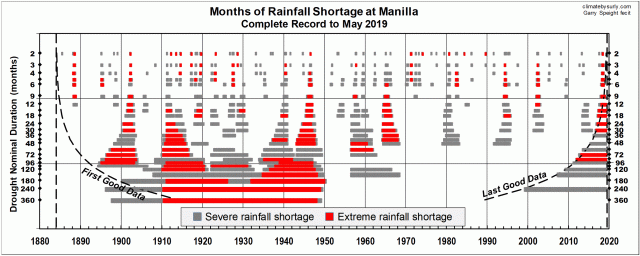
Drought record to May 2019

Compete record updated to May

When the graph of the complete record of months of rainfall shortage at Manilla is updated to May 2019 it is obvious that the current drought is one of the great droughts in history.
Although this drought seemed to have a sudden onset, shortages of longer duration actually began earlier: the longer the duration concerned, the earlier its time of onset.. The 2018 pattern is like the droughts of 1902, 1940 and 1946. Droughts that actually had a sudden onset were those of 1912, 1957 and 1965.


About drought duration graphs

These graphs show the onset, persistence, and breaking of episodes of extreme and severe rainfall shortage (droughts) at Manilla. The first shows detail since 2000. The second shows the complete historical record from 1884. The graph features and the data analysis are explained in the post “Rainfall Shortage History: Manilla”.

Extreme shortages, up to the 1st percentile, are shown in red and severe shortages, up to the 5th percentile, are shown in grey.
The dashed line labelled “Last Good Data” is a limitation of observed cumulative rainfall deficiency. Future observations may make any point to the right of this line more extreme.

Rainfall Shortage Sequence 05/2019

Sequence of rainfall shortages to May 2019

Black shows the driest or second-driest rainfall totals. In a record of more than 1600 months, they fall below the 0.1th percentile.

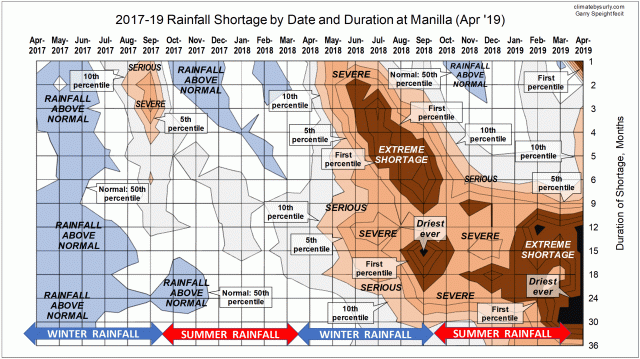
This contour plot shows the progress of the drought at Manilla up to May 2019. Colours show rainfall shortages as percentiles. Dates plot along the top, and durations down the side.

One month rainfall totals (on the top row)

This month (May 2019) like March, had rainfall above normal, but April had no rain. Months of serious rainfall shortage (light brown) had come much earlier, in May, June and July 2018, and also in September 2017.

Shortages lasting less than one year (rows 2 to 9)

As the effects of low monthly rainfall added up, extreme shortages appeared (dark brown). That is, rainfall totals in the lowest 1% of the historical record.
By June 2018, the 2-month and 3-month totals were already extreme shortages. Similarly, by July, the 3-month, 4-month, and 5-month totals were all extreme shortages. By September 2018, extreme shortages extended as far as 9-month totals. That total, adding up the nine months from January to September 2018, included only one month (February) that had rainfall above normal.
In these shorter durations, extreme shortages were rare after September 2018. March 2019 included no shortages (not even “serious” ones) for durations from 2 months up to 6 months. April saw some serious shortages return, but they were gone by May.

Shortages of 1-year to 3-year duration (rows 12 to 36)

By August 2018, an extreme 15-month shortage appeared. The 15-month total then included not only the dry months of winter 2018, but also the dry month of September 2017. By September 2018, the 15-month total became the driest on record at that time (400 mm). In January 2019, extreme shortages were current at 15-, 18-, and 24-months. By that time, some dry months in 2017 were excluded from the totals, but dry months in the current summer were included.
In February 2019, as the extreme shortages of the previous month persisted, the 12-month total became the driest ever (271 mm). March also had four extreme shortages in this group, but now they were at 12, 15, 24 and 30 months.
April saw lowest-ever or second-lowest values for all durations from 12 months to 30 months. In May, they persisted for 15-, 24-, and 30-month durations.
New lowest-ever values increased the percentile ranks of several earlier values that had been lowest-ever. For example, the 15-month total in September 2018 began as a lowest-ever value with percentile rank below 0.04% but, being replaced by new lowest-ever values in April and May, became third-lowest, with percentile rank 0.12%.

A line graph for May 2019

A profile of the rainfall status for May 2019 reveals that extreme shortages also exist at durations much longer than shown in this contour graph: durations of six years and seven years.


Data and method

This kind of graph simply displays the time sequence, month by month, of rainfall shortages that I have displayed on line graphs prepared for each month. In the post for a recent line graph (April 2019) I have described my method of analysis and its limitations.

May 2019 rain gives some relief

Rainfall status Apr-May 2019

Graph of Rainfall Shortages

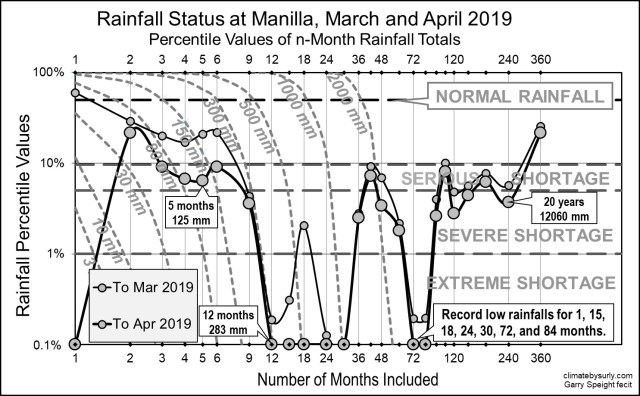
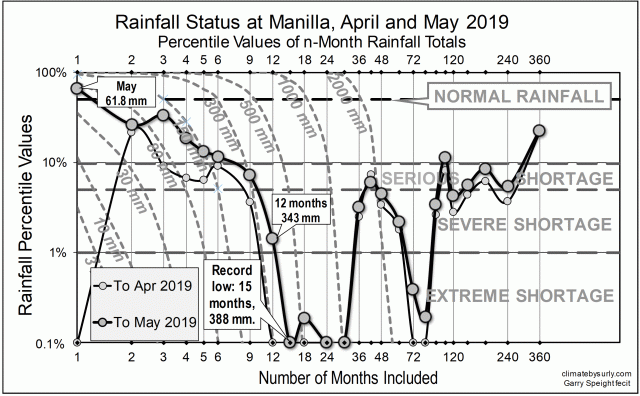
This graph shows all the present rainfall shortages at Manilla, short term and long term, as percentile values. The latest values, as at the end of May, are shown by a thick black line with large circles. Those from one month earlier are shown by a thinner line with smaller circles. [The method is described in “Further Explanation” below.]

Changes from April to May

Above-average rainfall in May relieved the drought situation in some ways. Rainfall shortages of 3-, 4-, 5-, and 6-month duration are no longer serious. The 9-month shortage is reduced from severe to serious, and the 12-month shortage from extreme to severe.

May rain did not prevent the rainfall total for 15 months falling to the record low value of 388 mm. The record, which had been set at 404 mm in 1912, has been broken three times in this drought: to 400 mm in September, 397 mm in April, and 388 mm in May.

Nearly all rainfall shortages at long and very long durations have been reduced to some extent. However, extreme shortages persist not only at 15-months, but also at 18-, 24-, 30-, 72- and 84-months.


Further Explanation

The following notes explain aspects of this work under these listed headings:

Data analysis

Cumulative rainfall totals
Percentile values
Severity of rainfall shortages

Limitations of this analysis

Monthly rainfalls form a single population
Observations are not retrospective
The rain gauge failed

Data analysis

Continue reading

Rainfall Shortage Sequence 04/2019

Sequence of raiinfall shortages to April 2019

By April 2019, driest-ever rainfall totals occur at durations of 15, 18, 24 and 30 months. The total for 12 months is the second driest for that duration.

This contour plot shows the progress of the drought at Manilla up to April 2019. Colours show rainfall shortages as percentiles. Dates plot along the top, and durations down the side.

One month rainfall totals (on the top row)

April 2019, which had no rain, followed eight months without serious monthly rainfall shortages. Months of serious rainfall shortage (light brown) had come earlier, in May, June and July 2018, and also in September 2017.

Shortages lasting less than one year (rows 2 to 9)

As the effects of low monthly rainfall added up, extreme shortages appeared (dark brown). That is, rainfall totals in the lowest 1% of the historical record.
By June 2018, the 2-month and 3-month totals were already extreme shortages. Similarly, by July, the 3-month, 4-month, and 5-month totals were all extreme shortages. By September 2018, extreme shortages extended as far as 9-month totals. That total, adding up the nine months from January to September 2018, included only one month (February) that had rainfall above normal.
In these shorter durations, extreme shortages were rare after September 2018. March 2019 included no shortages (not even “serious” ones) for durations from 2 months up to 6 months. However, April saw some serious shortages return.

Shortages of 1-year to 3-year duration (rows 12 to 36)

By August 2018, an extreme 15-month shortage appeared. The 15-month total then included not only the dry months of winter 2018, but also the dry month of September 2017. By September 2018, the 15-month total became the driest on record (400 mm). By October four totals in this group (12-, 15-, 18-, and 24-month totals) were extreme shortages. That was true again in January 2019. By that time, some dry months in 2017 were excluded, but dry months in the current summer were included.
In February 2019, as the four extreme shortages of the previous month persisted, the 12-month total became the driest ever (271 mm). March also had four extreme shortages in this group, but now they were at 12, 15, 24 and 30 months. The 24-month total (769 mm) was the second-driest on record and the 30-month total (1078 mm) equal driest.
April was much worse: lowest-ever or second-lowest values appeared for all five durations from 12 months to 30 months.

The 2002 extreme drought

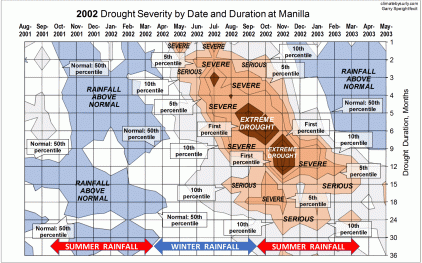
Contour chart 2002 drought at Manilla NSWA similar graph was posted in “The 2002 drought contour chart”. It is clear that, in that case, extreme shortages did not extend through the 15- to 30-month durations that have the most extreme shortages now.

A line graph for April 2019

A profile of the rainfall status for April 2019 reveals that extreme shortages also exist at durations much longer than shown in this contour graph: durations of six years and seven years. Severe shortages even occur at durations of ten years and twenty years.


Data and method

This kind of graph simply displays the time sequence, month by month, of rainfall shortages that I have displayed on line graphs prepared for each month. In the post for the most recent line graph (April 2019) I have described my method of analysis and its limitations.

April 2019: 7 lowest rainfall totals

In April 2019, rainfall totals were the lowest-ever values for 1 month and for 15, 18, 24, 30, 72, and 84 months.

Rainfall status Mar-Apr 2019

Graph of Rainfall Shortages

This graph shows all the present rainfall shortages at Manilla, short term and long term, as percentile values. The latest values, as at the end of April, are shown by a thick black line with large circles. Those from one month earlier are shown by a thinner line with smaller circles. [The method is described in “Further Explanation” below.]

Record and near-record low rainfall totals

There never has been a month at Manilla when rainfall totals have included so many record or near-record low values.

  • The 1-month total for April is zero (as in April 1912, 1925, 1942, and 1971).
  • The 12-month total of 283 mm is second-lowest after February 2019 (271 mm).
  • The 15-month total of 397 mm is a new record, beating September 2018 (400 mm).
  • The 18-month total of 510 mm is a new record, beating April 1966 (514 mm).
  • The 24-month total of 745 mm is a new record, beating July 1966 (766 mm).
  • The 30-month total of 1005 mm is a new record, beating March 2019 (1078 mm).
  • The 72-month total of 3060 mm is equal-lowest with February 1903.
  • The 84-month total of 3653 mm is a new record, beating February 2019 (3672 mm).

Other changes from March to April

When rainfall in April was 55 mm less than in March, the short-duration totals for 3, 4, 5, and 6 months became serious shortages again.
New severe rainfall shortages appeared at the very long durations of 144 months (12 years) and 240 months (20 years). Such shortages have not been seen in half a century: not since 1969 in the case of 144 months duration, and not since 1950 in the case of 240 months duration.

May and June 2019 data

Data for the following month, May 2019, is plotted in the same way in the post “May 2019 rain gives some relief“. See also “June breaks more drought records”.


Further Explanation

The following notes explain aspects of this work under these listed headings:

Data analysis

Cumulative rainfall totals
Percentile values
Severity of rainfall shortages

Limitations of this analysis

Monthly rainfalls form a single population
Observations are not retrospective
The rain gauge failed

Data analysis

Continue reading