Cool Dry April 2017

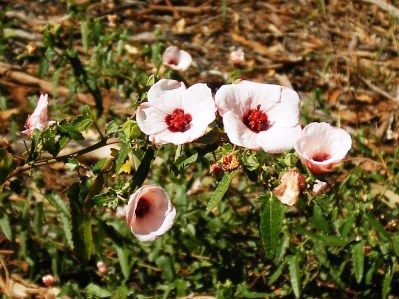
Pavonia blooms on a roadside

Roadside Pavonia

April began with cool days and nights, about three degrees below normal. However, the weather did not get any cooler until the last few days. In particular, ANZAC Day, at 27.4°, was the warmest day of the month – but that was more than a degree cooler than ANZAC Day 2002. (The average daily maximum temperature for ANZAC Day (from 2000) is 24.3°. The hottest was 28.7° (2002) and the coldest 16.8° (2012).)

Soaking rain of 10.6 mm, registered on the 26th, came with a remarkably warm night of 16.6°. Coming so late in autumn, this was 7.9° above normal, breaking the record of 7.1° above normal for an April night (20/04/06).
Further rain on the 27th (11.2 mm) fell as showers on a very cold day of 14.3°, that was 9.8° below normal. The final three nights were cold. The 30th, at 4.3°, was the coldest night of the month, but it was far from frosty.

Weather log for April 2017

Comparing April months

This month was cool, with a mean temperature of 17.0°, but not nearly as cool as April in 2008 (15.8°), 2006 (16.6°), or 1999 (15.6°). It was also rather low in moisture, with only 24 mm of rain, only 33% cloudy mornings, a daily temperature range as wide as 15.6°, and an early morning dew point of only 6.3°. What is unusual is the combination of low temperature values and low moisture values. Manilla’s climate generally swings between high temperature with low moisture (“droughts”) and low temperature with high moisture (“flooding rains”), as the poet said. (See these graphs.)
The total rainfall of 24.0 mm was at the 40th percentile, below the April average of 40 mm. There are no serious shortages of rainfall for groups of months to this date.
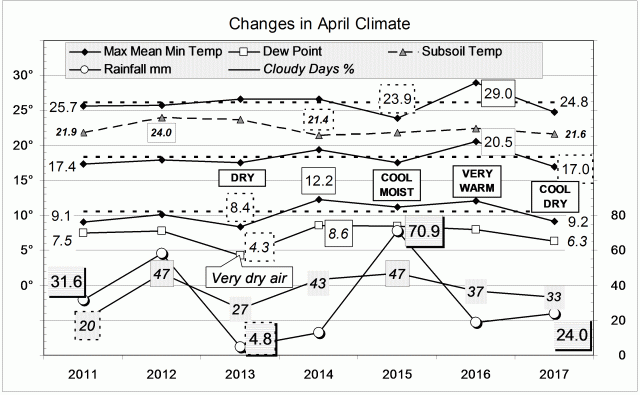
Climate for April 2017.


Data. A Bureau of Meteorology automatic rain gauge operates in the museum yard. From 17 March 2017, 9 am daily readings are published as Manilla Museum, Station 55312.  These reports use that rainfall data when it is available. All other data, including subsoil at 750 mm, are from 3 Monash Street, Manilla.

3-year trends to April 2017

Parametric plots of smoothed climate variables at Manilla
“Cold-Arid ‘Glacial'”

Climate trends to April 2017

April raw anomaly data (orange)

In terms of anomalies, April 2017 was even cooler than March, but much more arid. Anomalies of both daily maximum and daily minimum temperature fell by more than three degrees from February values, (They plot near the margins of the lower left graph.)
On most of the graphs, raw anomaly values for April plot towards the top left corner. Rather than moving along the top-right-to-bottom-left axis of “Droughts and flooding rains”, they combine low temperature and aridity as happened in ice ages.

 Fully smoothed data (red)

The most recent fully-smoothed data is for October 2016. Following a winter that was cool and moist, October shows a climate becoming steadily warmer and drier.
The smoothed anomaly of daily minimum temperature, which had hit a record high value in May 2016, approached a minimum value that was near normal.
Subsoil temperature anomaly was still falling rapidly, and was certain to reach a new record low smoothed value in November.


Note:

Fully smoothed data – Gaussian smoothing with half-width 6 months – are plotted in red, partly smoothed data uncoloured, and raw data for the last data point in orange. January data points are marked by squares.
Blue diamonds and the dashed blue rectangle show the extreme values in the fully smoothed data record since September 1999.

Normal values are based on averages for the decade from March 1999.* They appear on these graphs as a turquoise (turquoise) circle at the origin (0,0). A range of anomalies called “normal” is shown by a dashed rectangle in aqua (aqua). For values in degrees, the assigned normal range is +/-0.7°; for cloudiness, +/-7%; for monthly rainfall, +/-14 mm.

 * Normal values for rainfall are based on averages for the 125 years beginning 1883.

Rainy days in March 2017

March 2017 had 17 rain days. In 134 years, this was beaten only by June 1950, which had 18. [See Note below: “Manilla rain day statistics”]

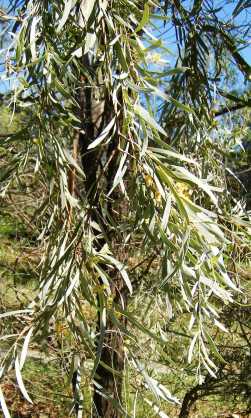
Fronds of Acacia pendula

Weeping Myall

[Three years later, this post still gets hits. Perhaps people are sucked in by the title. I have added information and links, in case they really are interested in the topic.]

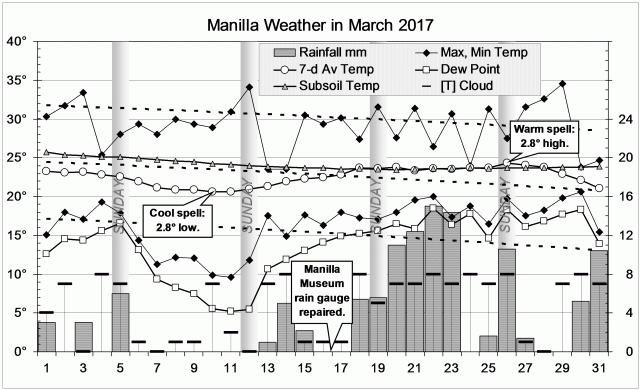
After the record high temperatures of February, day and night temperatures in March were normal, without extremes. On a weekly basis, the first half of the month was cooler than the second half. The subsoil temperature followed the weekly air temperature down, to be a degree below normal by the 20th.
The second week had mainly clear skies and low dew points, Then the skies became persistently cloudy and dew points were high. A number of afternoons had oppressive humidity, with minimum values over 70%.
Of the 17 rain days, only three were early in the month, and they had little rain. The highest daily reading of 15.0 mm came on the 22nd.

Weather log for March 2017

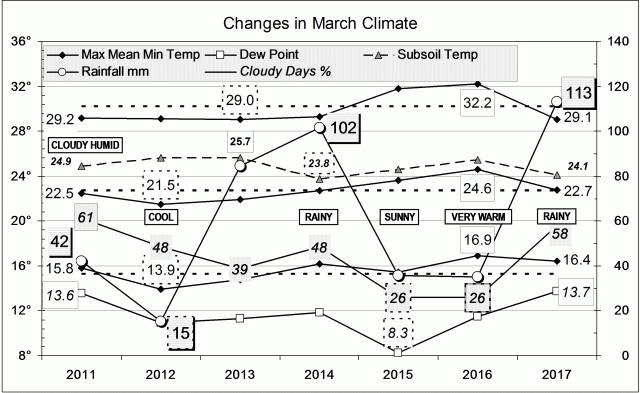
Comparing March months

March had been sunny and very warm in both 2016 and 2015. This March was like that of 2014 and 2013, but with even more moisture. The mean average temperature was normal but, due to the cloudiness (58% cloudy mornings), the mean daily maximum, 29.1° was low and the mean daily minimum, 16.4°, was high, yielding the record narrow daily temperature range for March of 12.7°. The mean early morning dew point, 13.7°, was the highest March value in a decade, and the mean afternoon humidity minimum, at 53%, was far above the usual value of 30%.
The total rainfall of 113.2 mm was at the 90th percentile, far above the March average of 54 mm. The previous month, February, had only 4.1 mm, at the 4th percentile for that month. Taken together the two-month total of 117.3 mm was well above normal, at the 63rd percentile.

Climate for March 2017

[Note: Manilla rain day statistics

The number of rain days in a month at Manilla reached 18 only once, in June 1950. Both June 2016 and this month, March 2017, had 17 rain days. This month’s high number is more remarkable, as March has only 4.8 rain days on average. Most months of the year have about six rain days on average, but the autumn months of March, April, and May have an average of 4.6 rain days per month. The averages are posted here.]


Data. In 2016, a Bureau of Meteorology automatic rain gauge (formerly used for flood prediction) was set up in the museum yard as the official Manilla rain gauge. From 23 May 2016, its daily readings were published as if from Manilla Post Office, Station 55031. The gauge ceased transmitting five months later, on 7 October 2016. This month, after repair, it came into operation again. From 17 March 2017, daily readings are now published as Manilla Museum, Station 55312.

In these reports,the rainfall data is from Station 55031 or Station 55312 when available. Otherwise, rainfall data is from 3 Monash Street, Manilla.  All other data, including subsoil at 750 mm, are also from there. 

3-year trends to March 2017

Parametric plots of smoothed climate variables at Manilla
“Very rainy and cloudy”

3-year trends to March 2017

March raw anomaly data (orange)

March 2017 was dramatically cooler and more moist than the extremely hot and dry February. March days were cooler than normal and both rainfall and cloud were very high. Dew point and daily temperature range moved to the moist side of normal.

 Fully smoothed data (red)

The most recent fully-smoothed data is for September 2016. Following a winter that was cool and moist, September days remained cool but the climate became drier.
The smoothed anomaly of daily minimum temperature, which had hit a record high value in May 2016, approached normal. Subsoil temperature fell rapidly to below normal.


Note:

Fully smoothed data – Gaussian smoothing with half-width 6 months – are plotted in red, partly smoothed data uncoloured, and raw data for the last data point in orange. January data points are marked by squares.
Blue diamonds and the dashed blue rectangle show the extreme values in the fully smoothed data record since September 1999.

Normal values are based on averages for the decade from March 1999.* They appear on these graphs as a turquoise (turquoise) circle at the origin (0,0). A range of anomalies called “normal” is shown by a dashed rectangle in aqua (aqua). For values in degrees, the assigned normal range is +/-0.7°; for cloudiness, +/-7%; for monthly rainfall, +/-14 mm.

 * Normal values for rainfall are based on averages for the 125 years beginning 1883.

Mirrors to reflect the sun

I have begun to warm the shady side of my house with reflected sunlight in winter.

Aluminium mirrors to reflect sun

Sun Mirrors Mar-17

This winter’s set-up (2017).

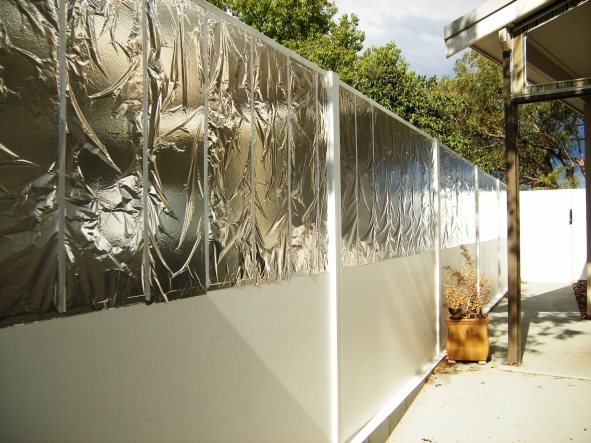
The first photo shows the present temporary set-up, done on the 10th of March 2017. That is, soon after I had changed the house from its summer regimen (to keep cool) to its winter regimen (to keep warm).
As shown, I attached aluminium foil to the courtyard wall on the south boundary of my block. The foil forms mirrors that reflect winter sun onto the south wall of the house, the edge of the floor slab, the footings and some nearby concrete paths.
The mirrors are sheets of aluminium cooking foil (“Alfoil”) 300 mm wide, cut to 900 mm lengths. I attached the foil to the wall in vertical strips with double-sided tape. As the wall is 12.6 metres long, the total mirror area is 11.3 square metres.

Update in 2020

By 11.30 sun mirrors fill the patio with reflected light.

By 11.30 reflected sunlight floods into the patio.

I have now replaced these mirrors of cooking foil with much improved sun mirror panels.
See the new post “My Better Sun Mirrors”.


{Winter 2018.
The mirrors that were set up in March 2017 were taken down on 1 November 2017. On 5 May 2018, the same “temporary” set-up (as pictured above) was done again. The mirrors were removed on 3 November 2018. I continue to monitor temperatures and plot correlations.]

[Note added October 2019.
Winter 2019.
During 2019, I arranged to have new mirrors installed, made of aluminium-faced “Foil Board” insulating panels 20 mm thick. Mounted in frames, these would be more robust, and would have the advantage of providing shade in summer.
These new mirrors are not yet installed. Consequently, temperature data for winter 2019 is all in the category “without mirrors”.]

The first trial set-up: winter 2016.

Temporary aluminium mirrors to reflect sunlight

Sun Mirrors May-16

Last year, during April and May (2016), I attached only 17 strips of foil 700 mm long in the same way. The total area then was 3.6 square metres. In that winter, the wind did a little damage, which I taped over. Much worse damage was caused by a magpie-lark attacking his reflection. By October, they were torn as shown in the third photo.

Aluminium foil damaged by birds

Bird Damage Oct-16

I repaired some of that damage, too, using builders’ foil, which is stronger. On 6 November 2016, I removed all the foil. By then I wanted shade. not sunlight.

Effect of the mirrors

The white-painted courtyard wall reflects nearly all the sunlight it receives. However, this is diffuse reflection, going equally in every direction. Only a small part of it goes to points likely to warm the house.

Sunlight that has been reflected towards the house.

Reflected Light May-16

The aluminium foil reflects in a specular (mirror-like) way, sending nearly all of the solar energy downward at the same angle that it arrived. Because the foil is wrinkled, these mirrors spread the beam of sunlight out to about twice the width of the mirror surface. It is still quite concentrated as can be seen in the last photo, which is lit mainly by reflection from the foil.

Light reflected from these aluminium mirrors is not aimed precisely at points where it would best warm the house. The mirrors are not mobile, and their location owes a lot to chance. Furthermore, the house shades the mirrors for parts of each day; different parts as the season changes.
However, I think the warming effect will be useful, and I hope to be able to measure it.

Related Topics

The mirrors are part of the Courtyard that I have described in posts and pages listed in “My House Page”.


I raised the question of mirrors to reflect sunlight in a thread titled “Reflective Film” on a forum of the Alternative Technology Association in Melbourne, now re-named “Renew”. (I posted as “Catopsilia”, my first post being the 15th from the top.)