El Niño and My Climate

ENSO and Manilla NSW temperature anomalies over sixteen years

Temperature

The first graph shows that the temperature at Manilla NSW agreed very closely with El Niño and La Niña temperatures for a good part of the last sixteen years.
The El Nino – Southern Oscillation (ENSO) is shown by NINO3.4 monthly anomaly values, and temperature at Manilla, NSW is smoothed monthly mean daily maximum temperature anomalies. (See the Note below.)
Values of Manilla temperatures agree with those of ENSO through the major temperature peaks and troughs in the spring seasons of 2002, 2006, 2007, 2009, and 2010. In the two highest peaks of 2002 and 2009 and the deep trough of 2010, Manilla temperature extremes were more than a month ahead of ENSO temperature extremes.
Since mid-2011, the two curves do not agree well:
* A La Nina in summer 2011-12 that was very weak produced the deepest of all troughs in Manilla temperature.
* An El Nino in winter 2012 resulted in heat at Manilla, but not until four months later.
* In spring 2013, when there was no El Nino at all, Manilla had a heat wave just like those with the El Nino’s of 2002 and 2009, .
The record for ENSO since January 2013 is unlike that earlier this century: it flutters rather than cycles.
To show slower changes, I have drawn cubic trend lines for both of the variables. These also agree closely, with ENSO going from a maximum (2004) to a minimum (2011) seven years later. Manilla temperature trends remained ahead of ENSO temperature trends by one or two years.

Rainfall
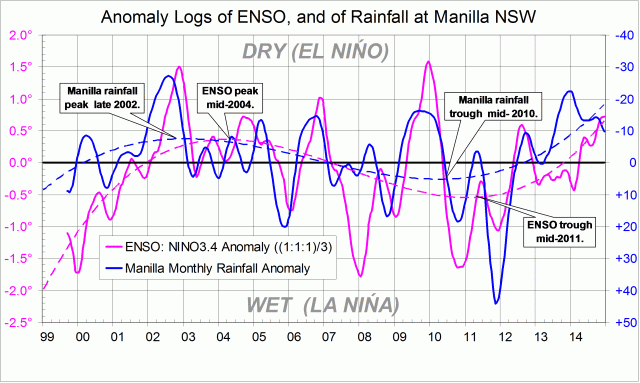
ENSO and Manilla NSW rainfall anomalies over sixteen years.

Continue reading

Manilla’s Hot Days to June 2015

Log of annual hot days in 16 years This post updates a similar one by including three more years to make a total of sixteen. It is in the same format as a recent post on Manilla’s frosts. Because the summer, which has the most hot days, crosses from one calendar year to the next, I have begun each year at July. I have called days warmer than 35° “hot days”, and days warmer than 40° “very hot days”.

Note added.

I have analysed the pattern of hot days in more detail in a later post “Hot days and ENSO”. By finding the relative frequency of hot days in all of the hotter months, I show that there is a cyclic variation related to ENSO. The cycle period is near 1.5 years, not 3 years as the log of annual frequency of hot days (above) suggests.

Graphical log of hot and very hot days

The first graph is a log of the number of hot and very hot days in each year. The three years with the most hot days had almost the same number: the year ’02-’03 had 41, the year ’09-’10 had 44, and the year ’13-’14 had 43. The two years with the fewest were ’07-’08 which had 5, and ’11-’12, which had only 4. The 13-year average is 26. Counting only the very hot days, ’03-’04 had the most (6), and four years had none at all. On the average, two days exceeded 40° in a year. (These are thirteen-year averages, not updated.) The number of hot days per year seems to have a cyclic pattern, with a period that increases from two years to four years during this short record. This is just a curiosity. The pattern of hot days has a lot in common with the pattern of smoothed monthly temperature anomalies for all months. These are plotted here, on a graph that relates them to ENSO. The relation of Manilla daily maximum temperature to ENSO was quite close from 1999 to 2011, but failed almost completely since mid-2011. In the earlier post on frosts, no cyclic pattern can be seen, nor any relation to ENSO.

New Record hottest days

In the sixteen years, there have now been 37 days hotter than 40 degrees: that is, 2.4 days per year. It remains true that December has fewer very hot days than November or February. A new record was set on 12/1/2013 by a daily maximum temperature of 43.2 degrees, beating the 42.6 degrees of 20/11/2009. This record was broken again on 3/1/2014, with 43.7 degrees. In the latest year, the hottest day (41.1 degrees) ranked only 12th, and it was not in summer, but in November.

Three new annual graphs

Continue reading

Manilla’s Frosts to 2014

Graphical log of frosts

This post updates a similar one by including three more years to make a total of sixteen.

The Number of Frosts in Each Year

The first graph is a log of the number of frosts in each year. The pattern is different when counting all frosts or only severe frosts.
The log for all frosts had two periods of stable, medium numbers of frosts: from 1999 to 2003, and from 2008 to 2011. Three years had many frosts: 2004 (68), 2006 (70), and 2012 (69). The year 2007 had the fewest frosts (43) until beaten by 2013 (34).
In the logs for severe frosts below minus 2° or minus 4° in the thermometer screen, the drought year 2002 stands out as the most frosty by far. It had the coldest mornings: -5.1° on both the 2nd and 11th of July.

The Last Three Years

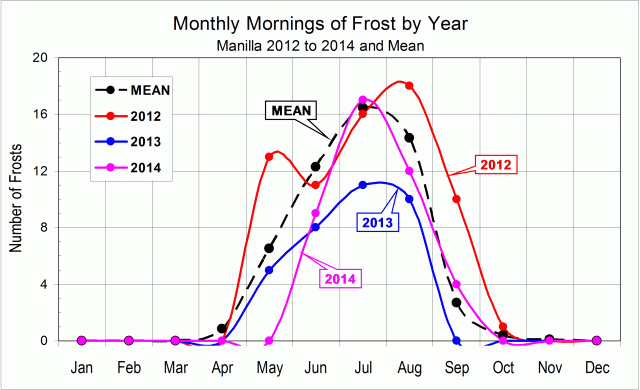
Monthly frosts in 2012, 2013, and 2014.

The second graph compares the mean seasonal pattern of frosts with the patterns for the three latest years: 2012, 2013, and 2014.
The frost season of 2012, which almost matched the record 70 frosts of 2006, began early and ended late. May had 13 frosts (like the 14 of 2006) and September had 10 (like the 8 of 2003).
The curve for the season of 2013 ( the new record fewest) was like that of a normal frost season, but lower.
The year 2014 was not very frosty, because the season began late, with no frosts in May and only nine in June.

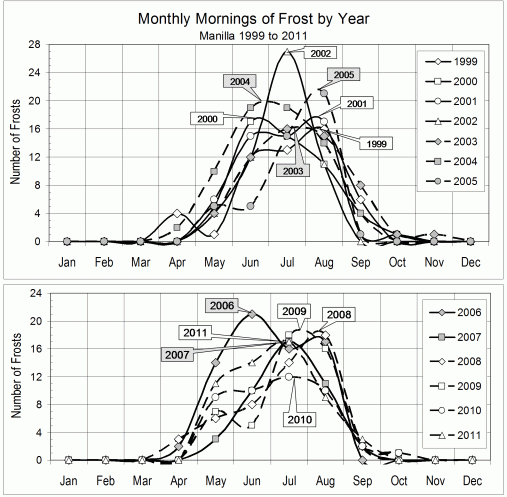
Monthly frosts each year

Graphs showing the seasonal frost patterns for earlier years are copied here.


There is 2013 reserch on frost in NSW titled “Understanding frost risk in a variable and changing climate” reported here.
It is in GRDC Update Papers (Grains Research and development Corporation). The research is done by Steven Crimp and co-workers at CSIRO Climate Adaption Flagship.
Referring to the period 1960 to 2010,
“Over many parts of NSW the frost season length has broadened by as much as 40 days and the mean number of consecutive frost days has increased to 5 days.”

February Climate Anomalies Log

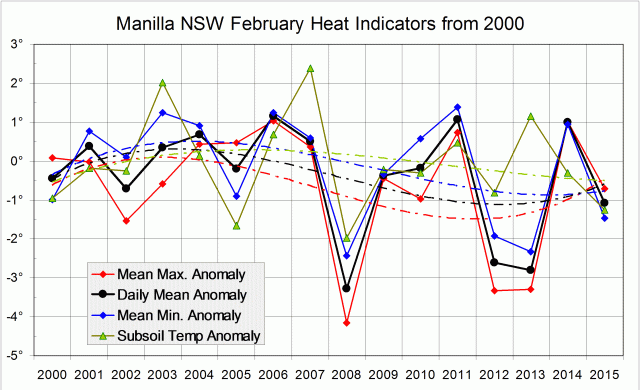
Heat indicators log for February

This post is the twelfth in a set for the 12 calendar months that began with March. Graphs are sixteen-year logs of the monthly mean anomaly values of nine climate variables for Manilla, NSW, with fitted trend lines. I have explained the method in notes at the foot of the page.

Raw anomaly values for February

Extreme values of February anomalies were as follows:

Daily Maximum Temperature Anomalies (3) -4.2 deg: February 2008; -3.3 deg: February 2012; -3.3 deg: February 2013;
Daily Mean Temperature Anomalies (1) -3.3 deg: February 2008;
Rainfall Anomalies (1) +120 mm: February 2012;
Dew Point Anomalies (2) -4.6 deg: February 2014; -4.6 deg: February 2015.

Trend lines for February

Heat Indicators

All heat indicator quartic trends began slightly low and ended slightly low. They had a low peak about 2004, and a trough later. The trough was deepest and earliest for daily maximum temperature (2011), followed by daily mean temperature in 2012, daily minimum temperature in 2014, and subsoil temperature in 2015 or later.

Moisture indicators log for February

Continue reading

January Climate Anomalies Log

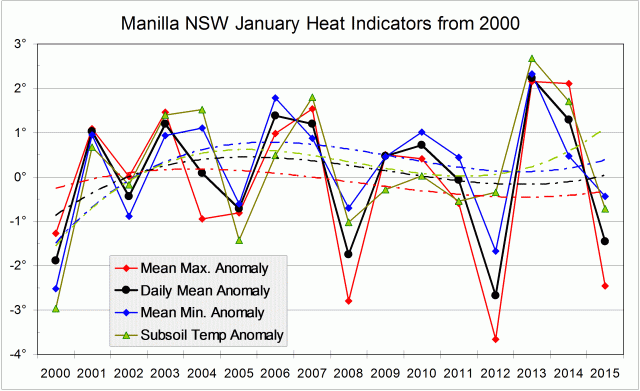
Heat indicators log for January

This post is the eleventh in a set for the 12 calendar months that began with March. Graphs are sixteen-year logs of the monthly mean anomaly values of nine climate variables for Manilla, NSW, with fitted trend lines. I have explained the method in notes at the foot of the page.

Raw anomaly values for January

Extreme values of January anomalies were as follows:

Daily Maximum Temperature Anomalies (1) -3.7 deg: January 2012;
Rainfall Anomalies (5) -70 mm: January 2002; -75 mm: January 2003; +80 mm: January 2004; +94 mm: January 2006; -85 mm: January 2014;
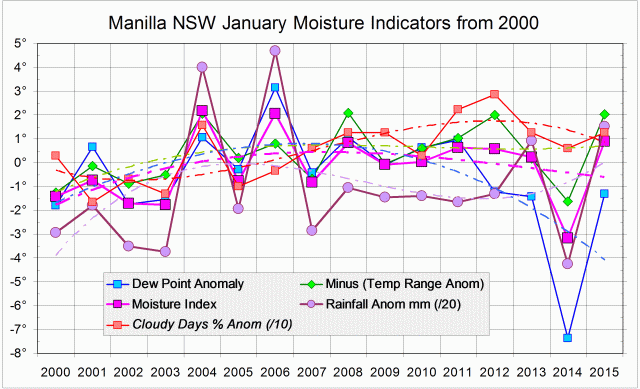
Dew Point Anomalies (2) +3.1 deg: January 2006; -7.4 deg: January 2014.

Trend lines for January

Heat Indicators

All heat indicator quartic trends began low and ended slightly high, and had a low peak in 2003, -05, or -06, and a shallow trough about 2012.

Moisture indicators log for January

Continue reading