Rainfall Shortages up to June 2018

Rainfall shortage Manilla, June 2018

Since the twelve-month drought of 2002, Manilla has been free from extreme rainfall shortage until now. Such a long gap between extreme droughts has not been seen here before. [See Note below: Dry May 2006.]

Rainfall shortages now

On this graph the black line with black squares shows Manilla rainfall shortages at the end of June 2018. Shortages are shown for short terms down to one month, and for long terms up to 360 months (30 years).

[Shortages at the end of May are shown in a previous post.]

[A graph showing shortages at the end of July is in a later post: “Drought Fifth Month; July 2018”.]

Extreme shortages

Three extreme rainfall shortages have now developed, all below the 1st percentile rank:
Total for two months (May and June): 6 mm;
Total for three months (April, May and June): 24 mm;
Total for four months (March, April, May and June): 50 mm.

Severe shortages

There were five severe shortages in rainfall totals as follows:
Total for six months: 141 mm, at the 4th percentile;
Total for twelve months: 350 mm, at the 2nd percentile;
Total for fifteen months: 492 mm, at the 3rd percentile;
Total for sixty months: 2672 mm, at the 4th percentile;
Total for seventy-two months: 3317 mm, at the 4th percentile.

Serious shortages

Some other rainfall shortages were not severe, but serious:
Total for one month: 5.2 mm, at the 7th percentile;
Total for five months: 120 mm, at the 6th percentile;
Total for nine months: 464 mm, at the 10th percentile;
Total for eighteen months: 658 mm, at the 6th percentile.
Comparing June 2018 with the month before

Continue reading

Rainfall Shortages up to May 2018

Rainfall shortage Manilla May 2018

Rainfall shortages now

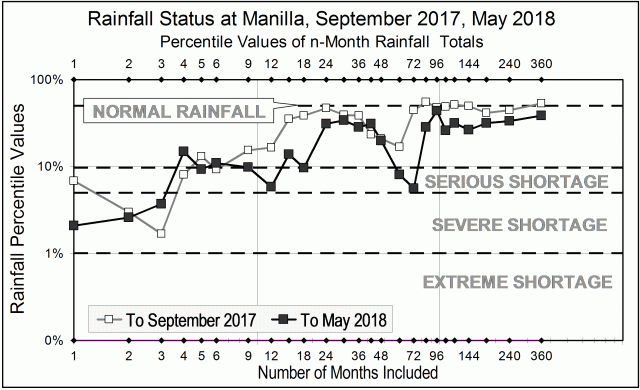
On this graph the black line with black squares shows Manilla rainfall shortages at the end of May 2018. Shortages are shown for short terms down to one month, and for long terms up to 360 months (30 years).

Extreme shortages

There were no extreme rainfall shortages at this date.

Severe shortages

There were severe shortages in rainfall totals as follows:
Total for one month (May): 1.2 mm, at the 2nd percentile;
Total for two months (April and May): 19 mm, at the 3rd percentile;
Total for three months (March, April and May): 45 mm, at the 4th percentile.

Serious shortages

Some other rainfall shortages were not severe, but serious:
Total for five months: 136 mm, at the 9th percentile;
Total for twelve months: 408 mm, at the 6th percentile;
Total for sixty months: 2765 mm, at the 8th percentile;
Total for seventy-two months: 3358 mm, at the 6th percentile.

General shortage

The first comment and reply below notes the fact that no rainfall total for any period reaches the 50th percentile. This has not happened for seventy years (1947).

[Later data

The following graph in this series is in the post: “Rainfall Shortages up to June 2018”. For the much worse situation in June 2019, see “June breaks more drought records”. ]

Comparing May 2018 with September 2017

The graph also has a grey line showing similar rainfall shortages at September 2017 (See the earlier post “A drought has begun”.). In the following month, October, there were no rainfall shortages, because the rainfall, 84 mm, was far above average. November, December and February also had rainfalls above average.
Since March 2018, shortages have appeared again. By comparing the black line (May 2018) with the grey line (September 2017), you can see that the rainfall totals are now lower for nearly all periods of time. Only four totals are now higher, including the 4-month total.

What are the classes of rainfall shortage?

We need to compare rainfall shortages. The best way is not by how far below normal the rainfall is, but by how rare it is. That is, not by the percentage of normal rainfall, but by the percentile value. As an example, when the rainfall is at the fifth percentile, that means that only five percent of all such rainfall measurements were lower than that.
Once the percentile values have been worked out for the rainfall record, each new reading can be given its percentile value. Percentile values of low rainfall are classed as extreme, severe, or serious.
For a rainfall shortage to be classed as extreme, its value must be at or below the 1st percentile.
A severe rainfall shortage is one that is below the 5th percentile.
A serious rainfall shortage is one that is below the 10th percentile.
A rainfall shortage that is above the 10th percentile is not counted as serious.

Long-lasting rainfall shortages

Rainfall shortages sometimes last a long time. The same classes of shortage are used for long periods, such as a year, as for short periods, such as a month. They depend on how rare such a shortage is on the average, and they all use the same percentile values to separate extreme, severe, and serious rainfall shortages.

A drought has begun

A year ago, I showed that Manilla was far from being in a drought. That is not true now. There are severe shortages of rain.

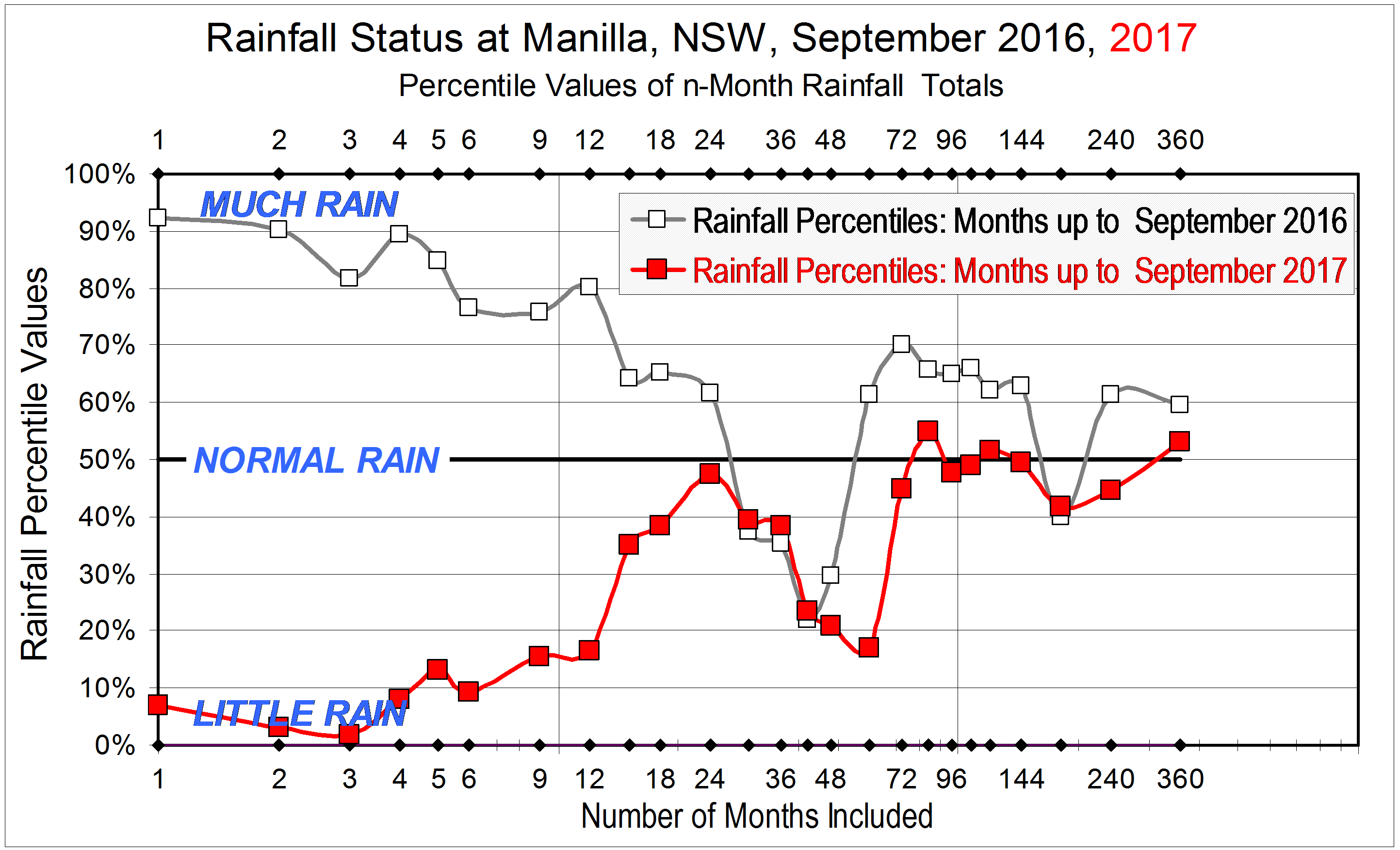
Rainfall status at Manilla, September 2016 and September 2017.

The first graph has rainfall totals up the left margin. They are not expressed in millimetres but as percentile values, Along the bottom margin is the number of months included in calculating each rainfall total.

On the graph, I have compared the rainfall situation today, September 2017, plotted in red with that of September 2016, plotted in grey. Much has changed.

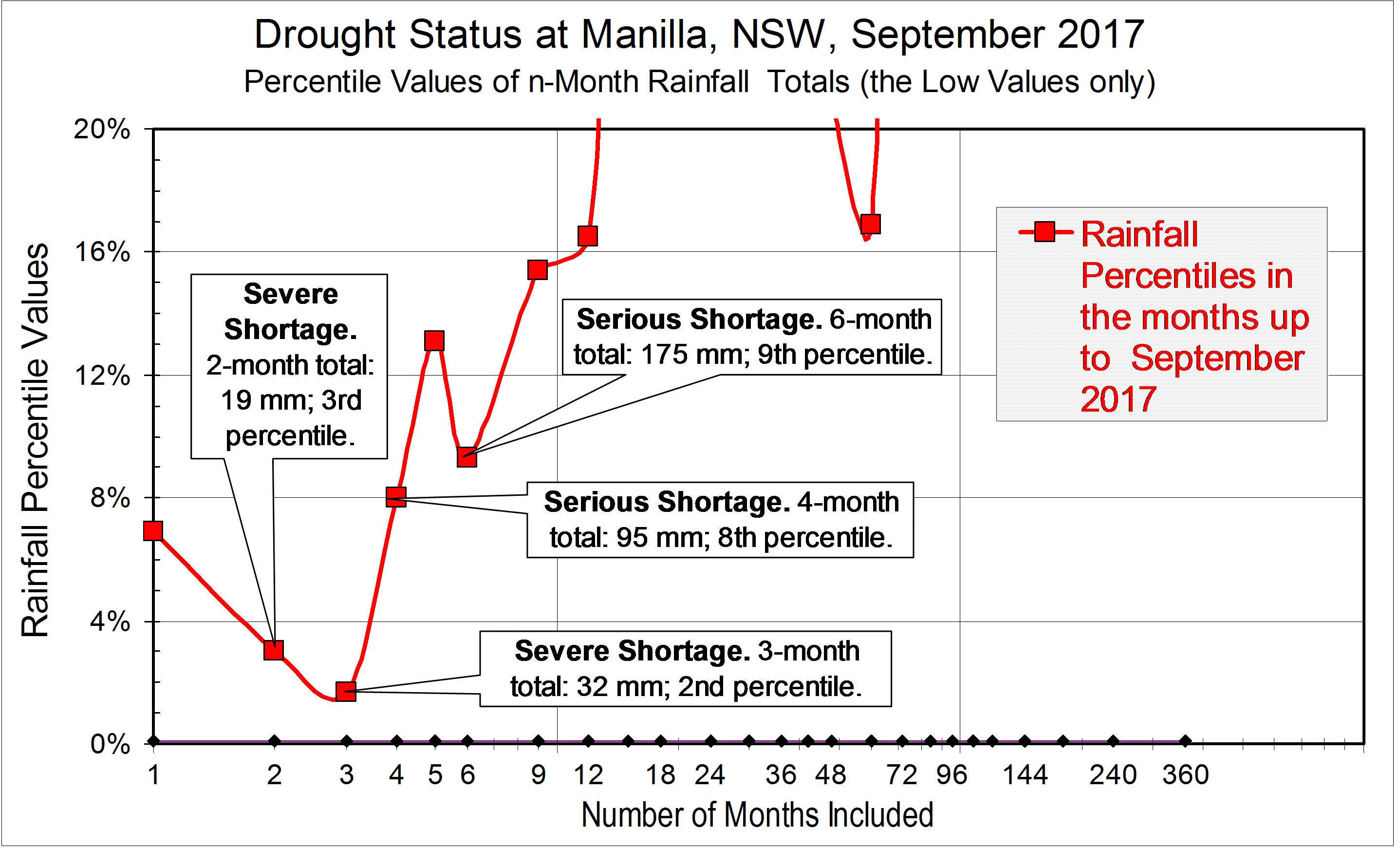
Take, for example, the 12-month (one-year) rainfall total. Rainfall totals for 12 month periods are directly above the value “12” at the bottom of the graph, near the label “Number of Months included”. In data for the month of September 2016 (grey), the 12-month total (actually 802 mm) had been at the 80th percentile, which was very high. In up-to-date data for the month of September 2017 (red), the 12-month total (actually 484 mm) is at the 17th percentile, which is very low.
Although rainfall totals for  periods longer than 12 months have not fallen so much, nearly all of them have fallen. Three that have not are those for 30 months, 36 months and 42 months. They were already low, due to including in them some months of low rainfall several years ago, in 2013 and 2014.

So far, real shortages have occurred mainly within the last 12 months. Beyond that, the two-year rainfall total of 1285 mm, for example, is still near normal, plotting at the 48th percentile.

The second graph shows in detail how shortages that are serious or severe have developed during the last six months. These were the monthly rainfall amounts, with the normal amounts in brackets:

April: 24.0 mm (39.3);
May: 55.6 mm (40.3);
June: 62.8 mm (44.3);
July: 13.2 mm (41.4);
August: 13.8 mm (39.5);
September: 5.5 mm (41.2).

As a result, the current situation is as shown below. There are already severe rainfall shortages, at the 2nd or 3rd percentile, in the two-month and three-month totals to date. There are also serious shortages, at the 8th and 9th percentiles, in the four-month and six-month totals to date.

Drought status at Manilla in September 2017

I will update these graphs each month to show how the situation changes.

[Monthly updates were not posted because serious rainfall shortages did not occur in any following months up to March 2018. The next post with a graph and analysis like this one was “Rainfall Shortages up to May 2018” of 15/6/2018.]

[This 2018-19 drought became the worst ever experienced at Manilla. Records for the lowest-ever rainfall totals were broken repeatedly. See, for example (June 2019)  “June breaks more drought records”.]

The 2002 rainfall shortages at Manilla

Graph of monthly percentile rainfall in a drought

In 2002, Manilla had a 6-month drought with one of the most extreme rainfall shortages on record. In nearly fifty years since 1966 there have been no other shortages like it.

I have discussed this drought in two posts: “Profile of an Extreme Drought”, and 3-year trends to August 2004 (An extreme 1-year drought).

[For an update on the longer and more extreme drought of 2018-19, see the note below.]

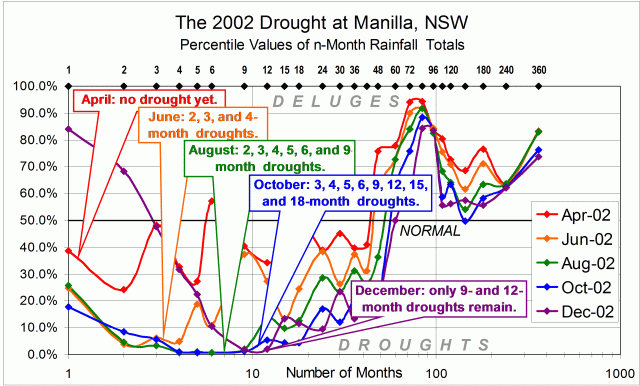
This post is about the rainfall record only. It compares the percentile values of rainfall totals for groups of months: one month, two months, and so on. The graph shows how the drought began, developed and faded. Other droughts may go through similar stages. I have plotted the pattern of rainfall shortages month by month, showing only even-numbered months. I have plotted them in different colours, with matching “Call-out” labels.

April 2002 (Red): no drought yet.
In April, the monthly rainfall was slightly below average: in the 40th percentile. In this month, nearly all rainfall totals up to the 42-month total were also below average. Only the 6-month total was above average. This set up the conditions for a drought. Notice that rainfall totals for periods longer than 42 months were all well above average. This hardly changed at all in this year. There had been a lot of rain in previous decades.

June 2002 (Orange): 2, 3, and 4-month droughts.
When May rainfall was in the 1st percentile and June rainfall in the 25th percentile, the June 2, 3, and 4-month totals became serious or severe shortages (below the 10th percentile).

August 2002 (Green): 2, 3, 4, 5, 6, and 9-month droughts.
With July rainfall again in the 1st percentile, and August rainfall in the 26th, the drought became extreme. The 4, 5, and 6-month totals were in the 1st percentile: few months had ever had such low figures.

October 2002 (Blue): 3, 4, 5, 6, 9, 12, 15, and 18-month droughts.
September and October both had rainfall in the 18th percentile. That relieved the short-term shortages somewhat, but not those in the medium term. Shortages in the 4, 5, and 9-month totals were in the 1st percentile, but the 6-month total was very much worse. At 76 mm, this 6-month total was the third driest on record, beaten only by August 1888 (43 mm) and September 1888 (69 mm).

December 2002 (Purple): only 9- and 12-month droughts remain.
November rainfall that was near average (40th percentile) and high December rainfall (84th percentile) broke the drought. Only some longer-term effects persisted as severe rainfall shortages in 9- and 12-month totals.

Rainfall status Jan-Feb 2019


Note added 2019.
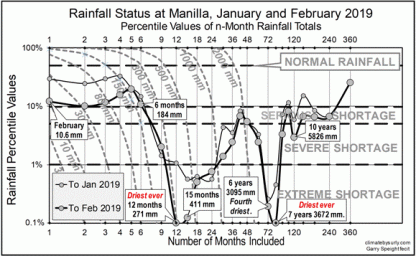
Later such graphs in this blog have a logarithmic scale to distinguish the extreme rainfall shortages. Here is the one for the even more extreme drought of February 2019.

Profile of an Extreme Drought

Rainfall vs Maximum temperature, 2002 droughtAt Manilla, NSW, there was a drought in 2002 that was extreme, but brief. There have been no other extreme droughts at Manilla in the 21st century. The current drought is not as bad (yet).
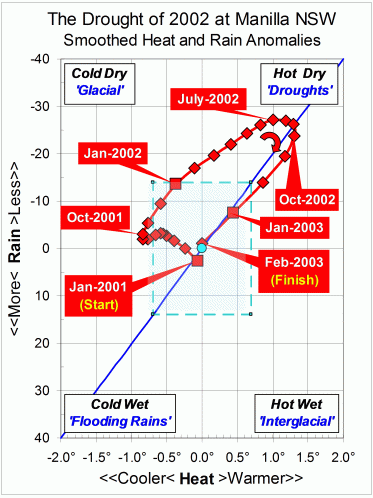
The first graph shows a profile of the 2002 drought. Low rainfall is at the top, and hot days are on the right. Droughts, with low rainfall and hot days, will be near the top right corner. Normal climate is marked by a rectangle (coloured aqua (aqua)) in the middle.
The climate in these months moved into drought and out of it. January 2001 (Start) had perfectly normal climate with no drought, and so did February 2003 (Finish). Rainfall first became lower than normal after January 2002, and reached a minimum 27 mm below normal in July 2002. Rainfall returned to the normal range by December 2002. Day-time temperature went above the normal range in May 2002, reached a peak 1.3 degrees above normal in September-October 2002, and fell back into the normal range in January 2003. For rainfall lower than normal, the drought lasted ten months: for days hotter than normal, it lasted eight months. In this drought, the time of lowest rainfall came two to three months earlier than the time of hottest days.

(There is more detailed analysis of  the 2002 drought in a post dated September 2004.)

Graphs showing the progress of the drought as rainfall shortages are in the post “The 2002 rainfall shortages at Manilla”.

The loop on the graph shows this drought as a simple event with a beginning, a middle, and an end. Droughts are not usually seen to be so simple. This graph is made using two “tricks”: anomalies and smoothing. You must judge whether you trust them to describe the drought as it happened.

Continue reading