Solar-passive House Testimonials

Photo of a birthday party in the solar-passive house

Birthday Group

Family members visited the solar-passive house in Monash Street, Manilla, NSW, in Mid-winter 2016. The date of their visit is shown on the graph in this earlier post. This photo shows us dressed for comfort at 17 degrees indoors.

Interviewer:
What do you think of Grandpa’s house in winter?

Grand-son (10):
I like Grandpa’s house. It’s nice. Except there’s no wifi. But apart from that, it’s good.

Grand-daughter (13):
Grandpa’s house? It’s cool. It’s interesting. Awesome curtains – I get a shock when they move because I’m not used to it. The garden is cool too – it’s pretty.

Daughter:
I love winter. And I love visiting my Dad. He built this really great house in Manilla nearly twenty years ago. Prior to that, he was tenanted in an old office space above the newsagent. I loved visiting him back then as well, even if his flat was super hot in summer and not at all cosy in winter. The house he built is wonderful all year round.

Even if there are only a few hours of sun each day in the depths of a NSW winter, that is all you need to warm my dad’s house. You can find yourself a chair in the sun, sit for a while and imagine you’re on vacation in Hawaii. Only with much better coffee. As the sun goes down, the sound of noisy birds settling in for the night comes through from outside.

Kitchen view SW

Kitchen view SW

The kitchen is well-stocked for preparing dinner (especially after we restock it) and, once the stove is on, it’s toasty warm in there. There is a curtain that closes the kitchen off from the rest of the house, but cooking time is social time for us, so we leave it open – which also helps flood the house with the delicious smells of curry. The house finally gets coolish sometime after dinner. That’s when we don the cardies and fluffy slippers and pre-heat the beds. The electric blankets, even on low, manage to warm the bedrooms all night.

Next morning, on a strict schedule, the automatic curtains fly open to announce the new day. Not being an early-morning person, I make good use of the curtain override button. At least, until I get the first whiff of toast.

Son-in-law:
Having grown up in India, I find summer is a breeze and cold weather is a challenge. After a couple of decades in Canberra and almost a decade in Switzerland, I have finally realised that dealing with winter boils down to managing the environment in the house and wearing the right gear.

I have stayed in my father-in-law’s house in Manilla several times, in summer and in winter, most recently in the winter of 2016. The house is comfortable in both summer and winter. I remember feeling colder in winter when I first stayed there compared with now – I am not sure whether the house is warmer, or I have more layers of fat to protect me as I get older. Maybe I just dress more appropriately now for winter thanks to my time in Switzerland.

The place where we hang out the most is the kitchen, and around the kitchen table, over cups of coffee or improvised meals, catching up on left and right leaning newspapers. The kitchen is very cozy in winter, especially when there are multiple dishes cooking away on the stove.

A memorable feature of my father-in-law’s house is the automated curtains which felt space-age when I first experienced them, but now I am used to them. They are like a bell-less morning alarm. Being a morning person, I beat them to it, and am awake before they start moving and letting in light.

Photos of porch awnings adjusted for outdoor living in winter and in summerI love the balcony on the first floor. It is well protected and I can sit there for hours with a cup of coffee and a book, and listen to cockatoos and other birds, and watch the paragliders in the distance when they are out. In winters the mid to late afternoons are the most comfortable.

Photo of a path between trees

In the garden

As the trees and shrubs in the evolving garden have grown and the paths have become more structured it has become a wonderful place to walk around and to relax. The garden bench is particularly inviting. This man is as passionate about his garden as he is about his house. The guided tour of his garden is one of the highlights of our stay there.

Interviewer:
Thank you all for your answers.
Goodnight, everyone.


Recent photos of the house and garden are here.

Hard Winter for Solar-passive

Graphical log of daily indoor and outdoor temperatures for winter 2016.

Temperature log: main features

This graph, for 2016, shows a winter pattern of indoor and outdoor temperatures that is typical for this house. Indoor temperatures vary much less than outdoor temperatures, they rise and fall with them, and they are higher nearly all the time.
While the outdoor temperatures shown go as low as minus three degrees, those indoors lie within the winter “comfort zone” from 17° to 24° (see this post) nearly all the time.

Weather this winter

This winter was harsh for a solar-passive house. Near-record rainfall (227 mm) came with the greatest number of cloudy days of any winter in the new century. There were 53 mornings with more than four octas of cloud, when the average is 33.

Heater use

Because cloud limited the the solar gain, I had to use blower heaters far more than in previous winters. My records show that I used 320 kWh ($80) in these heaters this winter, when I normally use about 40 kWh ($10).
Heaters were also used by guests who were present on the six days shown. As well as being unused to the climate, the guests lived in the colder west wing of the house. They may have used 72 kWh ($18). Those guests have kindly written reviews of their visit.
Even using 400 kWh of electricity for personal heating in a winter could not make a detectable change in house temperature. I have found that blower heaters are surprisingly good at making a room in this house comfortable. As the radiant temperature of the walls is only 2° or 3° too low for comfort, it can be compensated by making the air temperature only slightly higher.

The pattern in detail

While cloudy days are not plotted here (Cloud observations for this winter are plotted elsewhere.), cloudy days can be recognised on the graph. In this climate, days with low maximum temperature and high minimum temperature are always due to cloud. Only in fine weather are days warm and nights frosty. The graph shows how the weather goes through a cycle every week or two: sunny days get warmer, then rain sets in. As it clears, the air gets even colder, before warming up again.
Indoor temperatures follow the same cycle, but there are differences. There may be a delay of up to a day, and sometimes longer.

Correlations

I did scatter plots comparing all the variables shown in the first graph and I fitted linear regressions. I present the four scatter-plots that had the highest coefficients of determination (“R-squared”). Continue reading

Porch is a Breezeway or a Sun-trap

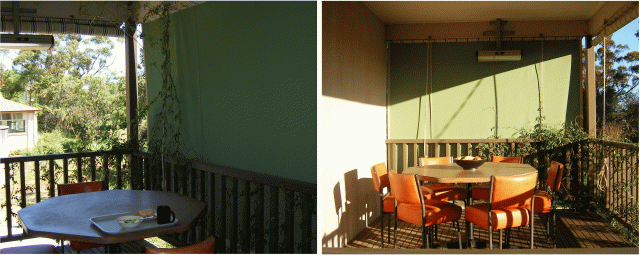
Photos show awnings arraged for summer and for winter

Porch Awnings in Summer and Winter

This porch, which is a sun-trap in winter, is converted simply to a shaded breezeway for summer.
The porch is an upstairs outdoor room, open on three sides, at the west end of my house. With a Tallowwood deck and steel balustrade, it could be called a verandah or a balcony. I like to call it a talar, although it is not as grand as the talar of the Ali Qapu Palace, Isfahan.
For the colder part of the year, from March to October, the talar awnings are arranged as in the right photo. I fasten down the canvas awning on the south side to stop drafts, and I roll up the awning on the west side so I can enjoy the views. On sunny winter afternoons it is pleasant to have a late lunch there, with temperatures in the high twenties, several degrees warmer than the maximum in the thermometer screen.
For the warmer part of the year, from November to February, the awnings are arranged as in the left photo. The awning on the west side is fastened down against the intolerable heat of the afternoon sun. That also keeps the heat off the west wall of the house. The south awning is raised, to allow air to flow through, from south to north. When there is a breeze, it can be comfortable to sit on this porch even on very hot days.
By the use of cheap canvas awnings, this porch can make outdoor living pleasant in months when the climate here is too cold or too hot for it.

My Heat-control Courtyard

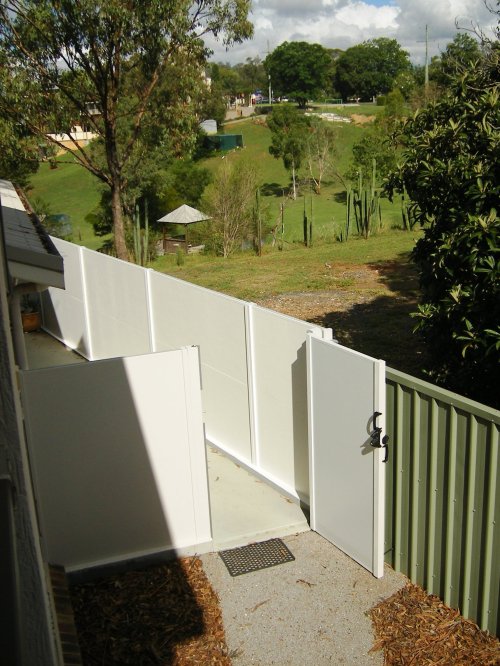
Photo of a small courtyard

A Heat-control Courtyard

I have added a courtyard to my high-mass solar-passive house to improve summer cooling and winter heating.

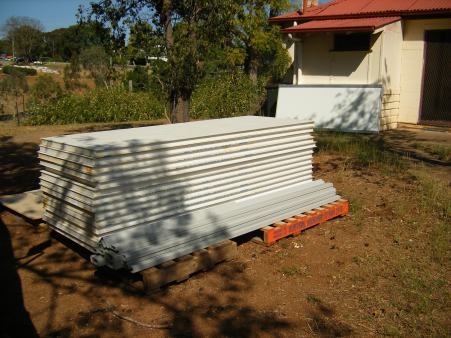
Photo of building materials

Courtyard Wall Panels and Gates

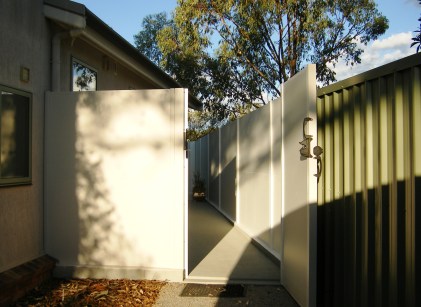
The courtyard extends 13 metres along the south wall of the house. It is completely enclosed by a wall of white-painted polystyrene sandwich panels 1.8 metres high, with two gates of the same material.

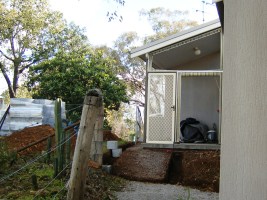
By September 2015 trenches had been dug for the courtyard foundation, and by December it was complete.

Photo of trenches dug for courtyard

Courtyard Trenches, West

Photo of trenches dug for courtyard

Courtyard Trenches, East

Operation

This house is in BCA Climate Zone 4: Hot dry summer, cool winter. For comfort, it must be made very much cooler in summer and very much warmer in winter. The courtyard was built to help to achieve both results without the use of heaters or coolers.
In summer, it should ensure a supply of very cool air at night. In this house, cool air is drawn in to replace warm air that flows out the clear-story windows by the stack effect, assisted by fans. By day, the courtyard walls also block some solar radiation.

Photo of courtyard from the west

The Courtyard Through The Western Gate

In winter, the white courtyard wall reflects sunshine north towards the house, and re-radiates heat lost from the house wall back towards it.

More

Much more detail is given in the page “A Heat-control Courtyard”. All photos on this topic are in a gallery in “House Photos – 2016”.

New Post on Wicket Gates

In August 2017 I added a new post about wicket gates that were added to the solid gates in the courtyard gateways.


To invite discussion of how courtyards can affect indoor and outdoor climate of houses, I opened a thread “Courtyards for Climate Control” on the forum of the Alternative Technology Association (ATA) based in Melbourne.