House June warmth profiles: II

Part II: Daily temperature cycles, west wing

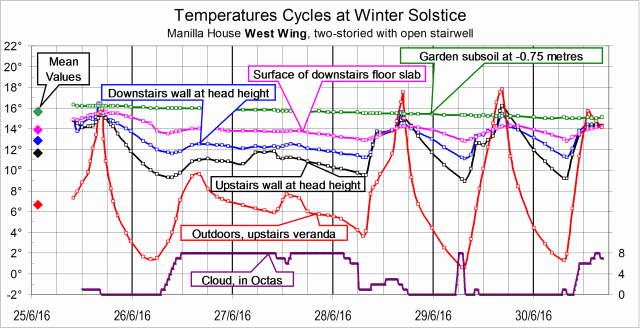
Graph of temperatures in the house west wing in mid-winter

I report here on the thermal performance of a solar-passive house in Manilla, NSW, during five days at the winter solstice of 2016. The house is described briefly in a Note below.
This post is about the 2-storied west wing of the house, which is less successful. The more successful east wing will be considered later. An earlier post showed that average temperatures decreased with height. Go to Part I.

This five-day period was a testing time for the unheated solar-passive house. Days were at their shortest, some nights were frosty, and overcast persisted for two days. It fell within a cold, wet, and cloudy winter.

Observations

View of the house from the street

House From the Street

In this wing, seen on the right in the photo, five thermometer stations define a profile in height. They are:

Subsoil in the garden near the house;
On the downstairs floor slab;
On the downstairs wall;
On the upstairs wall;
OUTDOORS, on the wall of the upstairs veranda.

During the five days I made 84 observations at each station at intervals as shown. They define the daily temperature cycles. I observed the amount of cloud in Octas (eighths of the sky) at the same intervals.

Table of west wing temperaturesThis table lists for each thermometer station the five-day values of the average, maximum, and minimum temperatures, and the temperature range.

The daily cycles

Subsoil

Continue reading

House June warmth profiles: I

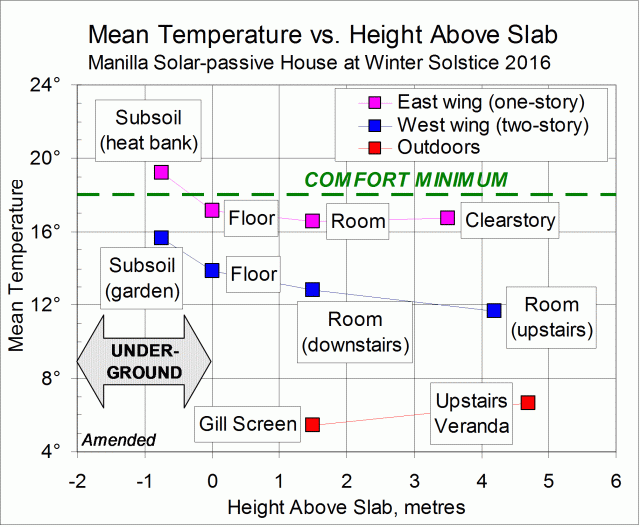
Graph of house temperatures versus height

Where is the warmth in a house?

People are building houses that should keep warm in winter with little heating.
Some parts of the house will stay warmer than other parts. Which parts? How warm?
Answers are not easily found. I hope this temperature record from a house with only personal heating may be useful. This was a time when the house was under extreme stress due to cold weather.

Over a five-day period in winter 2016, I read thermometers frequently at a number of stations around the house. I have selected those stations that form profiles from top to bottom of two wings of the house: the two-storied west wing, and the east wing that is one-storied with a clearstory.
To find how my house differs from yours, see the note below: “Key features of the house”.

Selected thermometer stations

In the West Wing (two-storied)

OUTDOORS, upstairs veranda (+4.7 metres);
Wall upstairs at head height (+4.2 metres);
Wall downstairs at head height (+1.5 metres);
Floor slab surface downstairs (0.0 metres);
Garden subsoil at -0.75 metres.

In the East Wing (single-storied)

Clearstory space at +3.5 metres;
Wall in the hallway at head height (+1.5 metres);
OUTDOORS, in a Gill Screen (+1.5 metres);
Floor slab surface in the en-suite (0.0 metres);
Solid “heat bank” beneath the floor slab (-0.75 metres).

Part I: Average temperature values

SUMMARY RESULT
In the ground under the floor slab the temperature would be just warm enough for winter comfort. Above the floor slab, the higher you go, the colder it gets.

Results

The graph above plots mean temperature against height above the floor slab. (The mean temperature is the time-average over the five days.)

Comparing east wing, west wing, and outdoors

The single-storied east wing was several degrees warmer at all heights than the two-storied west wing. The east wing has advantages: thermal mass, perimeter insulation in the footings, less shading, and a more compact shape.
Continue reading

Mirrors to reflect the sun

I have begun to warm the shady side of my house with reflected sunlight in winter.
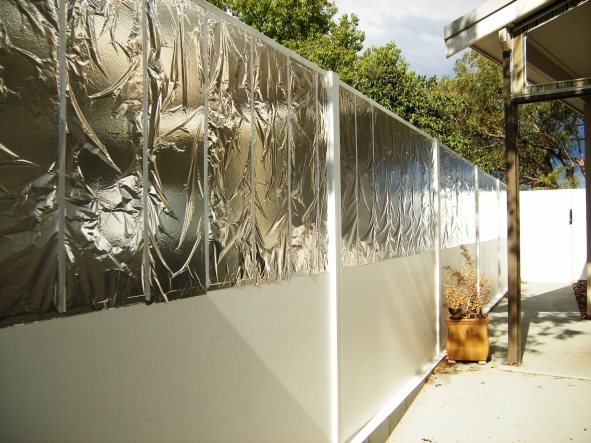
Aluminium mirrors to reflect sun

Sun Mirrors Mar-17

This winter’s set-up (2017).

The first photo shows the present temporary set-up, done on the 10th of March 2017. That is, soon after I had changed the house from its summer regimen (to keep cool) to its winter regimen (to keep warm).
As shown, I attached aluminium foil to the courtyard wall on the south boundary of my block. The foil forms mirrors that reflect winter sun onto the south wall of the house, the edge of the floor slab, the footings and some nearby concrete paths.
The mirrors are sheets of aluminium cooking foil (“Alfoil”) 300 mm wide, cut to 900 mm lengths. I attached the foil to the wall in vertical strips with double-sided tape. As the wall is 12.6 metres long, the total mirror area is 11.3 square metres.

Update in 2020

By 11.30 sun mirrors fill the patio with reflected light.

By 11.30 reflected sunlight floods into the patio.

I have now replaced these mirrors of cooking foil with much improved sun mirror panels.
See the new post “My Better Sun Mirrors”.


{Winter 2018.
The mirrors that were set up in March 2017 were taken down on 1 November 2017. On 5 May 2018, the same “temporary” set-up (as pictured above) was done again. The mirrors were removed on 3 November 2018. I continue to monitor temperatures and plot correlations.]

[Note added October 2019.
Winter 2019.
During 2019, I arranged to have new mirrors installed, made of aluminium-faced “Foil Board” insulating panels 20 mm thick. Mounted in frames, these would be more robust, and would have the advantage of providing shade in summer.
These new mirrors are not yet installed. Consequently, temperature data for winter 2019 is all in the category “without mirrors”.]

The first trial set-up: winter 2016.

Temporary aluminium mirrors to reflect sunlight

Sun Mirrors May-16

Last year, during April and May (2016), I attached only 17 strips of foil 700 mm long in the same way. The total area then was 3.6 square metres. In that winter, the wind did a little damage, which I taped over. Much worse damage was caused by a magpie-lark attacking his reflection. By October, they were torn as shown in the third photo.

Aluminium foil damaged by birds

Bird Damage Oct-16

I repaired some of that damage, too, using builders’ foil, which is stronger. On 6 November 2016, I removed all the foil. By then I wanted shade. not sunlight.

Effect of the mirrors

The white-painted courtyard wall reflects nearly all the sunlight it receives. However, this is diffuse reflection, going equally in every direction. Only a small part of it goes to points likely to warm the house.
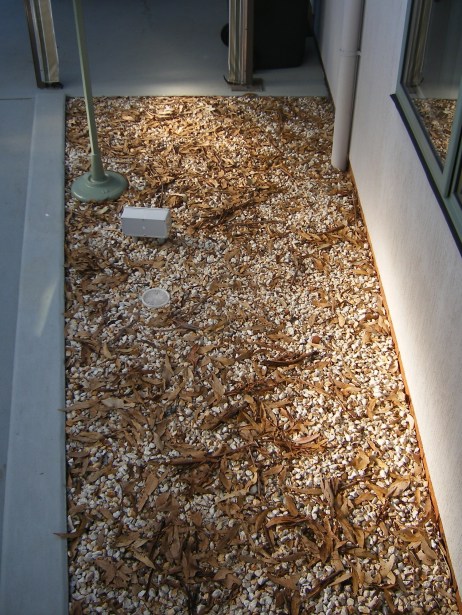
Sunlight that has been reflected towards the house.

Reflected Light May-16

The aluminium foil reflects in a specular (mirror-like) way, sending nearly all of the solar energy downward at the same angle that it arrived. Because the foil is wrinkled, these mirrors spread the beam of sunlight out to about twice the width of the mirror surface. It is still quite concentrated as can be seen in the last photo, which is lit mainly by reflection from the foil.

Light reflected from these aluminium mirrors is not aimed precisely at points where it would best warm the house. The mirrors are not mobile, and their location owes a lot to chance. Furthermore, the house shades the mirrors for parts of each day; different parts as the season changes.
However, I think the warming effect will be useful, and I hope to be able to measure it.

Related Topics

The mirrors are part of the Courtyard that I have described in posts and pages listed in “My House Page”.


I raised the question of mirrors to reflect sunlight in a thread titled “Reflective Film” on a forum of the Alternative Technology Association in Melbourne, now re-named “Renew”. (I posted as “Catopsilia”, my first post being the 15th from the top.)

Ventilation louvre hassles

I specified wooden louvre blades

This louvre window installation is described in this earlier post.

Photo of louvre for night purge

Louvre now fitted with glass blades

The automated louvre window that I specified for my system of summer cooling by nocturnal purge had wooden louvre blades of western red cedar 14 mm thick.
I specified wood because I preferred that this louvre should not be transparent, as I did not want to see through it and I did not want it to admit light. I took the risk that wooden blades might not seal as well as advertised.
Other posters on the ATA forum (see link below) doubted that the blades would seal effectively. They were right.

Failure of the wooden blades to seal

When the louvres were closed for the first time, there was clearly no seal at all. The rubber seals fastened to the blades failed to meet the matching blades, leaving gaps of up to 2 mm admitting daylight.

Attempts to rectify

I wrote a letter of complaint on 18/5/2016.
Rectification work on warranty first revealed faults in the gallery of gearing at the side of the window. However, when the gallery was replaced the gaps remained. The photo shows daylight visible on the right side through three of the gaps.

Photo evidence that louvre does not seal

Wooden louvres showing daylight

As the blades did not meet their specification, the company replaced them without charge. When these new blades did not seal any better, the company offered (on 10/10/2016) to replace them with aluminium blades, 6 mm thick. I reviewed the specifications of their blade options, and decided that this was not acceptable. The aluminium blades had little thermal resistance (U-value: 6.55). Glass blades 6 mm thick, with a low-e coating had much higher thermal resistance (U-value: 4.40), almost the same as the wooden blades (U-value: 4.39). The company agreed to provide these low-e glass blades. (In fact, this had been their original suggestion.)

Sealing of glass louvre blade gaps

Continue reading

House in a cold October

This October has been very cold. That has kept indoor temperature
in this solar-passive house almost too cool for comfort. I wore warmer clothes and opened windows to admit warm air.

Indoor/outdoor temperature scatter-plot.

The climate this October

The graph shows (on the x-axis) how cold this October [in red] was: the coldest of the new century.
Here on the North-west Slopes of NSW, October warms and cools more from year to year than other months. It is the month most affected by climate cycles such as the El Nino-Southern Oscillation (ENSO). As shown, October warmed by one degree each year from 2011 to 2015, then cooled by nearly six degrees from 2015 to 2016.
ENSO followed almost the same pattern, but October 2012 was warmer than October 2013.
For five months, world temperature has also been down: much lower than it was in the record-breaking months of February and March 2016. (HadCRUT4 Global monthly near-surface data set (Column 2 in the linked table.))

Indoor climate this October

As shown on this graph beginning 2005, the indoor mean temperature in October months has varied with outdoor mean temperature. This coldest October outdoors (15.9 degrees) was also the coldest indoors (20.8 degrees). (But see Note below.)
October is the final month that I keep the house in its winter warming regimen. In 2014 and 2015 it had been almost ideally warm, but in 2016 it was just above the comfort minimum. Since this figure is just an average, there were times when the house was too cool for comfort, especially in the mornings.

Successive unfavourable months this year

As in other seasons, I intend the indoor climate to be comfortable through each spring season.
As I posted in “Hard Winter for Solar-passive” this very cloudy winter had reduced solar gain, making heaters needed much more than usual. However, the mean indoor temperature at winter’s end (August) was normal, although the heat bank was 0.7 degrees cooler than normal.
In September months, the warmth indoors still depends on solar gain through the north windows. This time,the sky continued very cloudy, and the daytime temperature was a record low value. As a result, the indoor temperature was 0.9 degrees down and the heat bank 0.7 degrees down.
By October, there is no solar gain through the north windows: warmth is gained from the surroundings in daytime by conduction, convection and radiation and retained by closed curtains at night. This time, both day and night temperatures were three degrees below normal, reducing daily heat gain and increasing nightly loss. As a result, the indoor temperature was 1.2 degrees down and the heat bank 0.9 degrees down.

What I did

Continue reading