Warming and Carbon Emissions: Shifting Trends

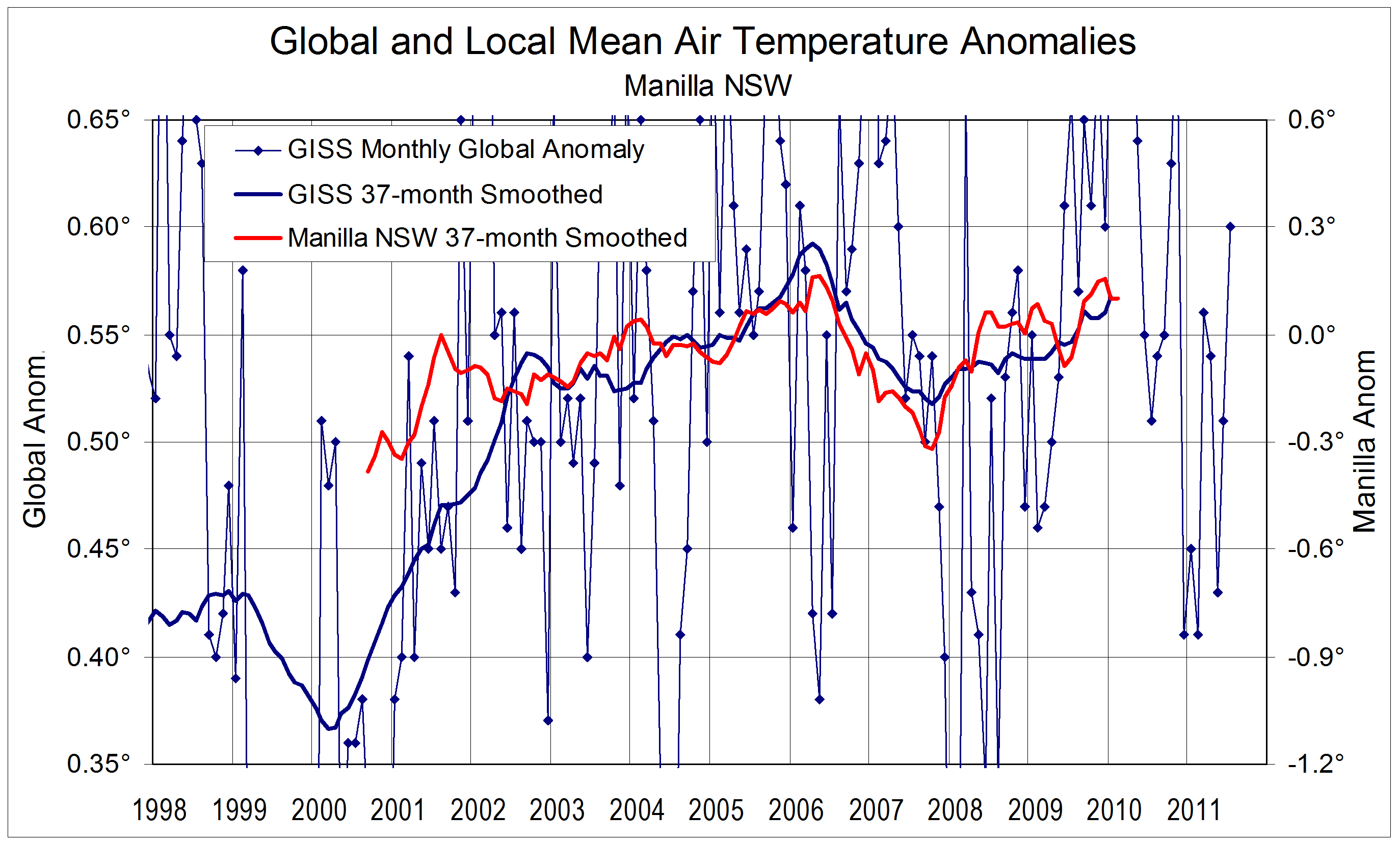
Log from 1850 of world surface air temperature and carbon emissions

Trends in global temperature and in carbon emissions changed sharply several times during the last 160 years.
One question is at the heart of concern about human influence on climate: how does global temperature relate to human-caused emissions of carbon dioxide?
This graph shows that relation: it does not explain it.

[This post published 9/05/2014 was made “sticky” during early April 2018 to show the inclusion of Gail Tverberg’s recent graph of world energy consumption.]

Data

I display two well-established data sets:
1. The HadCRUT4 record of estimated global surface air temperature. Values are expressed as the anomaly from 1961-1990 mean values in degrees celsius.(See Note 1. below.)
2. Global Fossil Fuel Carbon Dioxide Emissions, tabulated and graphed as tonnes of carbon (See Note 2. below.)) by the Carbon Dioxide Information Analysis Center, Oak Ridge.(See Note 3. below.)

The format of the data is given in Note 4. below.

Multi-decadal linear trends

Trends in carbon emissions

Throughout this time, the rate of carbon emissions increased exponentially, but at rates that changed abruptly at certain dates. In units of log-cycles per century, the rates were:

From 1850: 1.97 units;
From 1913: 0.28 units;
From 1945: 2.14 units;
From 1973: 0.77 units.

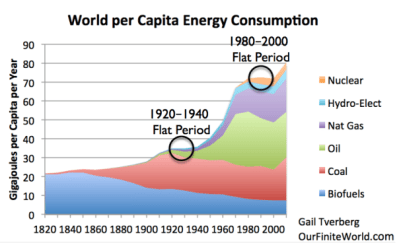
Energy consumption 1820-2010Note added April 2018.
The two episodes of low rate of growth of carbon emissions, from 1913 to 1945 and from 1973 to 2009, relate to times of low growth in world energy consumption. This graph by Gail Tverberg shows that world energy consumption grew so slowly from 1920 to 1940 and from 1980 to 2000 that it did not keep up with the growth of population. Continue reading

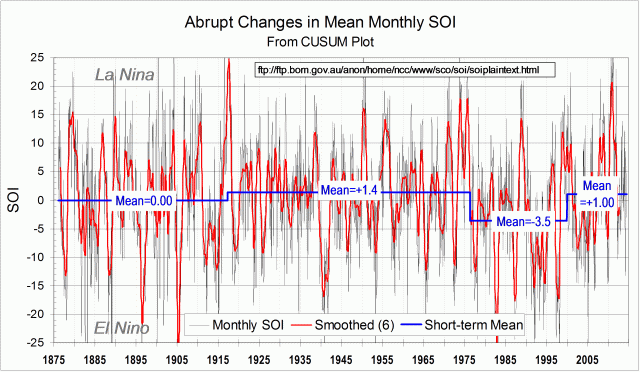
Log of the Southern Oscillation Index with climate shifts

SOI plot with climate shifts

This graph relates to a graph of the cumulative values of the Southern Oscillation Index, posted earlier and copied below.

SOI CUSUM plotThe graph above is in a more familiar form . It may help to explain what the earlier graph means. That is, that the SOI was dominated by positive values (towards La Niña) for about fifty-nine years before 1976, and was dominated by negative values (towards El Niño) for twenty-four years after that date. From 2000 the trend seems to be upward, showing La Niña dominance again. Broadly, these were straight-line CUSUM  relationships throughout each of the periods, as shown by the coloured trend lines. Slopes on a CUSUM plot represent offsets of the mean monthly value: the mean SOI in the earlier period was +1.4 units, and that in the second period was -3.5 units. Since 2000, the mean monthly value is around +1.0 units. Continue reading

Southern Oscillation Index: CUSUM plot

SOI CUSUM plot

This graph is a log of cumulative values of the monthly Southern Oscillation Index for the last 139 years. (See Note added 25th August 2014 below.)

(See also Note Added 19 December 2015 regarding the mis-match between this SOI record and the climate record at Manilla.)

(See Note added 27/3/2016 below, for a prior construction of this graph.)

High values of the SOI (contrary to NINO3.4 values for the ENSO index) relate to deluges in Australia and low values relate to droughts.

This is the CUSUM technique, invented in 1954 by E.S.Page. Pay attention to the slopes on the graph.

I have identified major El Niño and La Niña events on the graph. La Niñas have extreme upward slopes and El Niños exteme downward slopes.
The main feature of the graph, which is obscure in graphs that do not use CUSUM, is that La Niñas dominated the 60-year period from 1917 to 1976, and El Niños dominated the 25-year period from 1976 to 2000. I have drawn linear trend lines to make this clear. The first trend line (La Niña dominant) begins at an SOI CUSUM value of -30 in May 1917 and ends at a value of +960 in February 1976, yielding a slope of +1.4 SOI units per month. The second trend line (El Niño dominant) ends at a value of -40 in December 1999, yielding a slope of -3.5 SOI units per month.
The tendency to El Niños in the second period was greater than the tendency to La Niñas in the first period by a factor of more than two.
Although the period since 2000 is very short, the trend seems to slope upward at about +1.0 SOI units per month.

These decadal changes in the short-term mean value of the SOI are graphed in a later post. That graph does not use the CUSUM concept, and the changes in the mean value are overwhelmed by month-to-month variation.


I posted discussion of an earlier version of this graph in “Weatherzone” Forums >> Weather >> Climate and Climate Change >> ENSO Discussion 2012 Post #1103736


Note added 25th August 2014

Another CUSUM SOI graph

By searching the net for “cusum soi” I find that a plot of the cumulative sum of values of the Southern Oscillation Index was published by Cordery and Yao in 1993: “Non stationarity of phenomena related to drought”.

Neither the data nor the approach of Cordery and Yao are the same as mine.

Data

Cordery and Yao used monthly normalised SOI anomaly data supplied by the Bureau of Meteorology, as I did. They mention that “Prior to 1933 there are 7 gaps in the SOI sequence resulting from a total of 102 months of data missing from the Papeete pressure record.” I have not found any note of this with the Bureau’s current data table.
Apart from an (unexplained) reduction in the scale of CUSUM values by a factor of 500, there are important differences in detail. During the time of La Niña dominance, I find that the major CUSUM peaks (La Niña turning to El Niño) in 1918, 1939, and 1976 lie almost in one line. Cordery and Yao’s plot has the 1939 peak relatively much higher: the second highest on the record after the 1976 peak, and almost as high.

Approach

Cordery and Yao used CUSUM to show that the SOI series was not stationary for a part of the time. I used it to identify persistent shifts in the SOI mean value.


Note added 19 December 2015

The influence of the Southern Oscillation index on the climate of Manilla, NSW is cryptic at best.
In particular, the inter-decadal changes shown on this graph are not expressed at all in the episodes of drought at this station. Extreme droughts were concentrated in the period from 1900 to 1950 as shown here.

I have discussed the mis-match with the SOI in another post.

In that post, I also pointed out:
“The record for this site provides no support for any relation at all between global temperature and drought.”

Note added 22 March 2018, amended 21 May 2018.
I have since found a relation of that kind, described in the post “Rainfall kurtosis vs. HadCRUT4, revised”.
Patterns of rainfall kurtosis and global temperature.Leptokurtosis of Manilla 12-monthly rainfall totals, which indicates extremes of rainfall – both positive and negative – has a pattern that matches that of global temperature anomalies when detrended.


Note added 27 March 2016

Prior construction of this graph.
I constructed this CUSUM SOI graph in 2012 on my own initiative, without knowledge of a prior construction by David Archibald in 2010. His graph (yellow background colour) appears to have an identical trace. Without adding linear trend lines, Archibald identifies the same end points of the long period of La Nina dominance followed in 1976 by a period of El Nino dominance.
Archibald published his graph in a guest post in “Watt’s Up With That”:

My graph and Archibald’s can both by found in a search of images for “southern oscillation index”.

Manilla in Global Warming Context: II

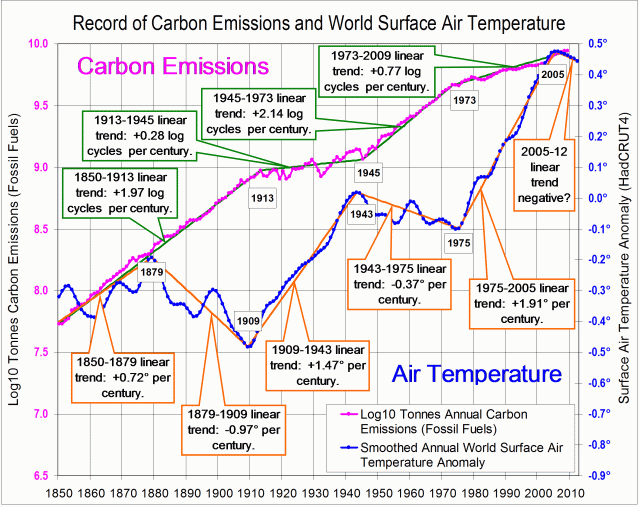
Logs of smoothed world and local temperatures. (25/7/14)

This post updates a similar post that was based on data available in July 2011. I now have data from three more years.

World surface air temperature

The blue line shows how the air has warmed and cooled during the 21st century. It is based on GISS, which is one of three century-long records that estimate the surface air temperature of the whole earth. The other two are HadCRUT and NCDC.
Monthly values of GISS vary wildly, and I have smoothed them with a 37-month moving average. Ole Humlum uses 37-month smoothing in many graphs on his website.

The 37-month smoothing allows plotting only up to 18 months ago, in December 2012. As you see, the GISS air temperature anomaly (See Note 1.), when smoothed in this way, moves rather steadily in one direction for years at a time.

The world’s surface air warmed rapidly from early 2000 to late 2002, then warmed slowly to a peak in early 2006. This is the warmest the world surface air has been in hundreds of years. After that peak, the air cooled rapidly by two-thirtieths of a degree to a trough in late 2007. It warmed again slowly to a lower peak in early 2010, steadied for a year, then fell to a trough in January 2012 that was like the previous trough. The air warmed rapidly through 2012. Continue reading

Manilla NSW in Global Warming Context

Logs of smoothed world and local temperatures.

[I posted an Up-dated version of this graph in July 2014]

Up-to -date data on global temperature change can easily be down-loaded from Ole Humlum’s website “climate4you“.
Humlum favours sampling windows 37 months wide. For my own data at Manilla, NSW, I have always used windows about six months wide, which show up Australia’s vigorous Quasi-biennial oscillations of climate. I tried Humlum’s 37-month window on my data, with quite startling results, as shown in the graph above.

Humlum re-presents three records since 1979 of global monthly air surface temperature anomalies:
* HadCRUT3: by the (UK Met Office) Hadley Centre for Climate Prediction and Research, and the University of East Anglia’s Climatic Research Unit (CRU), UK.
* NCDC: National Climatic Data Centre, NOAA, USA.
* GISS: Goddard Institute for Space Studies, Columbia University, New York, NASA, USA.
When smoothed by a 37-month running average, these data sets give very similar results. I use the GISS data because it matches my data best.

The match is very good, particularly in the sharp fall from the maximum in April 2006 to the minimum in September 2007. Where my data begins in September 2000, both curves rise steeply from low values, but mine peaks in August 2001, more than a year before a corresponding peak in global temperature (September 2002). After that, there is a plateau, where the graphs rise together to the highest peak (April 2006).
The other global data sets, HadCRUT and NCDC, have temperature falling or steady along the 2002-2006 plateau.
There are two reasons for plotting my data on a separate axis (on the right). First, the reference periods are different: GISS uses 1951-1980, while I use the decade from April 1999. Second, temperature varies much more at a single station than in the average of many stations around the world. I use a scale six times larger.

It turns out that the cold time in Manilla in late 2007, which I had mentioned in several contexts, was a cold time world-wide.

Home-made thermometer screen

Giant Mixing Bowl Thermometer Screen

I am over the moon at getting agreement between data from my home-made thermometer screen and the best that world climatologists can do. It makes me inclined to believe some of the things they say.


This article and graph were posted on 18th August 2011 in a weatherzone forum: General Weather/ Observations of Climate Variation.