Manilla’s Droughts, 1884 to 1916

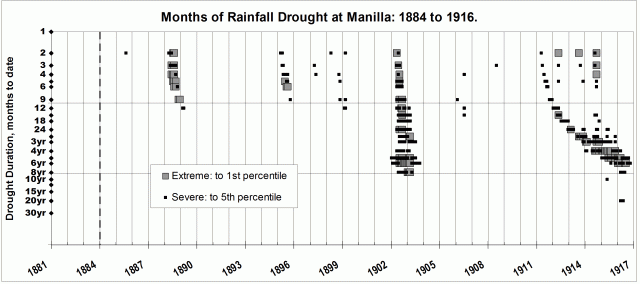
Graphical log of droughts, 1884 to 1916

The catastrophic droughts in 1902 and 1912-16 were quite different.

In the years before 1917 shown here, Manilla had several times of extreme drought. They came in 1888, 1895, 1902, and in a cluster that began in 1912.
(1.) The 1888 extreme droughts were of 2-, 3-, 4-, 5-, 6- and 9-month duration. The 2-month event was in August, and other events came later as they became longer, until the 9-month event came in December (having begun in April).
(2.) In 1895, drought was extreme only for durations of 5-months (June) and 6-months (July and August). Although droughts of 2-, 3-, 4-, and 9-month duration also occurred, they were not extreme, but merely “severe”.
(3.) Manilla’s 1902 (“Federation”) drought was phenomenal. Extreme droughts of nearly all durations from 2 months through to 96 months occurred (and ended) at practically the same time. The 2-month event plots at May 1902. The 96-month extreme drought plots at February-March 1903. None of the drought events around 1902 extended far into 1903; all ceased abruptly. The rainfall shortages began earlier according to a simple pattern; the longer the duration of the extreme event, the earlier it began. The 1902 extreme 1-year drought began in September 1901, and the extreme 8-year drought began in 1895.
(4.) The cluster of drought events extending through 1912 and 1916 was as bad as the events of 1902, but quite different. Merely “severe” short-duration events began in April 1911. Events of increasing duration came at later dates, forming a smooth curve on the graph. Beyond 12-month duration, and up to 72-month duration, there were extreme events at nearly all classes of duration. By the 72-month duration, the date of plotting had drifted forward in time to January-July 1916. The beginning of these 72-month events would have been during Continue reading

Ranked Hot and Cold Days

Graphs like this show how the trends of temperature differ between the coldest days (or nights) of the year, the hottest ones, and all those ranked in between.

This first post on this topic is a “sampler” of Manilla data that I will present. It compares my first 9-year period March 1999 to February 2008 with the 9-year period September 2003 to August 2012, four and a half years later.

Graphs showing trends of temperatures for ranked days.

All the days (or nights) of the year are arranged from the coldest on the left to the hottest on the right. Columns show by how much the day or night of that rank has trended warmer or cooler during the nine years. (See also Notes below.)

1. Days
In the earlier period (blue), most winter days and a few mid-summer days cooled at 0.1 to 0.2 degrees per year. Days in spring and autumn, and cooler days in summer warmed at less than 0.1 degrees per year.
In the later period (red), all days of the year cooled, but there was a gradient from no cooling in midwinter to extremely rapid cooling (more than 0.3 degrees per year) in midsummer.

2. Nights
In the earlier period (blue), nights in the warmer half of the year, and in midwinter warmed at about 0.1 degrees per year. There was no warming either in midsummer or in the warmer part of winter.
In the later period (red), it was now in the cooler half of the year that nights warmed at about 0.1 degrees per year. Nights in the warmer part of summer cooled more and more rapidly as they approached midsummer, where the cooling rate was 0.25 degrees per year.
[The 50-year average warming of this part of australia is 0.015 degrees per year. That is, less than two tick-marks on the y-axis.]


Prior postings

This graph and its commentary appeared as a post in “weatherzone” forums on 25/10/12:

Continue reading

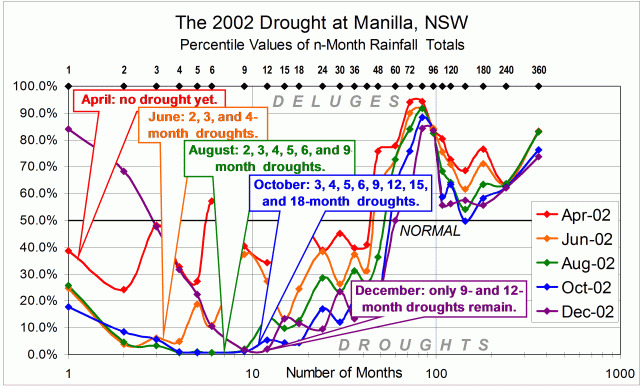
The 2002 rainfall shortages at Manilla

Graph of monthly percentile rainfall in a drought

In 2002, Manilla had a 6-month drought with one of the most extreme rainfall shortages on record. In nearly fifty years since 1966 there have been no other shortages like it.

I have discussed this drought in two posts: “Profile of an Extreme Drought”, and 3-year trends to August 2004 (An extreme 1-year drought).

[For an update on the longer and more extreme drought of 2018-19, see the note below.]

This post is about the rainfall record only. It compares the percentile values of rainfall totals for groups of months: one month, two months, and so on. The graph shows how the drought began, developed and faded. Other droughts may go through similar stages. I have plotted the pattern of rainfall shortages month by month, showing only even-numbered months. I have plotted them in different colours, with matching “Call-out” labels.

April 2002 (Red): no drought yet.
In April, the monthly rainfall was slightly below average: in the 40th percentile. In this month, nearly all rainfall totals up to the 42-month total were also below average. Only the 6-month total was above average. This set up the conditions for a drought. Notice that rainfall totals for periods longer than 42 months were all well above average. This hardly changed at all in this year. There had been a lot of rain in previous decades.

June 2002 (Orange): 2, 3, and 4-month droughts.
When May rainfall was in the 1st percentile and June rainfall in the 25th percentile, the June 2, 3, and 4-month totals became serious or severe shortages (below the 10th percentile).

August 2002 (Green): 2, 3, 4, 5, 6, and 9-month droughts.
With July rainfall again in the 1st percentile, and August rainfall in the 26th, the drought became extreme. The 4, 5, and 6-month totals were in the 1st percentile: few months had ever had such low figures.

October 2002 (Blue): 3, 4, 5, 6, 9, 12, 15, and 18-month droughts.
September and October both had rainfall in the 18th percentile. That relieved the short-term shortages somewhat, but not those in the medium term. Shortages in the 4, 5, and 9-month totals were in the 1st percentile, but the 6-month total was very much worse. At 76 mm, this 6-month total was the third driest on record, beaten only by August 1888 (43 mm) and September 1888 (69 mm).

December 2002 (Purple): only 9- and 12-month droughts remain.
November rainfall that was near average (40th percentile) and high December rainfall (84th percentile) broke the drought. Only some longer-term effects persisted as severe rainfall shortages in 9- and 12-month totals.

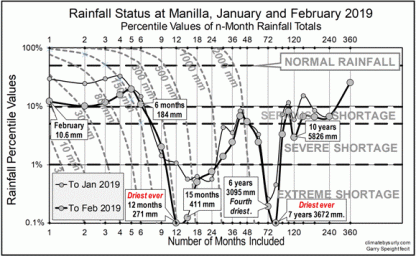
Rainfall status Jan-Feb 2019


Note added 2019.
Later such graphs in this blog have a logarithmic scale to distinguish the extreme rainfall shortages. Here is the one for the even more extreme drought of February 2019.

Hot Days and ENSO

Graphical log of max temps and hot days

More frequent hot days do not come in a three year cycle, but in a 1.5 year cycle related to ENSO.

The Hot Day data set

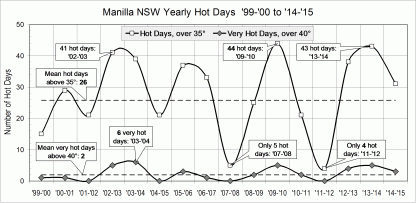
The graph of number of hot days per year

Log of annual hot days in 16 yearsThe graph on the left is one I posted earlier. The height of each data point represents the number of hot days in a year, plotted near January. The pattern of points led me to join them by a smooth curve. This curve swings up and down rather regularly, with five peaks and five dips in the fifteen years. That is, more frequent hot days seem to come in a three-year cycle.
Is this cycle “real”? Should we look for a cause? Will the cycle continue?
Probably not! The points of measurement are one year apart. Cycles that are only three years long may be “aliases” of different and shorter undetectable cycles. (See Note below on Nyquist frequency.)

More detailed hot day data

Other graphs already shown include further data: the number of hot days in each month, and the 13-year average number of hot days in each calendar month. From these I have calculated a relative frequency. That is, the ratio of the actual number to the average number for that month.
Only the months of November, December, January and February have enough hot days to calculate a relative frequency, but these can show changes within the hotter months of each year.

The daily maximum temperature data set

A graph that I posted in “El Niño and my climate” shows a curve of smoothed monthly means of daily maximum temperature anomalies. The yearly cycle of summer-to winter temperature has been removed. I have also applied a smoothing function, which makes the monthly points of measurement effectively two or three months apart. As a result, cycles longer than about six months can be detected.
There are about 10 peaks and 10 dips in the 15.5 year curve. They define a cycle of about 1.5 years wavelength. That cycle is so much longer than the minimum-detectable six month cycle that “aliasing” is not likely.
The reality of this temperature curve is supported by its close similarity to the recognised curve of the El Niño – Southern Oscillation (ENSO), as read from NINO3.4 Pacific Ocean sea surface temperature anomalies.

A combined graph of hot day and temperature data

The graph at the top of the page presents the monthly smoothed maximum temperature anomaly again, using the scale at the left. To this I have added data on the number and frequency of hot days.
The annual number of hot days is shown in blue, in blue boxes. The boxes are placed higher or lower according to the number, but the height is adjusted to match other data better.
A “Hot Day Index” is shown by blue diamonds. This index is based on the relative frequency of hot days in each month that has data.  I have re-scaled the values to improve the match. (See Note on Re-scaling below.)

Matching hot days with temperature

Continue reading

El Niño and My Climate

ENSO and Manilla NSW temperature anomalies over sixteen years

Temperature

The first graph shows that the temperature at Manilla NSW agreed very closely with El Niño and La Niña temperatures for a good part of the last sixteen years.
The El Nino – Southern Oscillation (ENSO) is shown by NINO3.4 monthly anomaly values, and temperature at Manilla, NSW is smoothed monthly mean daily maximum temperature anomalies. (See the Note below.)
Values of Manilla temperatures agree with those of ENSO through the major temperature peaks and troughs in the spring seasons of 2002, 2006, 2007, 2009, and 2010. In the two highest peaks of 2002 and 2009 and the deep trough of 2010, Manilla temperature extremes were more than a month ahead of ENSO temperature extremes.
Since mid-2011, the two curves do not agree well:
* A La Nina in summer 2011-12 that was very weak produced the deepest of all troughs in Manilla temperature.
* An El Nino in winter 2012 resulted in heat at Manilla, but not until four months later.
* In spring 2013, when there was no El Nino at all, Manilla had a heat wave just like those with the El Nino’s of 2002 and 2009, .
The record for ENSO since January 2013 is unlike that earlier this century: it flutters rather than cycles.
To show slower changes, I have drawn cubic trend lines for both of the variables. These also agree closely, with ENSO going from a maximum (2004) to a minimum (2011) seven years later. Manilla temperature trends remained ahead of ENSO temperature trends by one or two years.

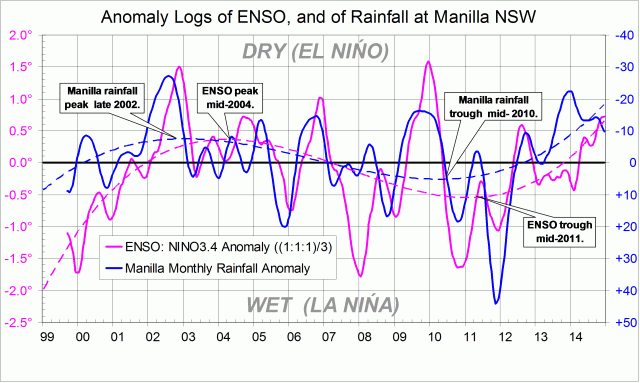
Rainfall

ENSO and Manilla NSW rainfall anomalies over sixteen years.

Continue reading