
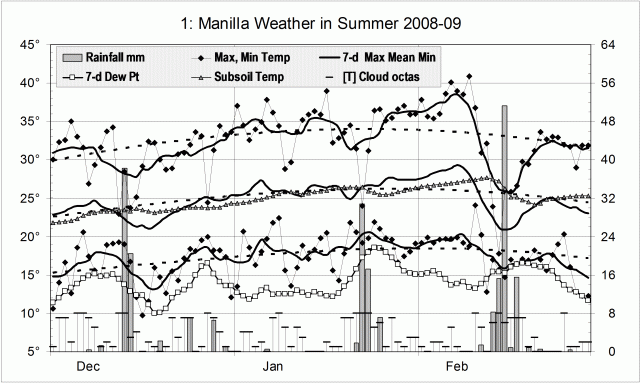
For most of the summer, 7-day average temperatures got steadily warmer. From 4° below normal in mid-December they rose to 4° above normal in early February. They then crashed to 5° below normal before recovering. Two days exceeded 40°: February 6th (40.1°) and February 9th (40.9°). In ten summers, 19 days have exceeded 40°, the hottest being 42.0° on 21/2/04.
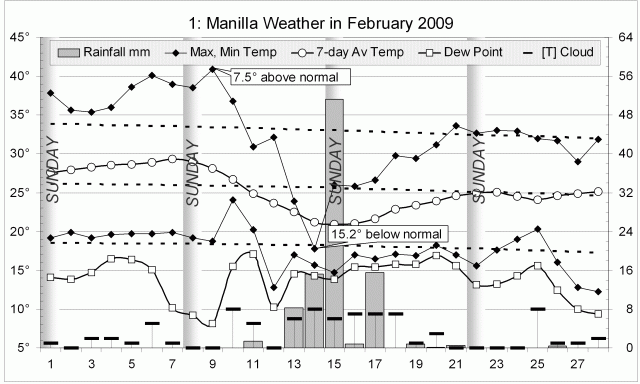
This season had the coldest summer day so far this century: February 14th 2009, with 17.8°. That is 15.3° below normal (it would be normal in winter, not summer)!
NOTE. This is the daily maximum reading that is furthest below normal in the ten-year record from March 1999. There have been only 23 days when the maximum was more than 10° below normal. Only 18 days were more than 8° above normal. The furthest above normal (by 10.5°) was the reading of 38.8° on November 10th 2002.
Humidity was low both in the early cool spell and in the later hot spell. At both times the daily range of temperature was high (17°) and the skies mainly clear.
There were 23 rain days, which is normal and far fewer than the 33 rain days last summer. Dry spells (with falls less than 1 mm) were long: 21 days from the 30th of December, and 16 days from the 25th of January. February the 15th was the wettest day, with 51.2 mm, and the summer total was 228 mm.
The number of overcast mornings (12) was normal for summer, but the number of cloud-free mornings (17) was very low, as it was last summer (13).
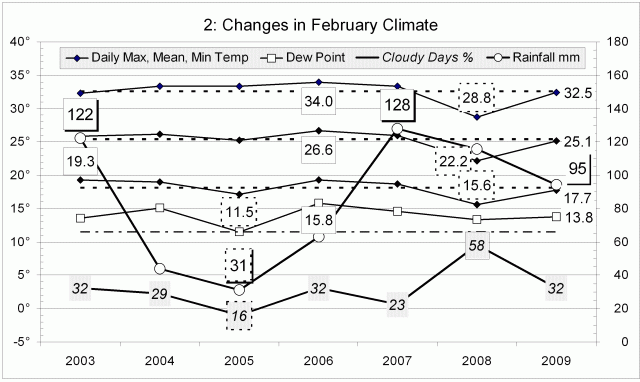
All mean temperatures (daily maximum, mean, and minimum) were normal this summer. They were much higher than last summer, with the daily maximum a remarkable 2.8° higher. The mean morning Dew Point was also normal.
The total rainfall of 228 mm is very close to the long-term summer average of 227 mm. It is on the 54th percentile.
At 38% cloudy mornings, this summer was cloudy, but not extremely cloudy like last summer (53%).
The summers of 05-06 and 07-08 were both very wet (319 mm and 311 mm). They differed in other ways: summer 05-06 was hot, humid and not cloudy; summer 07-08 was cold, not humid, and extremely cloudy.

Data. Rainfall data is from Manilla Post Office, courtesy of Phil Pinch. Dew Point values before August 2005 are from Tamworth Airport 6am data supplied by the Bureau of Meteorology. Temperature and other data are from 3 Monash Street, Manilla.
 climate by surly