March 2015 was hot

Photo of bird in a gum tree

Blue-faced honeyeater in a White Box tree

March had 5 hot days over 35°: more than January (2) or February (3), but less than December (7) or November (10!). On the 20th the temperature reached 40.0°, making it the hottest March day of the century, 10.2° above normal. It came in a warm spell, with a weekly mean temperature 3.6° above normal. Some days had extremely low humidity, with afternoon values below 10%. The morning dew point on the 28th, minus 4.2°, was the lowest March value.
There were five rain days, with the highest reading 22.0 mm on the 12th.
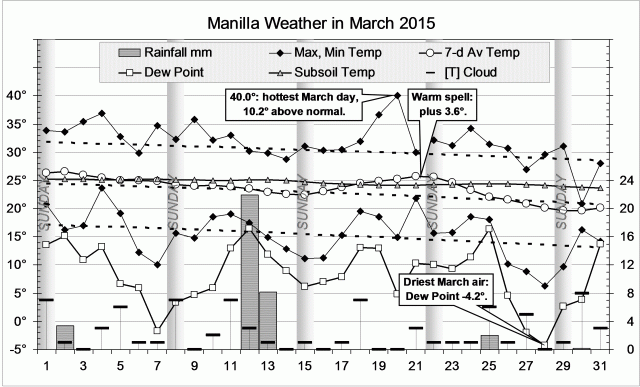
Weather log for March 2015

Comparing March months

The average daily maximum temperature, at 31.8°, was the hottest of any March in this short record. It was almost the same as in each of the months of this summer, but not as high as that of last November (33.9°). The daily mean temperature (23.6°) was also the highest for March, just beating the 23.4° of March 2000. Night temperatures were normal, making the daily temperature range wider than normal. The mean early morning dew point of 8.3° was a record low value.
The total rainfall of 35.8 mm, while well below the average of 53 mm, is quite normal. It is in the 46th percentile: nearly half of all March totals were lower. Among rainfall totals for more than one month, there is little change. Again, the only serious shortage is in the 24-month total, which is now in the 5th percentile.
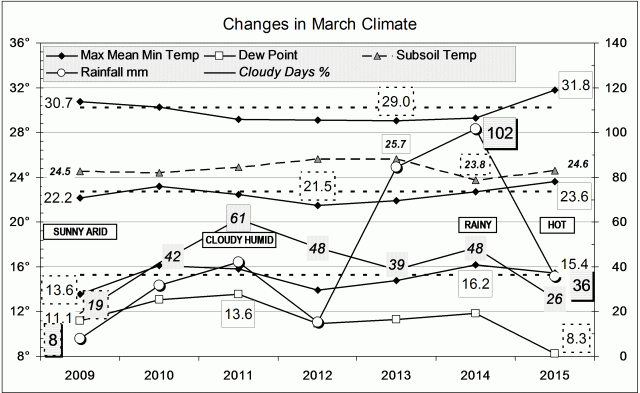
Climate for March 2015


Data. Rainfall data up to 26/3/15 is from Manilla Post Office, courtesy of Phil Pinch. Temperatures, including subsoil at 750 mm, and other data are from 3 Monash  Street, Manilla.
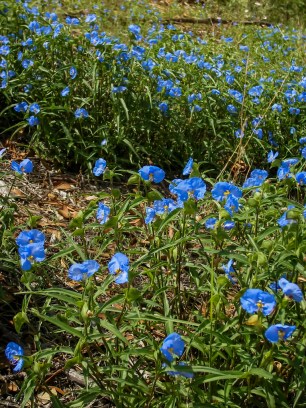
Summer 2014-15 on average

Wildflower photo

Commelina cyanea in Monash Street

This summer, January was no warmer than December or February, and none of these months was as warm as November! The number of hot days (over 35°) had a similar pattern that “sagged” in midsummer: Oct: 4 days; Nov: 10 days; Dec: 7 days; Jan: 2 days; Feb: 3 days; Mar: 2 days (in the first week). There were no very hot days over 40° this summer, although there had been three in spring.

A very cool spell from late January to early February had day and night temperatures 4.5° degrees lower than normal. Humidity was also low at that time and earlier, in mid-December.

Weather log for summer 2014-15

By most measures, this was a normal summer. Compared with the 21st century average, the daily maximum temperature and the daily temperature range were both just one degree low, and skies were a little more cloudy. The dew point (humidity) was low, but much higher than last summer.

The rainfall of 224 mm could hardly be more “normal”. It lies between the 125-year average of 227 mm and the 125-year median value of 221 mm. Summer rainfall totals like this also occurred in 2002-03 (227 mm) and 2008-09 (229 mm). Historically, summer rainfall totals in the “normal” range from 220 mm to 230 mm occurred in 1902-03, 1917-18, 1936-37, 1948-49, and 1957-58.

Climate for summer 2014-15.


Data. Rainfall data is from Manilla Post Office, courtesy of the Post-master, Phil Pinch. I thank Phil for his help over the years. When he retires this March, there is some uncertainty about the future of rainfall observations that have been maintained for 132 years since March 1883.

 Temperature, including subsoil at 750 mm, and other data are from 3 Monash Street, Manilla.

February 2015 a very dry month

Photo of a baby Kookaburra

Baby Laughing Kookaburra

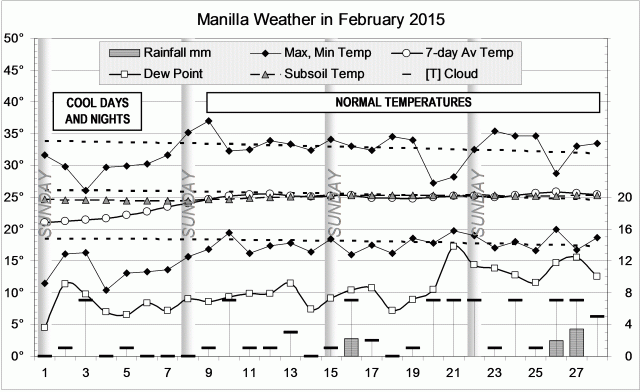
After a very cool first week, normal temperatures returned, both by day (33°) and by night (18°) . Early on, most mornings were sunny. Later, many were almost overcast, but only three days had light rain, with a maximum of 3.4 mm.

Weather log  February 2015

Comparing February months

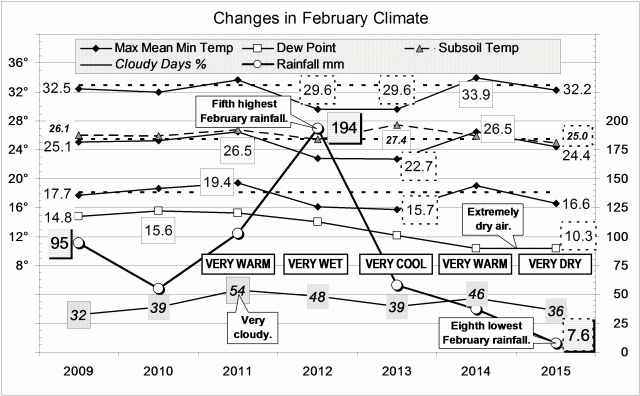
Most of the last seven February months have been unusual in some way. This month was very dry, with near-record low rainfall and very low humidity. By contrast, February 2012 was very wet, as well as very cool. Both 2011 and 2014 were very warm, but 2011 was also very cloudy and humid. February 2013 was the coolest, without being wet like 2012.
The total rainfall of 7.6 mm this month was very low (6th percentile): this was the 8th driest February, and the driest since 1989, which (like 1974) had 7.0 mm. Still, taking rainfall totals for groups of months, only the 24-month total (985 mm) is a serious shortage, in the 9th percentile.

Climate forFebruary 2015


Data. Rainfall data is from Manilla Post Office, courtesy of Phil Pinch. Temperatures, including subsoil at 750 mm, and other data are from 3 Monash  Street, Manilla.
With the retirement of the Post-master, Phil Pinch, the future of rainfall observations at Manilla Post Office (055031), kept for 132 years since March 1883, is uncertain.

January 2015: cool rainy days

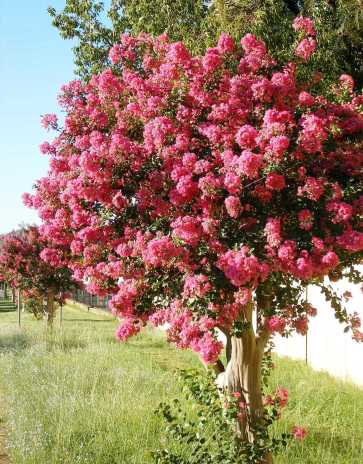
Crepe myrtle shrubs

Crepe Myrtles in Arthur Street

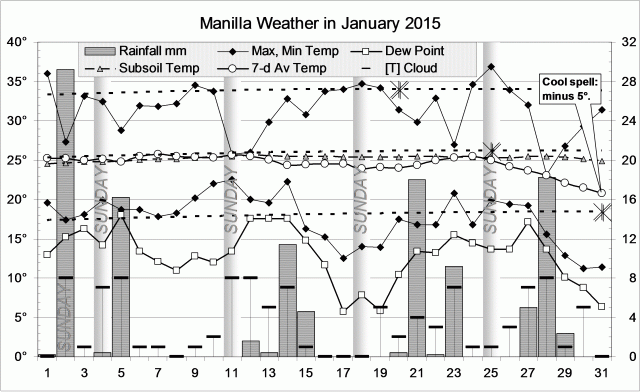
Only five days were warmer than average. The final five days and four nights were very cool, taking the weekly average (normally the hottest of the year) down to five degrees below normal. (This would be normal for the end of March, not January!) There were fifteen rain days, equalling the 125-year record number for January, set in 1941. Rain was spread evenly through the month, with the highest reading 29.2 mm on the 2nd.

Weather log January 2015

Comparing January months

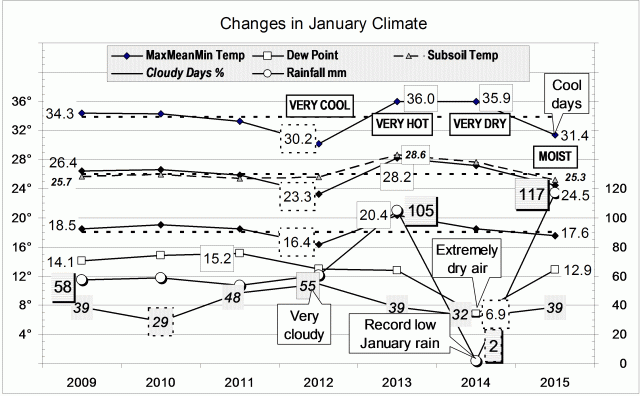
The mean daily maximum temperature (31.4°) was well below the average of 33.8°. Since nights, at 17.6°, were near normal, the daily temperature range was the record narrow value for January of 13.8°.
The dew point (humidity) returned to a normal value of 12.9°, after last January’s arid 6.9°. Subsoil temperature (25.3°) fell to normal after two January months above normal.
The total rainfall of 117.4 mm was in the 75th percentile, well above the average of 87 mm. This clears all shortages in rainfall totals for groups of months. The lowest percentile value remaining (15th) is for the 18 month total of 746 mm.

Climate for January 2015


Data. Rainfall data is from Manilla Post Office, courtesy of Phil Pinch. Temperatures, including subsoil at 750 mm, and other data are from 3 Monash  Street, Manilla.

December 2014 rainy with warm nights

Photo of a rain-shower

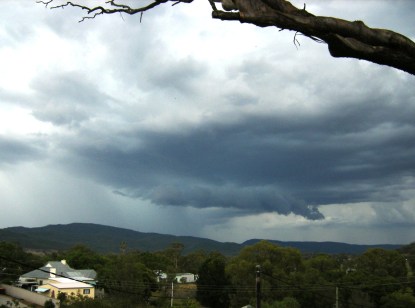
A shower on Mt Baldwin

Few days or nights were unusually warm or cool, except for a very cold day on the 28th. Thunderstorm clouds were often seen, but only a few yielded any rain. Later, overcast skies brought steady rain recorded on the 27th (25.2 mm) , 28th (11.2 mm) and 29th (12.6 mm). There were fourteen rain days: twice the usual number.

Weather log December 2014

Comparing December months

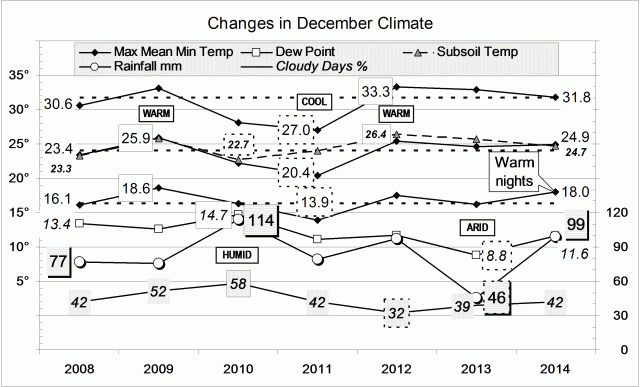
The mean daily maximum temperature (31.8°) was normal, but the mean daily minimum temperature (18.0°) was very high (Very warm nights!), just below the record of 18.6° set in 2009.
Subsoil temperature (24.7°) fell to normal after two Decembers above normal.
The total rainfall of 99.0 mm was in the 72nd percentile, well above the average of 74 mm. This clears most of the shortages in rainfall totals for groups of months. Two serious shortages remain: the nine month total of 306 mm is in the 8th percentile, and the eighteen month total of 659 mm is in the 6th percentile.

Climate for December 2014

The Year 2014

This year had the warmest nights (11.34°) of the new century. Although the days, at 26.67°, were cooler than in 2002 (26.72°), this year had also the warmest mean temperature: 19.01°. The second-warmest, at 18.85°, was 2009 and the coolest, at 17.19°, was 2008.
The subsoil temperature: 20.5°, fell back to near average.
In the year, 39% of the mornings were cloudy (more than four octas of cloud). This is close to the recent average (40%) for 2007 to 2014, but much more cloudy than the earlier average (26%) for 2000 to 2006.
The rainfall, 447 mm, was second lowest in the new century, after 2002 (366 mm). In the long-term rainfall record, this is a serious, but not severe deficiency: it is in the 8th percentile.


Data. Rainfall data is from Manilla Post Office, courtesy of Phil Pinch. Temperatures, including subsoil at 750 mm, and other data are from 3 Monash  Street, Manilla.