
Warm and Very Dry
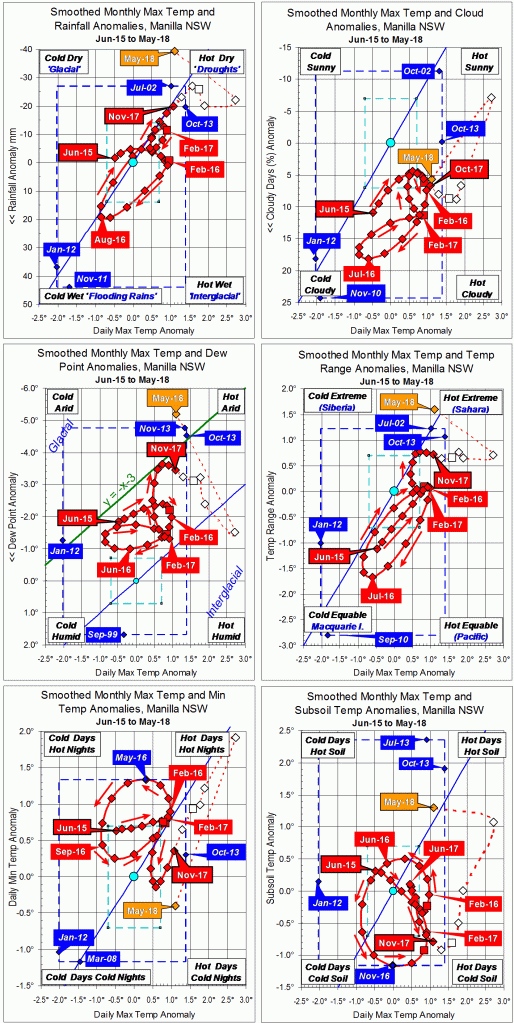
May raw anomaly data (orange)
The raw maximum temperature anomaly for May 2018 was rather high, as was that of the subsoil. The anomaly of daily minimum temperature was low. Very low moisture was shown by the rainfall, daily temperature range, and dew point anomalies, but cloudiness was normal.
Fully smoothed data (red)
Fully-smoothed data are now available for the spring months (SON) of 2017. In that season, all three temperatures were within their normal range. Both air temperatures were rising, but subsoil temperature was falling.
Rainfall was moving up the graph to less than normal (i.e. arid). The other three moisture measures were moving down their graphs towards humidity: cloudiness more than normal (i.e. humid), dew point still less than normal (i.e. arid), and daily temperature range still wider than normal (i.e. arid).
Note:
Fully smoothed data – Gaussian smoothing with half-width 6 months – are plotted in red, partly smoothed data uncoloured, and raw data for the last data point in orange. January data points are marked by squares.
Blue diamonds and the dashed blue rectangle show the extreme values in the fully smoothed data record since September 1999.
Normal values are based on averages for the decade from March 1999.* They appear on these graphs as a turquoise (turquoise) circle at the origin (0,0). A range of anomalies called “normal” is shown by a dashed rectangle in aqua (aqua). For values in degrees, the assigned normal range is +/-0.7°; for cloudiness, +/-7%; for monthly rainfall, +/-14 mm.
* Normal values for rainfall are based on averages for the 125 years beginning 1883.

 climate by surly