3-year trends to September 2014

Parametric plots of smoothed climate variables at Manilla
“September 2014 had little rain”
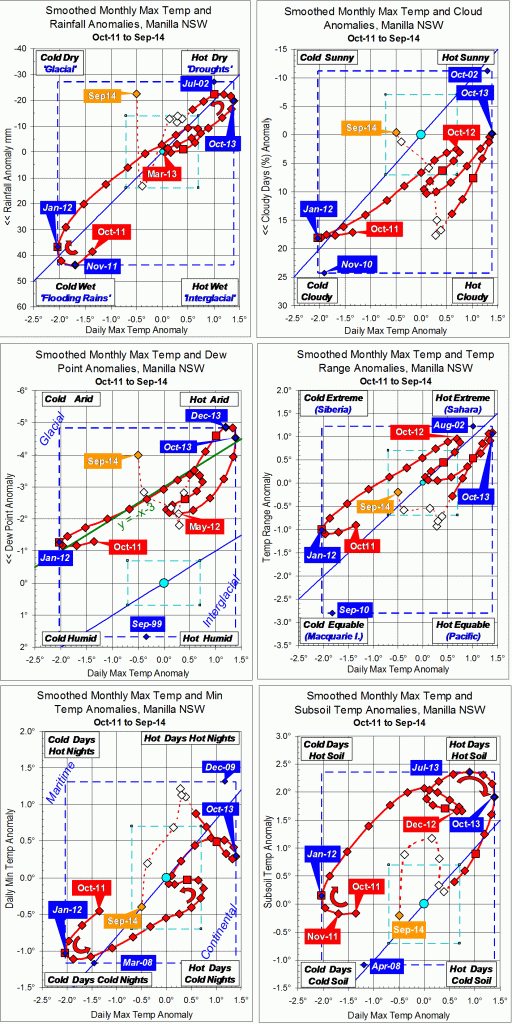
Trends to September 2014

 September data (orange)

Most raw anomaly values for September remained on the cool-moist side of normal. However. both rainfall and dew point were again well below normal.

Fully smoothed data (red)

The latest fully-smoothed data (March 2014) continued the trends established in summer. All were moving away from drought, except for daily minimum temperature. That is, nights were becoming very warm.


Note:

Fully smoothed data – Gaussian smoothing with half-width 6 months – are plotted in red, partly smoothed data uncoloured, and raw data for the last data point in orange. January data points are marked by squares.
Blue diamonds and the dashed blue rectangle show the extreme values in the fully smoothed data record since September 1999.

Normal values are based on averages for the decade from March 1999. They appear on these graphs as a turquoise (turquoise) circle at the origin (0,0). A range of anomalies called “normal” is shown by a dashed rectangle in aqua (aqua). For values in degrees, the assigned normal range is +/-0.7°; for cloudiness, +/-7%; for monthly rainfall, +/-14 mm.
 

3-year trends to August 2014

Parametric plots of smoothed climate variables at Manilla
“August 2014 back to normal”

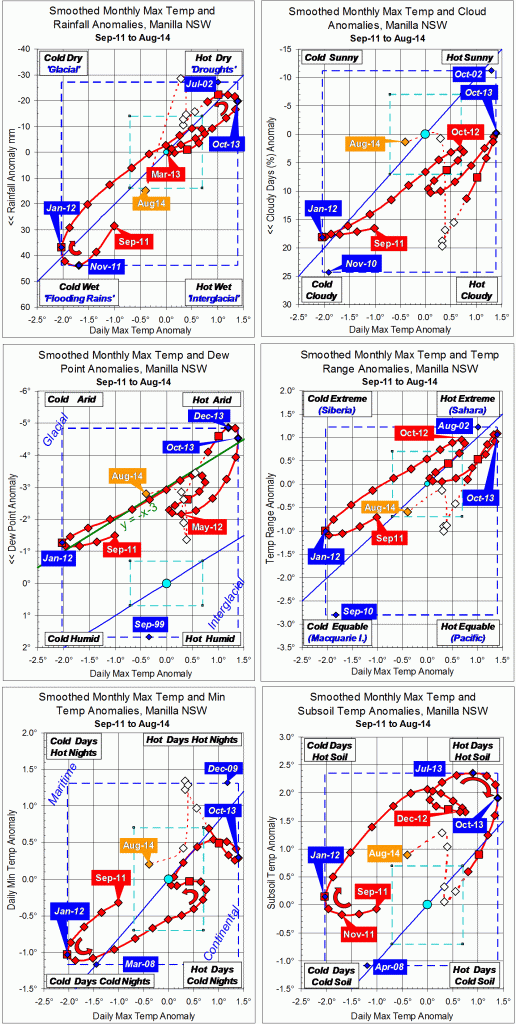
Trends to August 2014

 August data (orange)

Most raw anomaly values for August have returned to near normal. The daily maximum temperature anomaly has finally fallen below normal and rainfall has risen above normal. The dew point anomaly remains well below normal, but its value is on the (green) trend line that has applied during the last three years.

Fully smoothed data (red)

Fully-smoothed data is now available for the summer season ending in February 2014. During the summer all variables except daily minimum temperature moved decisively away from drought. Rainfall increased rather slowly, but cloudiness increased very rapidly, and daily temperature range fell very rapidly.

The hot-arid climatic peak (drought) of spring 2013

Extreme anomaly values of climate variables came in the following order:

Highest minimum temperature (not high): July;
Highest subsoil temperature (extreme): July;
Widest temperature range (very wide): October;
Highest maximum temperature (extreme): October;
Least cloudiness (normal): October;
Lowest dew point (extreme): December;
Lowest rainfall (very low): December-January.

This is not the order that is typical in recent extreme episodes. The smoothed rainfall anomaly minimum of -22.3 mm (not nearly as low as the -27.1 mm of July 2002) came much later than the peak of daily maximum temperature. On the top left graph the trace curved anti-clockwise, which is unusual.


Note:

Fully smoothed data – Gaussian smoothing with half-width 6 months – are plotted in red, partly smoothed data uncoloured, and raw data for the last data point in orange. January data points are marked by squares.
Blue diamonds and the dashed blue rectangle show the extreme values in the fully smoothed data record since September 1999.

Normal values are based on averages for the decade from March 1999. They appear on these graphs as a turquoise (turquoise) circle at the origin (0,0). A range of anomalies called “normal” is shown by a dashed rectangle in aqua (aqua). For values in degrees, the assigned normal range is +/-0.7°; for cloudiness, +/-7%; for monthly rainfall, +/-14 mm.


3-year trends to July 2014

Parametric plots of smoothed climate variables at Manilla
“July 2014 dry again”

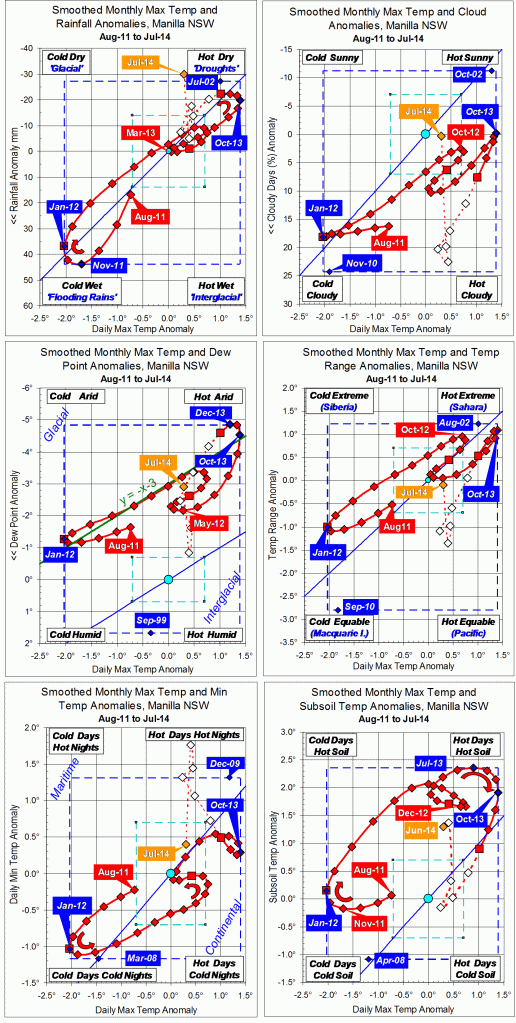
Trends to July 2014

 July data (orange)

Most raw anomaly values for July have now moved back to be like the smoothed values during the summer drought. Very few of the partially-smoothed values during the last few months suggested a trend in this direction.

Fully smoothed data (red)

January 2014 is now the latest fully-smoothed data point. Through November, December and January all variables moved decisively away from drought, except for rainfall and daily minimum temperature. In those months, rainfall remained near a (drought) minimum. Daily minimum temperature (which has a cryptic relation to drought) increased, bringing very warm nights in autumn.


Note:

Fully smoothed data – Gaussian smoothing with half-width 6 months – are plotted in red, partly smoothed data uncoloured, and raw data for the last data point in orange. January data points are marked by squares.
Blue diamonds and the dashed blue rectangle show the extreme values in the fully smoothed data record since September 1999.

Normal values are based on averages for the decade from March 1999. They appear on these graphs as a turquoise (turquoise) circle at the origin (0,0). A range of anomalies called “normal” is shown by a dashed rectangle in aqua (aqua). For values in degrees, the assigned normal range is +/-0.7°; for cloudiness, +/-7%; for monthly rainfall, +/-14 mm.


Manilla in Global Warming Context: II

Logs of smoothed world and local temperatures. (25/7/14)

This post updates a similar post that was based on data available in July 2011. I now have data from three more years.

World surface air temperature

The blue line shows how the air has warmed and cooled during the 21st century. It is based on GISS, which is one of three century-long records that estimate the surface air temperature of the whole earth. The other two are HadCRUT and NCDC.
Monthly values of GISS vary wildly, and I have smoothed them with a 37-month moving average. Ole Humlum uses 37-month smoothing in many graphs on his website.

The 37-month smoothing allows plotting only up to 18 months ago, in December 2012. As you see, the GISS air temperature anomaly (See Note 1.), when smoothed in this way, moves rather steadily in one direction for years at a time.

The world’s surface air warmed rapidly from early 2000 to late 2002, then warmed slowly to a peak in early 2006. This is the warmest the world surface air has been in hundreds of years. After that peak, the air cooled rapidly by two-thirtieths of a degree to a trough in late 2007. It warmed again slowly to a lower peak in early 2010, steadied for a year, then fell to a trough in January 2012 that was like the previous trough. The air warmed rapidly through 2012. Continue reading

3-year trends to June 2014

Parametric plots of smoothed climate variables at Manilla
“Climate normal for now”

Trends to June 2014

 June data (orange)

Raw anomaly values for June 2014 have nothing in common with the droughty conditions at the end of 2013. Daily maximum temperature and rainfall (top left graph) are both normal. A return to a moist climate, like that in spring 2011, shows as cloudy skies (top right), high dew point (mid left), and narrow temperature range (mid right). Daily minimum temperature (lower left) has moved independently to a high value (that is, very warm nights). Only subsoil temperature (lower right) has jumped back to warm 2013 values, after a period of normalcy.

Fully smoothed data (red)

December 2013 is now the latest fully-smoothed data point. It seems to mark the point of lowest rainfall and dew point anomalies in recent months. In other variables (except daily minimum temperature) December continued a retreat from recent extreme (drought) values.

Note:
Fully smoothed data – Gaussian smoothing with half-width 6 months – are plotted in red, partly smoothed data uncoloured, and raw data for the last data point in orange. January data points are marked by squares.
Blue diamonds and the dashed blue rectangle show the extreme values in the fully smoothed data record since September 1999.

Normal values are based on averages for the decade from March 1999. They appear on these graphs as a turquoise (turquoise) circle at the origin (0,0). A range of anomalies called “normal” is shown by a dashed rectangle in aqua (aqua). For values in degrees, the assigned normal range is +/-0.7°; for cloudiness, +/-7%; for monthly rainfall, +/-14 mm.