Indoor versus Outdoor Maxima (1096 days)

Indoor-Outdoor maximum temperature scatter-plot

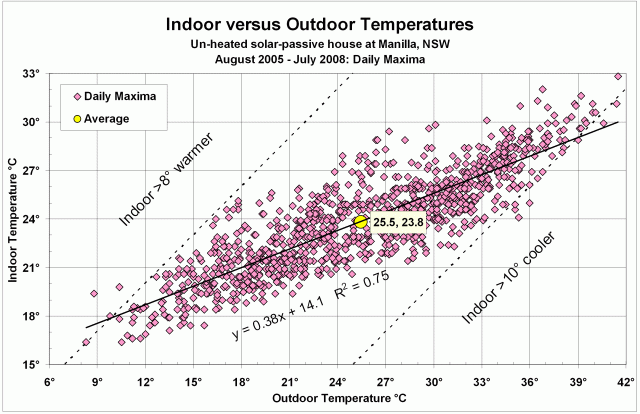
This scatter-plot shows only daily maximum temperatures, indoors and outdoors, and displays the average values. The Manilla average outdoor maximum of 25.5° is already comfortable, if a little on the warm side. The average indoor maximum of 23.8° is closer to the ideal.
While this solar-passive house scarcely changes the average maximum daily temperature, it drastically reduces the extremes. The slope of the linear regression line shows that indoor maxima vary only 38% as much as outdoor maxima. This results from effective insulation and daily and seasonal storage of heat and coolness in thermal mass material through the year. In addition, the house is well shaded in summer, and catches warmth from the sun mainly in winter.

Dashed lines to the left and right show how the indoor temperature on the hottest days is reduced by up to 10 degrees, while on the coldest days it is increased by up to 8 degrees.
This post is one of a set of four back-dated to June 2010:
Indoor versus Outdoor Temperatures (1096 days)
Indoor versus Outdoor Minima (1096 days)
Indoor versus Outdoor Maxima (1096 days) (This post.)
Indoor/Outdoor Regressions for Maxima and Minima


This article was originally posted in the weatherzone forum thread “Indoor Climate” on 7th June 2010. It is backdated here to 19th June 2010.
Indoor versus Outdoor Minima (1096 days)

Indoor-Outdoor minimum temperature scatter-plot

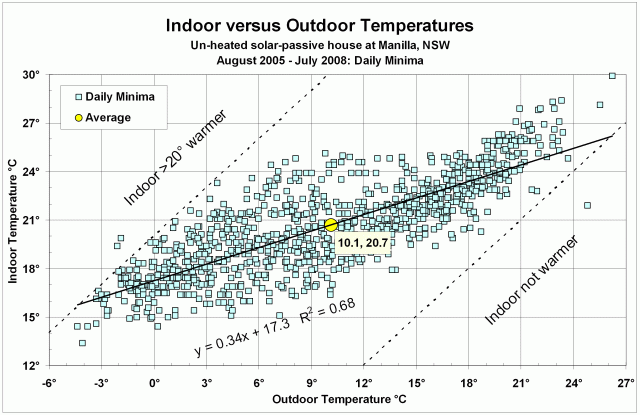
This scatter-plot shows only daily minimum temperatures, indoors and outdoors, and displays the average values. The Manilla average outdoor minimum of 10.1° is far too cold for comfort. Solar-passive design has raised the indoor minimum by 10.6° without applied heating. The indoor average minimum of 20.7° is near the middle of the comfort zone.

The slope of the linear regression line shows that indoor minima vary only 34% as much as outdoor minima. This results from effective insulation, daily and seasonal heat storage in thermal mass material, and warmth from the sun captured in winter.
A dashed line in the lower right shows that nearly all points have indoor minima warmer than outdoor minima. This is a disadvantage only on nights warmer than about 20 deg.

A dashed line in the upper left shows that many cold nights have indoor minima nearly 20° warmer than outdoors. One morning (9/5/06) the indoor temperature was 21.8° warmer than outdoors. Could this be a record for an unheated house?  Such large over-temperatures come with very dry air in autumn and early winter.

This post is one of a set of four back-dated to June 2010:
Indoor versus Outdoor Temperatures (1096 days)
Indoor versus Outdoor Minima (1096 days) (This post.)
Indoor versus Outdoor Maxima (1096 days)
Indoor/Outdoor Regressions for Maxima and Minima

[For a more personal perspective, there are testimonials.]


This article was originally posted in the weatherzone forum thread “Indoor Climate” on 7th June 2010. It is backdated here to 17th June 2010.


Indoor versus Outdoor Temperatures (1096 days)

Indoor-Outdoor temperature scatter-plot

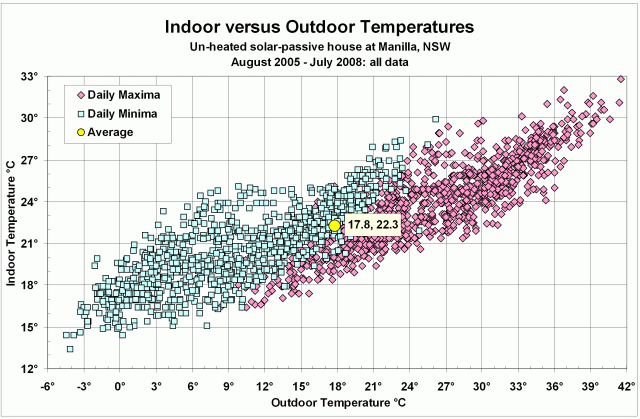
This is a scatter-plot of indoor and outdoor daily maximum and minimum temperatures for a solar-passive house in Monash Street, Manilla, NSW. The house is not heated or air-conditioned.

Data in this graph are taken from two thermometers; one in a Gill-type thermometer screen seven meters from the house (photo in Gallery), and one on a wall in a core room of the house. The data are for the first three years of good screen readings.

The graph shows that indoor temperatures vary only 42% as much as outdoor temperatures. The outdoor temperature range is 45.9° (from -4.4° to 41.5°), but the indoor temperature range is only 19.4° (from 13.4° to 32.8°). Most indoor temperatures are within the “adaptive comfort zone”. Average temperatures are 17.8° outdoors and 22.3° indoors. The house raises the indoor average by 4.5° to near the ideal for comfort.

There is a similar three-year scatter plot for a solar-passive house at Bonnyrigg, near Liverpool, Sydney in “Energy Efficient Housing for New South Wales” by Ballinger, Prasad and Cassell.
Very likely the data is in this paper by John Ballinger:
I think Ballinger’s scatter-plot for a house near Liverpool must include daily maxima and minima as mine does. His extreme outdoor points are 40° and +1° (range 39°) and extreme indoor points 32° and 12° (range 20°). In broad terms these two houses seem to yield similar levels of comfort, but the Manilla house does it in a more extreme climate. Manilla’s daily temperature range is 15.5°, while Prospect Reservoir, near Bonnyrigg, has only 10.9°.

This post is one of a set of four back-dated to June 2010:
Indoor versus Outdoor Temperatures (1096 days) (This post.)
Indoor versus Outdoor Minima (1096 days)
Indoor versus Outdoor Maxima (1096 days)
Indoor/Outdoor Regressions for Maxima and Minima


This article was originally posted in the weatherzone forum thread “Indoor Climate” on 5th June 2010. It is backdated here to 15th June 2010 and made sticky 9th July 2014.