
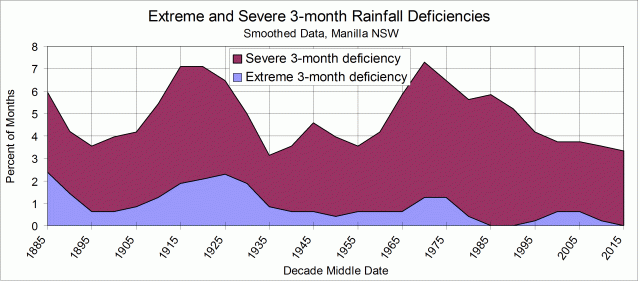
This is the first of four graphs that show Manilla’s history of rainfall deficiencies (rainfall droughts), for periods of duration 3 months, 12 months, 36 months, and 120 months.
This first graph includes those short periods of severe or extreme rainfall deficiency that last only three months. They are rainfall droughts for one season rather than for a year or more. Crops and pastures may fail.
In Manilla’s climate, a time of severe 3-month rainfall deficiency has a rainfall total less than 50 mm, when it normally would be 150 mm.
The graph shows that such short-term droughts have occurred in every decade, but more often in some than in others. These brief droughts were most common (in 7% of months) around 1915, 1920 and 1970. They were least common (in only 3% of months) around 1895, 1935, 1940, 1955, and (more recently) in the twenty years since 1995.
Extreme short-term droughts (3-month total less than 26 mm) were more common near those times when severe short-term droughts were more common.
Areas shown on the graph
Rainfall deficiencies are called “severe” when they are lower than are recorded for five percent of the months. I have called deficiencies “extreme” when they are lower than are recorded for one percent of the months.
In this graph, I have coloured extreme deficiencies in blue. The maroon colour is deficiencies that are severe, but not extreme. The top edge of the maroon area marks the proportion of severe deficiencies including extreme deficiencies. As an average, this line is at five percent.
 climate by surly