Decadal and Inter-decadal changes in rainfall: II.

Log of smoothed summer and winter rainfall anomalies.

Part 2 of 3: The record restricted to 1891-1982 (92 years)

(See Notes below for data and plotting details.)

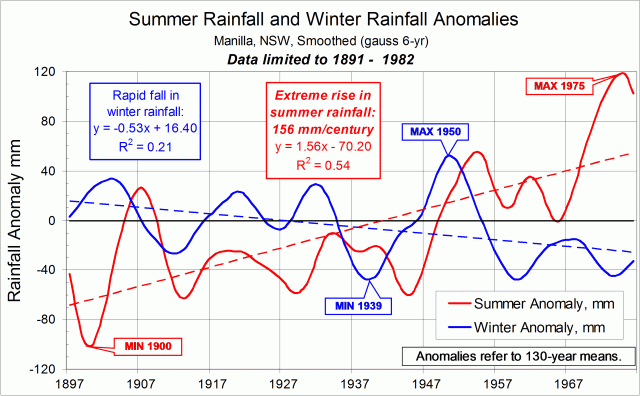
No climatic record is ever long enough to demonstrate apparent cycles, trends or extremes beyond doubt. In Part 1, a linear trend of summer rainfall rising at 24.7 mm per century was fitted to the whole 130-year record. Although this is a very high (perhaps unsustainable) rate of increase, the trend line explains hardly any of the variation. The R-squared value is 0.03! However, there does seem to be a steeper quasi-linear trend prevailing for most of the period of record. The graphs I have posted here show a restricted record beginning in 1891 and ending in 1982. This simulates an analysis done in 1983 (which could not have used more recent data) and supposes that records earlier than 1891 were unavailable for some reason.

I have chosen these dates so that
(i) the near-record smoothed summer rainfall maximum of 1891 is excluded but the record smoothed summer rainfall minimum of 1900 is included;
(ii) the record smoothed summer rainfall maximum of 1975 is included but the very low smoothed summer rainfall minimum of 1987 is excluded.
(Due to the smoothing window extending six years before and after a specified date, smoothed rainfall values can be calculated only from 1897 to 1976.)

Log of smoothed sum and difference of summer and winter rainfall anomalies.

Linear trends

For this restricted data set of 92 years, all four linear trends are very much steeper than for the whole 130-year record. The R-squared values are also much higher, indicating that the Continue reading
September Climate Anomalies Log

Heat Indicators log for September months

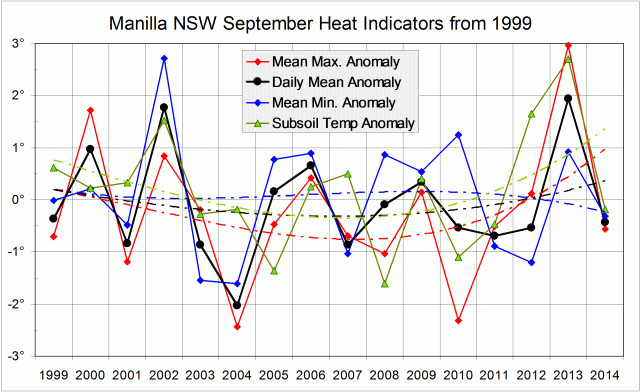
This post is the seventh in a set for the 12 calendar months that began with March. Graphs are sixteen-year logs of the monthly mean anomaly values of nine climate variables for Manilla, NSW, with fitted trend lines. I have explained the method in notes at the foot of the page.

Raw anomaly values for September

Extreme values of September anomalies in this period were all in the “Moisture Indicators” group:

Temperature range anomaly (minus) +3.6 deg: September 2010;
Cloudy days % anomaly +33%: September 2010;
Dew Point Anomalies (4) -3.8 deg: September 2011, -4.7 deg: September 2012, -4.9 deg: September 2013, -4.1 deg: September 2014.

Trend lines for September

Heat Indicators

The trend of daily maximum temperature anomalies was concave, with a minimum at 2007. The trend of mean temperature anomalies was similar, but less concave. The trend of minimum temperature anomaly was almost straight, but had a weak maximum in 2008 and ended low. The subsoil temperature anomaly trend was parallel to that of the daily maximum, but higher.

Moisture Indicators log for September months

Continue reading

Decadal and Inter-decadal changes in rainfall: I.

Log of smoothed summer and winter rainfall anomalies.

Part 1 of 3: The whole 130-year record

(See Notes below for data and plotting details.)

Anomalies of smoothed summer and winter rainfall

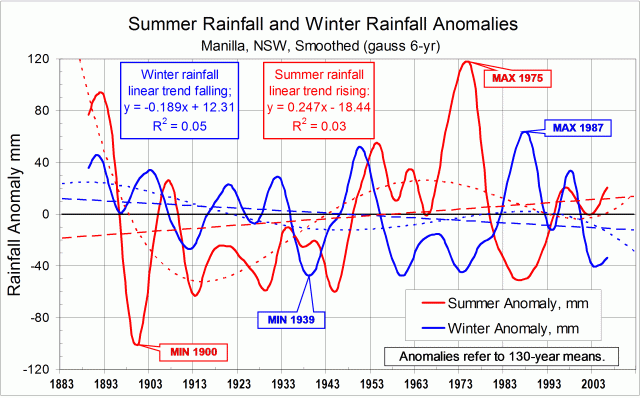
Episodes of high or low summer rainfall do not coincide with those of winter rainfall (except in 1891). Nor do they consistently oppose each other, although this is common. The summer rainfall anomaly (red) was extremely low (-101 mm) about 1900, and extremely high (+119 mm) about 1975. The winter rainfall anomaly (blue) had lower extreme values: 1939 (-48 mm) was the lowest of several low values, and 1987 (+63 mm) the highest of several high ones.

Seasonal sums and differences

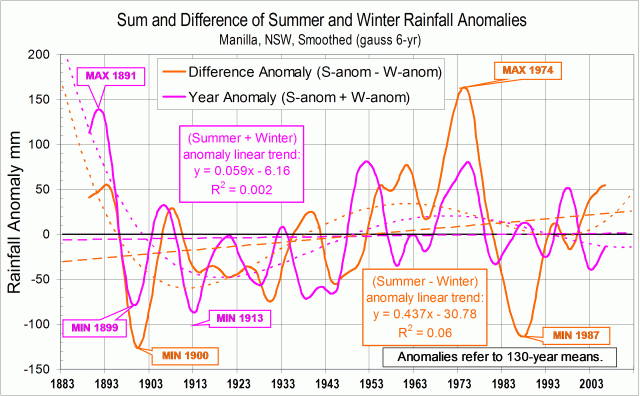
I plotted the smoothed yearly value of rainfall anomaly as the sum (purple) of a winter anomaly value and that of the following summer. There was an extreme maximum in 1891 (+139 mm!), and minimal values in 1899 (-79 mm) and 1913 (-87 mm), among others.
The difference between summer and winter seasonal anomalies (orange) shows as an extreme summer excess in 1974 (+163 mm), and extreme winter excesses in 1900 (-126 mm) and 1987 (-114 mm).

Log of smoothed sum and difference of summer and winter rainfall anomalies.

“Dreadful Thirst”

Banjo Paterson’s comic verse “City of Dreadful Thirst” refers to the town of Narromine, 300 kilometres west of Manilla.
Continue reading

August Climate Anomalies Log

Heat Indicators log for August months

This post is the sixth in a set for the 12 calendar months. Graphs are sixteen-year logs of the monthly mean anomaly values of nine climate variables for Manilla, NSW, with fitted trend lines. I have explained the method in notes at the foot of the page.

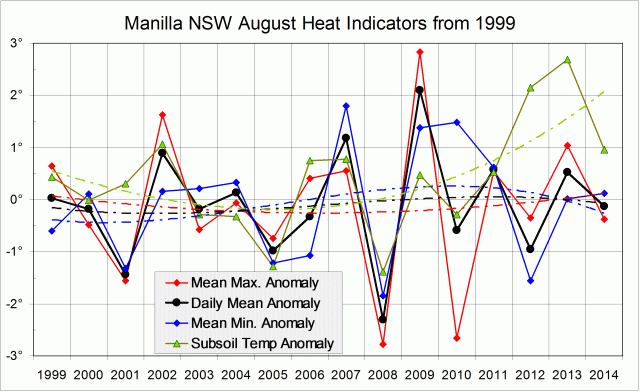
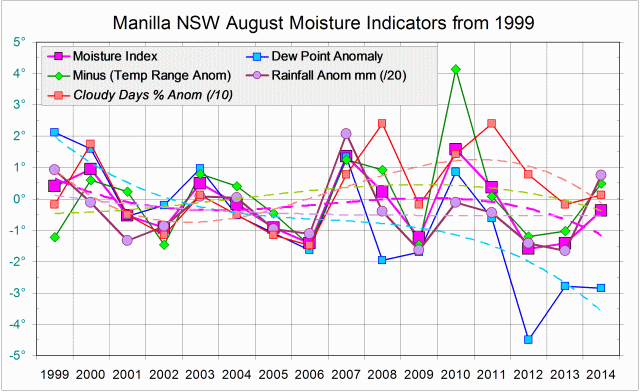
Raw anomaly values for August

Extreme values of August anomalies in this period were:

Temperature range anomaly (minus) +4.1 deg: August 2010;
Dew Point Anomaly -4.5 deg: August 2012.

Trend lines for August

Heat Indicators

The trend of mean temperature anomalies was almost constant. The trend of daily maximum temperature anomalies was almost constant, but had a weak minimum at 2007. The trend of minimum temperature anomaly had a weak minimum in 2001 and a weak maximum in 2010. The subsoil temperature anomaly trend ended very high, after a weak minimum in 2005.

Moisture Indicators log for August months

Continue reading

July Climate Anomalies Log

Heat Indicators log for June months

This post is the fifth in a set for the 12 calendar months. Graphs are sixteen-year logs of the monthly mean anomaly values of nine climate variables for Manilla, NSW, with fitted trend lines. I have explained the method in notes at the foot of the page.

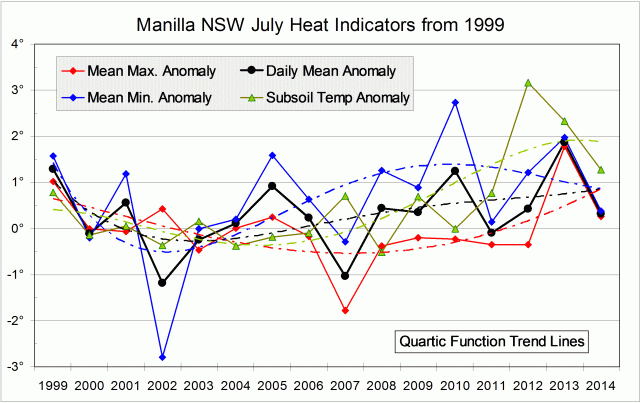
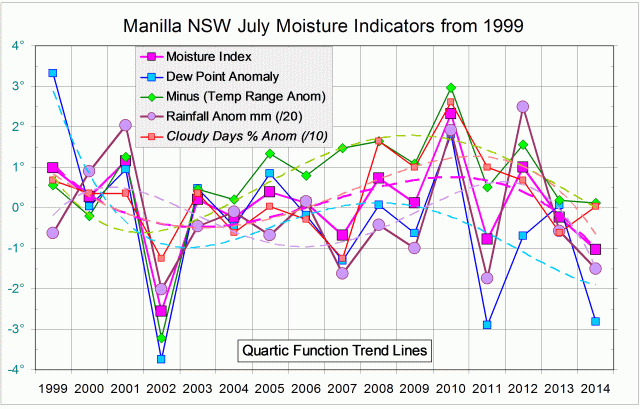
Raw anomaly values for July

Extreme values of July anomalies in this period were:

Subsoil Temperature anomaly +3.2 deg: July 2012;
Temperature range anomaly (minus) -3.2 deg: July 2002;
Dew Point Anomaly +3.3 deg: July 1999;
Dew Point Anomaly -3.8 deg: July 2002.

Trend lines for July

Heat Indicators

The trend of mean temperature anomalies fell below zero in 2003 then rose to +1 by 2014.
The trend of daily maximum temperature anomalies fell more slowly to -0.5 in 2007, then rose to meet the mean in 2014. The trend of minimum temperature anomaly reached an early minimum in 2002. It rose to a broad peak (+1.4) in 2010, then declined. The subsoil temperature anomaly trend was slightly low in 2004 and very high (+1.9) in 2013.Moisture Indicators log for July months

Continue reading