Manilla’s Droughts, 1884 to 1916

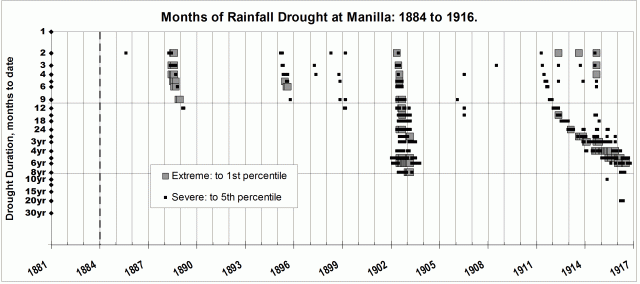
Graphical log of droughts, 1884 to 1916

The catastrophic droughts in 1902 and 1912-16 were quite different.

In the years before 1917 shown here, Manilla had several times of extreme drought. They came in 1888, 1895, 1902, and in a cluster that began in 1912.
(1.) The 1888 extreme droughts were of 2-, 3-, 4-, 5-, 6- and 9-month duration. The 2-month event was in August, and other events came later as they became longer, until the 9-month event came in December (having begun in April).
(2.) In 1895, drought was extreme only for durations of 5-months (June) and 6-months (July and August). Although droughts of 2-, 3-, 4-, and 9-month duration also occurred, they were not extreme, but merely “severe”.
(3.) Manilla’s 1902 (“Federation”) drought was phenomenal. Extreme droughts of nearly all durations from 2 months through to 96 months occurred (and ended) at practically the same time. The 2-month event plots at May 1902. The 96-month extreme drought plots at February-March 1903. None of the drought events around 1902 extended far into 1903; all ceased abruptly. The rainfall shortages began earlier according to a simple pattern; the longer the duration of the extreme event, the earlier it began. The 1902 extreme 1-year drought began in September 1901, and the extreme 8-year drought began in 1895.
(4.) The cluster of drought events extending through 1912 and 1916 was as bad as the events of 1902, but quite different. Merely “severe” short-duration events began in April 1911. Events of increasing duration came at later dates, forming a smooth curve on the graph. Beyond 12-month duration, and up to 72-month duration, there were extreme events at nearly all classes of duration. By the 72-month duration, the date of plotting had drifted forward in time to January-July 1916. The beginning of these 72-month events would have been during Continue reading
April 2016 also warm

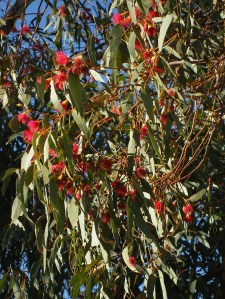
Photo of red flowers

Red flowering gum

In the whole month, only one day and seven nights were cooler than normal. Days and nights warmed together. Weekly average temperature was 4.1° above normal early in the month, and again 3.5° above normal at the very end.
Rain was recorded only on the 10th (5.8 mm) and the 11th (13.0 mm). While the early morning dew point was high only when it rained, the afternoon humidity was always high, falling below 30% only once.

Weather log for April 2016

Comparing April months

Daily maximum, minimum, and mean temperatures were all very high but not record values for April. The mean of 20.5° was beaten by 20.6° in April 2005. In that month, this month’s daily maximum (29.0°) was also beaten (29.5°). This month’s daily minimum (12.1°) was beaten by the record value of 12.2° set in 2014.
The subsoil temperature, and other variables were near normal.
The total rainfall of 18.8 mm was well below the average of 40 mm, in the 32nd percentile. However, for the sixth month in a row, there are no serious rainfall shortages for totals for any number of months. Now, the greatest shortage is the 48-month total of 2191 mm, which is in the 12th percentile. Ponds persist in Greenhatch Creek.

Climate for April 2016


Data. All data, including subsoil at 750 mm, are from 3 Monash Street, Manilla. Rainfall data up to 26/3/15 is from Manilla Post Office, Station 055031.

March 2016 had a warm dry spell

Photo of Pittosporum berries

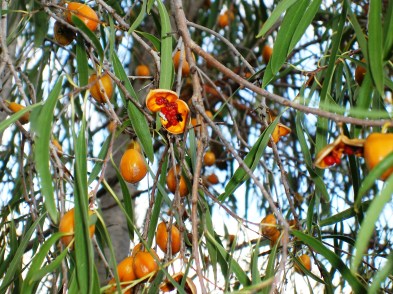
“Native Apricots”

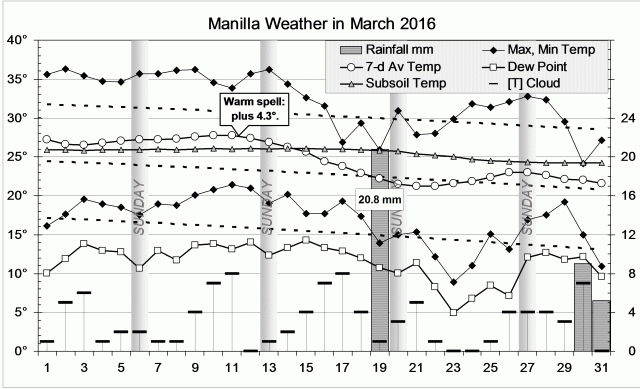
In the first half of March the average weekly temperature was more than three degrees above normal. Nine days had maxima above 35°, when the month usually has only one. However, no day reached 40°, as happened in March last year (20/03/15).
No rain fell in this time: the period of 43 days between February 4 and March 19 may have been the seventh longest rain-free period in 133 years. (No official record is now kept.)
Normal weather returned in the second half of the month. I recorded 20.8 mm of rain on the 19th, and further rain on the 30th and 31st.

Weather log for March 2016

Comparing March months

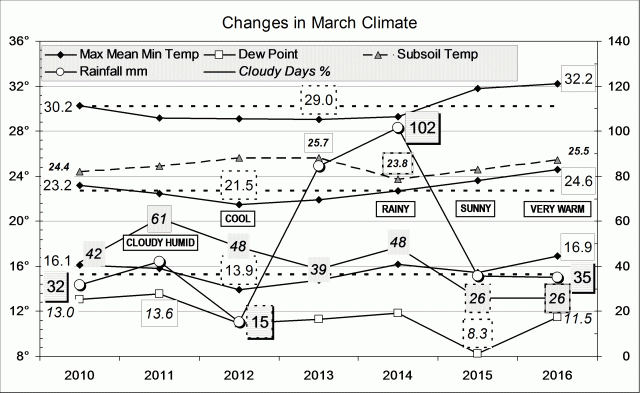
Despite the cool change, this was the warmest March of the new century. Daily maxima, minima, and means were all 2° above average. The subsoil temperature was also 1° high, as in March 2012 and 2013, but not as high as in 2007 (2° high).
This was not a dry month. The moisture indicators cloudiness, humidity, and (low) daily temperature range were just slightly on the dry side.
The total rainfall of 35mm was below the average of 53 mm, but in the 46th percentile, not far below the median. Again, there are no serious rainfall shortages for totals for any number of months. In fact, the five-month total of 362 mm is high, in the 81st percentile. Ponds persist in Greenhatch Creek.

Climate graph for March 2016.


Data. All data, including subsoil at 750 mm, are from 3 Monash Street, Manilla. Rainfall data up to 26/3/15 is from Manilla Post Office, Station 055031.

February 2016: hot, dry days

Photo of cooba blossom

Cooba in February

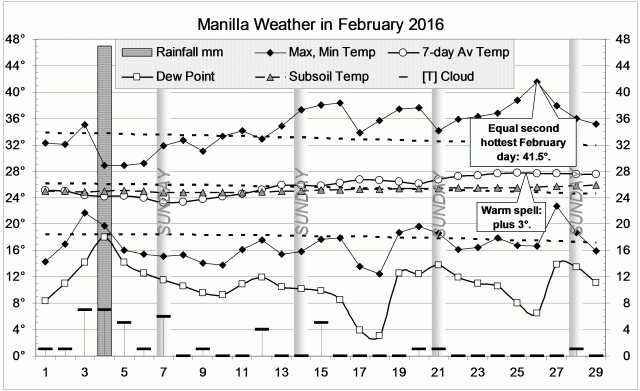
Weekly average temperatures began 2 or 3 degrees low, but ended with a long warm spell 3 degrees high, that extended into March. Days were especially hot, with the 26th reaching 41.5°, the equal second hottest February day. Nights were seldom very warm, and the early morning of the 26th was 25° cooler than the afternoon.
Few days were cloudy, none of them late in the month
Rain fell only on the 3rd, as three heavy showers of 7mm, 27mm and 13mm. The second shower, at 5pm, had the most intense rain of the new century: 27 mm in less than 27 minutes. Bureau of Meteorology data show that such a half-hour storm, yielding 1 mm of rain per minute, has only a 10% chance of happening here in any year. It is a “one in 10 year event”.

Weather log February 2016

Comparing February months

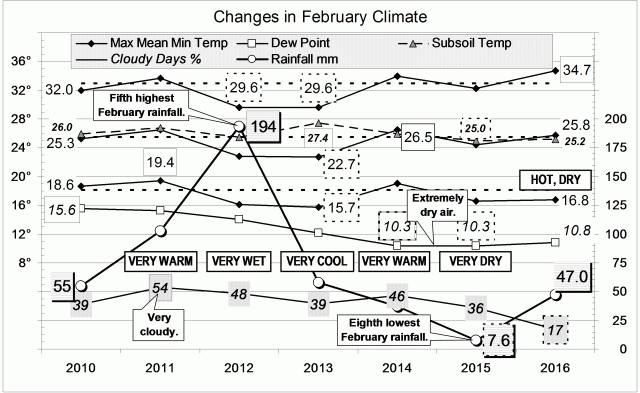
While the average temperature for the month (25.8°) was normal, the mean daily maximum, at 34.7°, was the hottest for February. A rather low mean daily minimum, (16.8°) made the daily temperature range a desert-like 17.9°. This is the widest February value, 3.5° wider than normal.
Other signs of dryness were the low early morning dew point (10.8°) and very few cloudy mornings (17%).
The total rainfall of 47mm was below the average of 67 mm, but right on the median 50th percentile: just half of all February months have been wetter. Again, there are no serious rainfall shortages for totals for any number of months.

Climate for February 2016


Data. All data, including subsoil at 750 mm, are from 3 Monash Street, Manilla. Rainfall data up to 26/3/15 is from Manilla Post Office, Station 055031.

Ranked Hot and Cold Days

Graphs like this show how the trends of temperature differ between the coldest days (or nights) of the year, the hottest ones, and all those ranked in between.

This first post on this topic is a “sampler” of Manilla data that I will present. It compares my first 9-year period March 1999 to February 2008 with the 9-year period September 2003 to August 2012, four and a half years later.

Graphs showing trends of temperatures for ranked days.

All the days (or nights) of the year are arranged from the coldest on the left to the hottest on the right. Columns show by how much the day or night of that rank has trended warmer or cooler during the nine years. (See also Notes below.)

1. Days
In the earlier period (blue), most winter days and a few mid-summer days cooled at 0.1 to 0.2 degrees per year. Days in spring and autumn, and cooler days in summer warmed at less than 0.1 degrees per year.
In the later period (red), all days of the year cooled, but there was a gradient from no cooling in midwinter to extremely rapid cooling (more than 0.3 degrees per year) in midsummer.

2. Nights
In the earlier period (blue), nights in the warmer half of the year, and in midwinter warmed at about 0.1 degrees per year. There was no warming either in midsummer or in the warmer part of winter.
In the later period (red), it was now in the cooler half of the year that nights warmed at about 0.1 degrees per year. Nights in the warmer part of summer cooled more and more rapidly as they approached midsummer, where the cooling rate was 0.25 degrees per year.
[The 50-year average warming of this part of australia is 0.015 degrees per year. That is, less than two tick-marks on the y-axis.]


Prior postings

This graph and its commentary appeared as a post in “weatherzone” forums on 25/10/12:

Continue reading