January 2015: cool rainy days

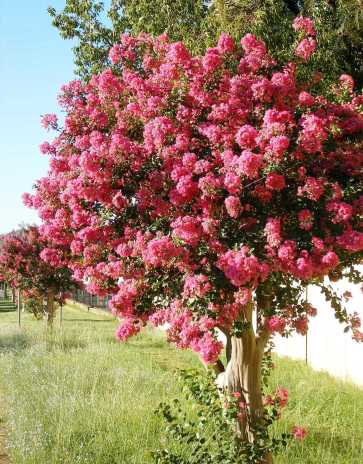
Crepe myrtle shrubs

Crepe Myrtles in Arthur Street

Only five days were warmer than average. The final five days and four nights were very cool, taking the weekly average (normally the hottest of the year) down to five degrees below normal. (This would be normal for the end of March, not January!) There were fifteen rain days, equalling the 125-year record number for January, set in 1941. Rain was spread evenly through the month, with the highest reading 29.2 mm on the 2nd.
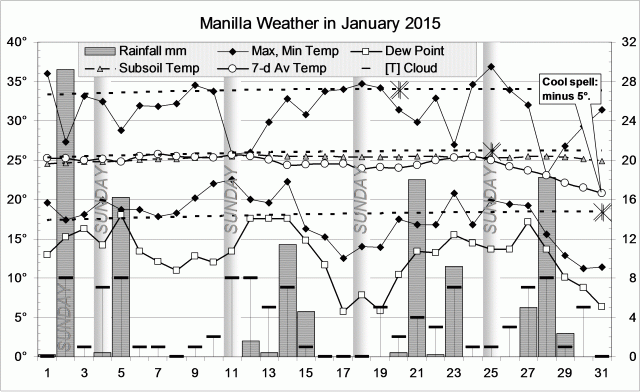
Weather log January 2015

Comparing January months

The mean daily maximum temperature (31.4°) was well below the average of 33.8°. Since nights, at 17.6°, were near normal, the daily temperature range was the record narrow value for January of 13.8°.
The dew point (humidity) returned to a normal value of 12.9°, after last January’s arid 6.9°. Subsoil temperature (25.3°) fell to normal after two January months above normal.
The total rainfall of 117.4 mm was in the 75th percentile, well above the average of 87 mm. This clears all shortages in rainfall totals for groups of months. The lowest percentile value remaining (15th) is for the 18 month total of 746 mm.
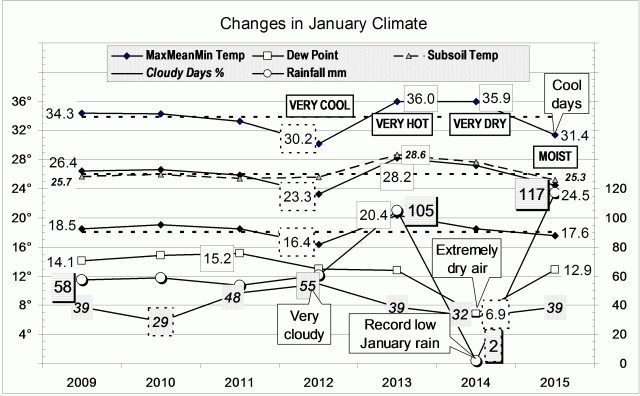
Climate for January 2015


Data. Rainfall data is from Manilla Post Office, courtesy of Phil Pinch. Temperatures, including subsoil at 750 mm, and other data are from 3 Monash  Street, Manilla.
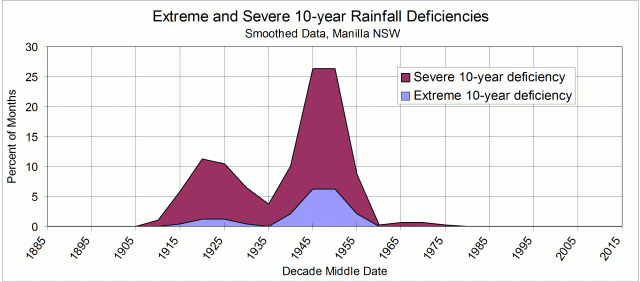
Rainfall Deficiencies IV: 120-months Duration

Log of severe and extreme rainfall deficiency of 120-month duration at Manilla This is the fourth of four graphs that show Manilla’s history of rainfall deficiencies (rainfall droughts), for periods of duration 3 months, 12 months, 36 months, and 120 months.

This fourth graph includes those periods of severe or extreme rainfall deficiency that last one-hundred-and-twenty months. They are rainfall droughts that affect about ten successive years.

(As I note below, in this series, a time of severe rainfall deficiency is one that is drier than the 5th percentile of cases, and a time of extreme rainfall deficiency is one that is drier than the 1st percentile of cases.)

In Manilla’s climate, a time of severe 120-month rainfall deficiency has a rainfall total less than 5860 mm, when it normally would be 6390 mm: that is, through the 10-year period, there is as an average a rainfall deficit of 53 mm each year. A time of extreme 120-month rainfall deficiency has a rainfall total less than 5670 mm: that is, through the 10-year period, there is as an average a rainfall deficit of 72 mm each year.

Even more than three-year droughts, these ten-year droughts have quite different effects to those that are shorter. The importance of severe and extreme rainfall deficiencies of 120-month duration is that even very large surface and sub-surface reservoirs may not be adequate to supply demand through to the end of the drought.

The graph shows that such ten-year droughts hardly occurred earlier than 1915 or later than 1955, but were confined to that 40-year interval. While deficiencies of this duration were twice as common as normal (5%) in the decades around 1920 and 1925, it was the decades around 1945 and 1950 that were extraordinary: 26% of all months had a severe rainfall deficiency of this duration.

Again, extreme 120-month droughts generally comprised about one-fifth of the total, as one might expect (unlike the case for one-year droughts).

Areas shown on the graph

Rainfall deficiencies are called “severe” when they are lower than are recorded for five percent of the months. I have called deficiencies “extreme” when they are lower than are recorded for one percent of the months. In this graph, I have coloured extreme deficiencies in blue. The maroon colour is deficiencies that are severe, but not extreme. The top edge of the maroon area marks the proportion of severe deficiencies including extreme deficiencies. As an average, this line is at five percent.

Data analysis

Continue reading

Rainfall Deficiencies III: 36-months Duration

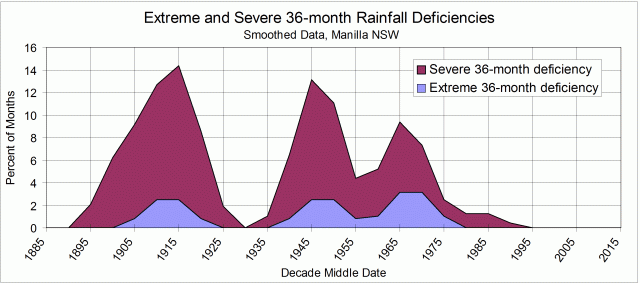
Log of severe and extreme rainfall deficiency of 36-month duration at Manilla

This is the third of four graphs that show Manilla’s history of rainfall deficiencies (rainfall droughts), for periods of duration 3 months, 12 months, 36 months, and 120 months.

This third graph includes those periods of severe or extreme rainfall deficiency that last thirty-six months. They are rainfall droughts that affect about three successive years.
In Manilla’s climate, a time of severe 36-month rainfall deficiency has a rainfall total less than 1505 mm, when it normally would be 1940 mm. A time of extreme 36-month rainfall deficiency has a rainfall total less than 1380 mm.
Droughts of this duration have quite different effects to those that are much shorter.
While the 3-month drought that just qualifies as “severe” (by having rainfall in the fifth percentile) would have a rainfall total of 50 mm, in the similarly defined 36-month drought, each 3-month period within it would have, on average, a rainfall total of 125 mm (i.e. 1505*3/36). This 3-month rainfall total is only 25 mm less than the normal 150 mm total. It would scarcely be noticed if it did not persist for 36 months.
The importance of severe and extreme rainfall deficiencies of 36-month duration is that they use up the reserves that are held in surface and sub-surface water storage.

In the Manilla rainfall record, such three-year droughts were concentrated in just a few decades. They were very common around 1910-1915 and 1945 (in more than 12% of months) and in 1965 (in 9% of months). They were very rare or absent (less than 2% of months) before 1900, from 1925 to 1935, and in the entire forty years since 1975.
Extreme 36-month droughts generally comprised about one-fifth of the total, as one might expect (unlike the case for one-year droughts).

Areas shown on the graph

Rainfall deficiencies are called “severe” when they are lower than are recorded for five percent of the months. I have called deficiencies “extreme” when they are lower than are recorded for one percent of the months.
In this graph, I have coloured extreme deficiencies in blue. The maroon colour is deficiencies that are severe, but not extreme. The top edge of the maroon area marks the proportion of severe deficiencies including extreme deficiencies. As an average, this line is at five percent.

Data analysis

Continue reading

December 2014 rainy with warm nights

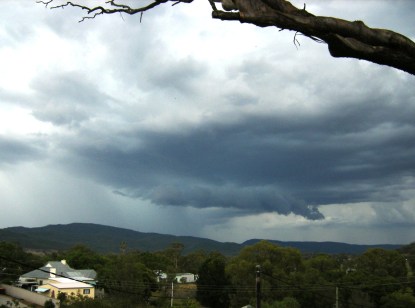
Photo of a rain-shower

A shower on Mt Baldwin

Few days or nights were unusually warm or cool, except for a very cold day on the 28th. Thunderstorm clouds were often seen, but only a few yielded any rain. Later, overcast skies brought steady rain recorded on the 27th (25.2 mm) , 28th (11.2 mm) and 29th (12.6 mm). There were fourteen rain days: twice the usual number.

Weather log December 2014

Comparing December months

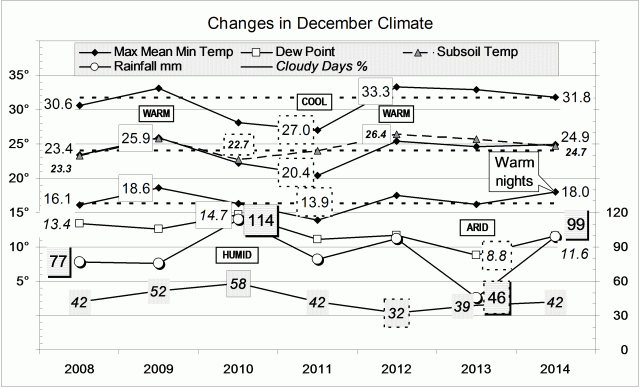
The mean daily maximum temperature (31.8°) was normal, but the mean daily minimum temperature (18.0°) was very high (Very warm nights!), just below the record of 18.6° set in 2009.
Subsoil temperature (24.7°) fell to normal after two Decembers above normal.
The total rainfall of 99.0 mm was in the 72nd percentile, well above the average of 74 mm. This clears most of the shortages in rainfall totals for groups of months. Two serious shortages remain: the nine month total of 306 mm is in the 8th percentile, and the eighteen month total of 659 mm is in the 6th percentile.

Climate for December 2014

The Year 2014

This year had the warmest nights (11.34°) of the new century. Although the days, at 26.67°, were cooler than in 2002 (26.72°), this year had also the warmest mean temperature: 19.01°. The second-warmest, at 18.85°, was 2009 and the coolest, at 17.19°, was 2008.
The subsoil temperature: 20.5°, fell back to near average.
In the year, 39% of the mornings were cloudy (more than four octas of cloud). This is close to the recent average (40%) for 2007 to 2014, but much more cloudy than the earlier average (26%) for 2000 to 2006.
The rainfall, 447 mm, was second lowest in the new century, after 2002 (366 mm). In the long-term rainfall record, this is a serious, but not severe deficiency: it is in the 8th percentile.


Data. Rainfall data is from Manilla Post Office, courtesy of Phil Pinch. Temperatures, including subsoil at 750 mm, and other data are from 3 Monash  Street, Manilla.
Rainfall Deficiencies II: 12-months Duration

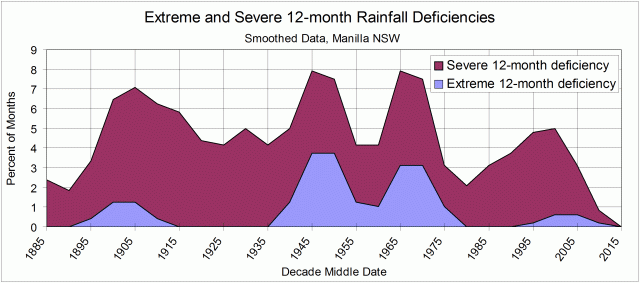
Log of severe and extreme rainfall deficiency of 12-month duration at Manilla

This is the second of four graphs that show Manilla’s history of rainfall deficiencies (rainfall droughts), for periods of duration 3 months, 12 months, 36 months, and 120 months.

This second graph includes those periods of severe or extreme rainfall deficiency that last twelve months. They are rainfall droughts that affect four successive seasons, sometimes making for two failures a year apart.
In Manilla’s climate, a time of severe 12-month rainfall deficiency has a rainfall total less than 400 mm, when it normally would be 640 mm.
The graph shows that such one-year droughts were very common around 1945-1950 and 1965-1970 (in 8% of months) and also 1905 (in 7% of months). They were not common (only 2% of months) around 1885, 1890, and 1980. Recently, around 2015, there have been none at all.
Remarkably, extreme 12-month rainfall droughts (in blue) were almost as common as severe ones in the long period from 1940 to 1975.

Note added June 2015

I have analysed a remarkable and unexpected relation between days of heavy rainfall and the frequency of year-long droughts at Manilla (as graphed here) in a series of posts:
More droughts After Heavier Rains I.
More droughts After Heavier Rains II.
More droughts After Heavier Rains III.

Areas shown on the graph

Rainfall deficiencies are called “severe” when they are lower than are recorded for five percent of the months. I have called deficiencies “extreme” when they are lower than are recorded for one percent of the months.
In this graph, I have coloured extreme deficiencies in blue. The maroon colour is deficiencies that are severe, but not extreme. The top edge of the maroon area marks the proportion of severe deficiencies including extreme deficiencies. As an average, this line is at five percent.

Data analysis

Continue reading