Geoff’s solar-passive house at Manilla

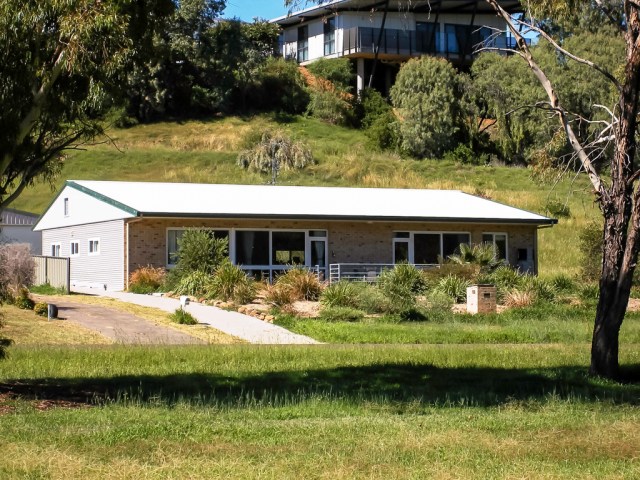
View of solar-passive house

Geoff’s solar-passive house

A second high-mass solar-passive house was built in 2009 in Strafford Street Manilla, within 300 metres of my house in Monash Street.
My friend Geoff designed his house and used the same builder that I did. Sadly, after five comfortable years in his house, Geoff has passed away. Thanks to his daughter, I can show you the features of the house.
Thermometers, and power bills show that its performance is similar to mine. That is to say, it is very successful!

In Manilla’s climate of daily and seasonal temperature extremes, Geoff rarely needed to use his low-powered reverse-cycle air conditioner.
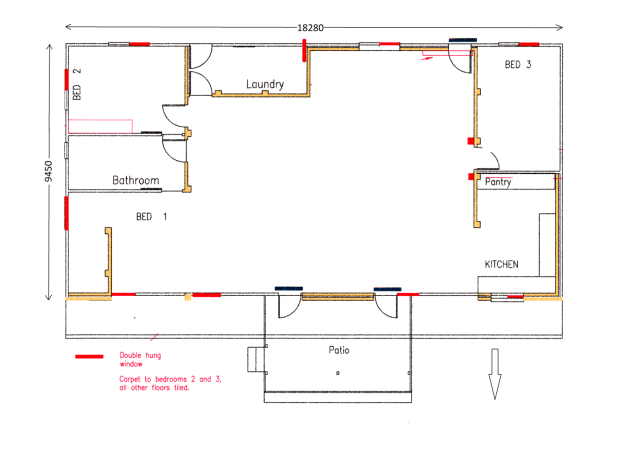
Plan of solar-passive house

Strafford Street solar-passive house: plan

Specifications

Dimensions

Length, East-West:     18.28 m
Width, North-South:    9.45 m
Ceiling height:               2.70 m

Area

Room area, Living/Kit/Bed 1/Study:      115.9 m^2
Room area, Bed 2:                                    13.8 m^2
Room area, Bed 3:                                    14.1 m^2
Room area, Bathroom:                              8.6 m^2
Room area, Laundry/Darkroom:               7.7 m^2
Area of walls:                                             12.7 m^2
Total House Area (without patio):       172.8 m^2

Exterior walls

North wall: double brick
East, west, and south walls: 90 mm stud, including 9.61 m reverse brick veneer
Cladding of stud walls: custom orb (horizontal)
Cladding of gable ends: plain roofing panels with 50 mm foam

Interior walls

Single brick:    17.16 m
Stud wall:        11.66 m

Windows (and two glass doors)

All double-glazed 3/6/3 in uPVC frames
(North-facing window area is 16% of the floor area of the house.)
North-facing:           27.00 m^2 (76%)
East-facing:               3.84 m^2 (11%)
South-facing:            4.50 m^2 (13%)
West-facing:             0.00 m^2 (0%)
Total:                      35.34 m^2 (100%) Continue reading
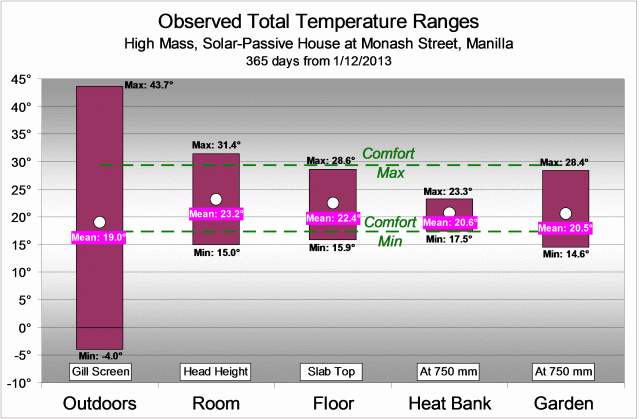
House Thermal Mass Works in Summer Too

House temperature ranges diagram

My house at Manilla, NSW, is in a climate with temperatures that are extreme, but comfortable on the average. To reduce extreme temperatures indoors, the house contains more than a hundred tonnes of thermal mass within a shell of insulation.
The “thermal mass” is the materials, such as bricks, stones, concrete, earth or water, that have high thermal capacity (See Notes below): they take in and give out a lot of heat.
Many people, who can see that having thermal mass inside a house will help to keep it warm in winter, think that the thermal mass will make it hard to keep the house cool in summer. They see many brick and brick-veneer houses in which thermal mass is exposed to the intense heat of the summer sun. In that case, thermal mass material does no good.

In this graph, I have used my last twelve months of temperature data to show the benefit of well-insulated thermal mass in summer as well as in winter.
Outdoor temperature in this year went as low as minus 4.0° Celsius and as high as plus 43.7°: a range of 47.7°. Continue reading

One year of House Performance: II

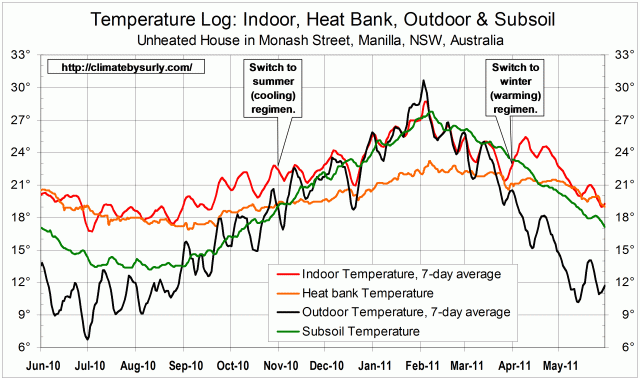
Graphical 1-year record of outdoor and indoor mean temperatures, subsoil and heat bank.

See also “One Year of House Performance: I”.

Like the graph in the post linked above, this is a log of indoor and outdoor 7-day mean temperatures at my low-energy solar-passive house at Manilla, NSW.
In place of the curves for normal air temperature and comfort zone limits, this graph includes two (raw value) logs of subsoil temperature at 750 mm below the surface. The green trace is the subsoil temperature outdoors in the garden. The orange trace is that below the middle of the main floor slab. The mass of material below the slab is surrounded by insulation at the edge so as to form a “heat bank”.

Continue reading

One year of House Performance: I

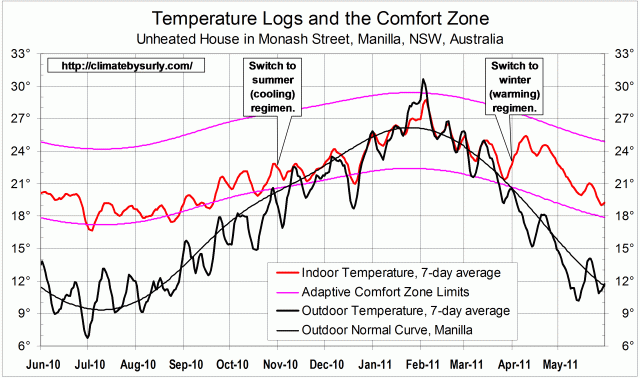
Graphical 1-year record of outdoor and indoor mean temperatures with the comfort zone

This graph is a log of indoor and outdoor 7-day mean temperatures at my low-energy solar-passive house at Manilla, NSW. Indoor mean temperatures are in red, and outdoor mean temperatures in black. Both logs show the same cycles of temperature with a period of two to three weeks. Indoor cycles have a much smaller amplitude.

Continue reading

Indoor/Outdoor Regressions for Maxima and Minima

Regressions for maximum and minimum temperatures compared

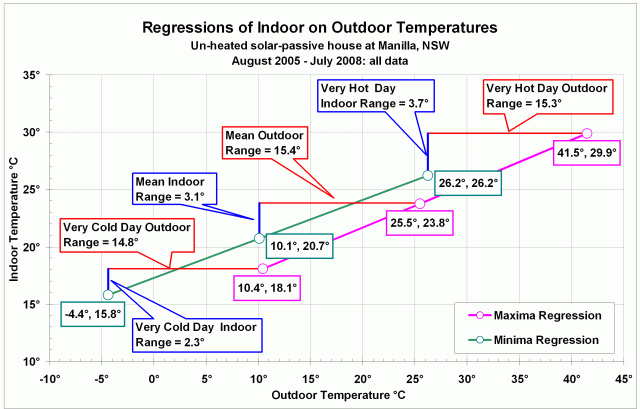
This graph shows the two regression lines for Indoor versus Outdoor daily maximum temperature (purple) and daily minimum temperature (green), taken from separate scatter-plots for maxima and minima. I have marked three points on each line: the mean temperature point and points at the extreme ends of the lines, one for a very hot day and one for a very cold day.

The interest of this graph is in the space between the regression lines. It represents the daily temperature range. I have linked each pair of points by two lines like the tread and riser of a stair. The tread (red) is the outdoor daily temperature range; the riser (blue) is the indoor daily temperature range.

The mean outdoor temperature range here is 15.4° and the mean indoor temperature range of the house is 3.1°. By this measure, the indoor temperature range is one fifth of that outdoors.
It happens that, in Manilla, the outdoor temperature ranges in the hottest and coldest parts of the year are, as shown, slightly less than for the year as a whole. Indoor temperature ranges show a clear gradient, from as much as 3.7° on a very hot day through 3.1° at the mean, to only 2.3° on a very cold day.

These very narrow temperature ranges result from the way the high thermal mass dispersed within the house allows heat to be absorbed and radiated at room temperature, eliminating extremes. Hot spots and cold spots are few and do not last long.

Adaptive Comfort

[I have re-posted the lost graph of the Adaptive Comfort Zone here.]

For comfort, we do not need indoor temperature ranges as narrow as these. Using the Adaptive Comfort Zone model we find that the neutrality temperature (for best comfort) based on Manilla’s January mean temperature of 26°  is also 26°, and the neutrality temperature based on Manilla’s July mean temperature of 10° is 21°.
According to the model, 80% of the population feel comfortable when the temperature is within 3.5° of the neutrality temperature: in January at Manilla they are comfortable up to 29.5°, and in July they are comfortable down to 17.5°.
My graph shows that the maximum indoor temperature of this house on a very hot day (29.9°)is only 0.4° above the January comfort limit, and the minimum indoor temperature on a very cold day (15.8°) is just 1.7° below the July comfort limit.
On this model, most people could live comfortably in this house using heating or cooling for only a few days in a year.
This post is one of a set of four back-dated to June 2010:
Indoor versus Outdoor Temperatures (1096 days)
Indoor versus Outdoor Minima (1096 days)
Indoor versus Outdoor Maxima (1096 days)
Indoor/Outdoor Regressions for Maxima and Minima (This post.)


This article was originally posted in the weatherzone forum thread “Indoor Climate” on 9th June 2010. It is backdated here to 19th June 2010.