Spring 2014 dry and hotter

Weather log for spring 2014

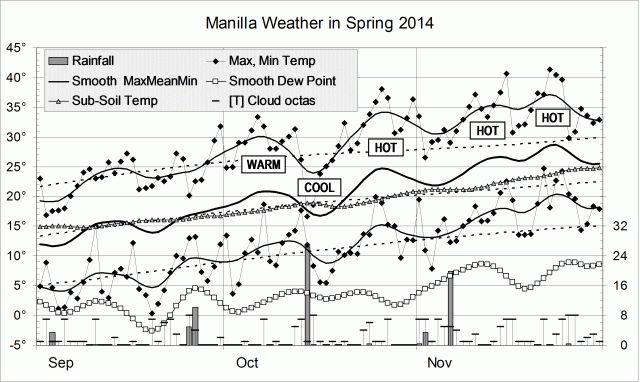
Warm weather developed in early October, followed by a cool spell with one rain day of 26.4 mm. After that came three hot spells. There were showers and storms in the district, but little more rain fell at Manilla.
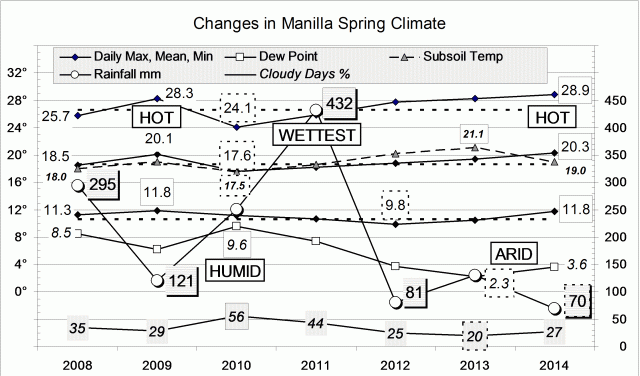
This spring was slightly hotter than spring 2013 and spring 2009, but not as hot as spring 2002. The air was not as extremely arid (dew point 3.6°) as in last spring (dew point 2.3°), and skies were a little more cloudy.
The total rainfall of 69.8 mm was in the 8th percentile: the 10th lowest spring rainfall. (Spring 2002 had been equal 5th lowest at 66 mm, and spring 1957 the lowest at 23 mm.) Rain fell on 11 days: more than in spring of 2002 (9 days), but fewer than in 2013 (13).
Climate for spring 2014


Data. Rainfall data is from Manilla Post Office, courtesy of Phil Pinch. Temperature, including subsoil at 750 mm, and other data are from 3 Monash Street, Manilla.

Manilla’s Hot Days

I have used my 13-year weather record to find the number of hot days in each year and in each month. Earlier I did the same for frosty mornings. Because the summer, which has the most hot days, crosses from one calendar year to the next, I have begun each year at July.
I have called days warmer than 35° “hot days”, and days warmer than 40° “very hot days”.

Total hot days

The first graph shows the number of hot and very hot days in each year. The most hot days were in the year ’09-’10, which had 44; the fewest were in the year ’11-’12, which had only 4. The 13-year average is 26, but the number of hot days is quite different from year to year.

Counting only the very hot days, ’03-’04 had the most (6), and four years had none at all. On the average, two days exceeded 40° in a year.
Hot days each year, and seasonal distribution.

Months with hot days

The second graph shows how the number of hot and very hot days peaks strongly in January, with very few earlier than November or later than March. On average, Manilla’s summer has about 22 days warmer than 35°, while spring has 3, and autumn only 1.


The other graphs show how each year had a different pattern of hot days. The highest monthly peaks, each 19 hot days, came in January 2003 (following drought) and January 2007. Annual peaks also came in January in 2008 and 2012, but these peaks were extremely low: only 4 and 3 hot days. Continue reading