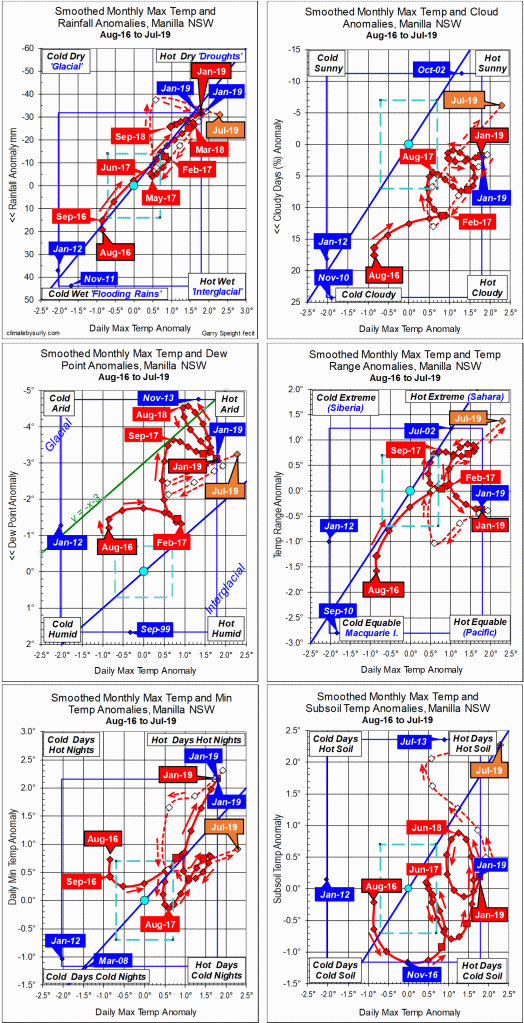
3-year trends to July 2019

Record dry and warm (as smoothed)

3-year climate trends to July 2019

July raw anomaly data (orange)

Temperatures

Daily maximum temperature anomaly (all x-axes): above the maximum for smoothed values.
Daily minimum temperature anomaly (lower left): just above the upper limit of normal values.
Subsoil temperature anomaly (lower right): very high.

Moistures (moist is at the bottom)

Rainfall anomaly (upper left): very low.
Cloudiness anomaly (upper right): normal.
Dew point anomaly (middle left): low, like the other recent values.
Daily temperature range anomaly (middle right): very high.

 Latest fully smoothed data (red), January 2019

Temperatures

Daily maximum temperature was a new record positive value of +1.79 deg, beating +1.62 deg set in March and December 2018.
Daily minimum temperature set a new record of +2.18 deg, beating +1.98 deg set the previous month.
Subsoil was normal due to phase lag.

Moistures (moist is at the bottom)

Rainfall smoothed anomaly was a new 136-year record value of minus 31.75 mm per month, breaking the record of minus 30.8 mm set the previous month.
Cloudiness was normal.
Dew point was low.
Daily temperature range was normal.


Notes:

January data points are marked by squares.

Smoothing Continue reading

June 2019 still warm and dry

Road in Manilla

The Bendemeer road

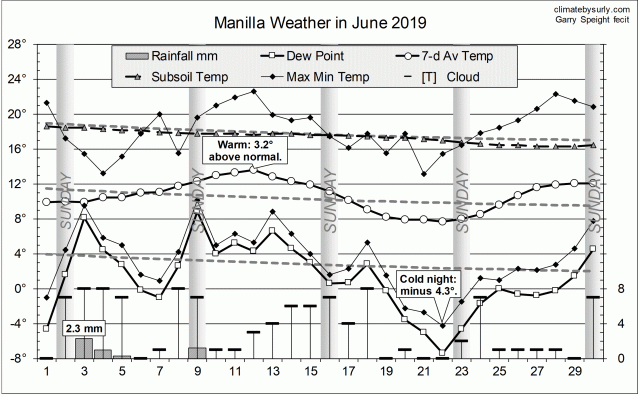
The second week was 3.2° warmer than normal, the third week cool, and the fourth warm again. There were 12 frosts (normally 13), with that on the 22nd reading minus 4.3° in the screen. It was one of only 20 readings below minus 4.0° this century.
The wettest of the four rain days registered only 2.3 mm.

Weather log June 2019

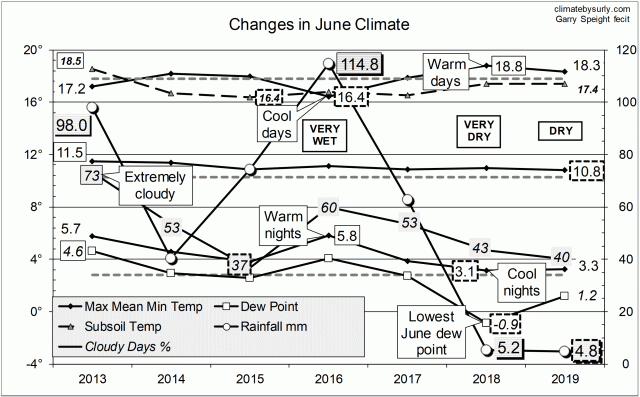
Comparing June months

The mean temperature for June has changed little in recent years. It has slowly fallen from 11.5° in 2013 to 10.8°. That is higher by 0.5° than the 10.3° that was normal in the first decade of this century. This month’s mean daily maximum (18.3°) and mean daily minimum (3.3°) were also just 0.5° above normal.
This June was a little more moist than last June in its higher dew point and narrower daily temperature range but less moist in cloudiness and rainfall. The low total rainfall of 4.8 mm (est.) is at the 8th percentile, the 12th driest June on record.
Climate for June 2019

Drought

The on-going unprecedented drought is reported in another post.


Data. A Bureau of Meteorology automatic rain gauge operates in the museum yard. From 17 March 2017, 9 am daily readings are published as Manilla Museum, Station 55312.  These reports use that rainfall data when it is available.  Since no 9 am readings have been recorded since August 2018, I have substituted my non-standard gauge readings for all days.
All other data, including subsoil at 750 mm, are from 3 Monash Street, Manilla.

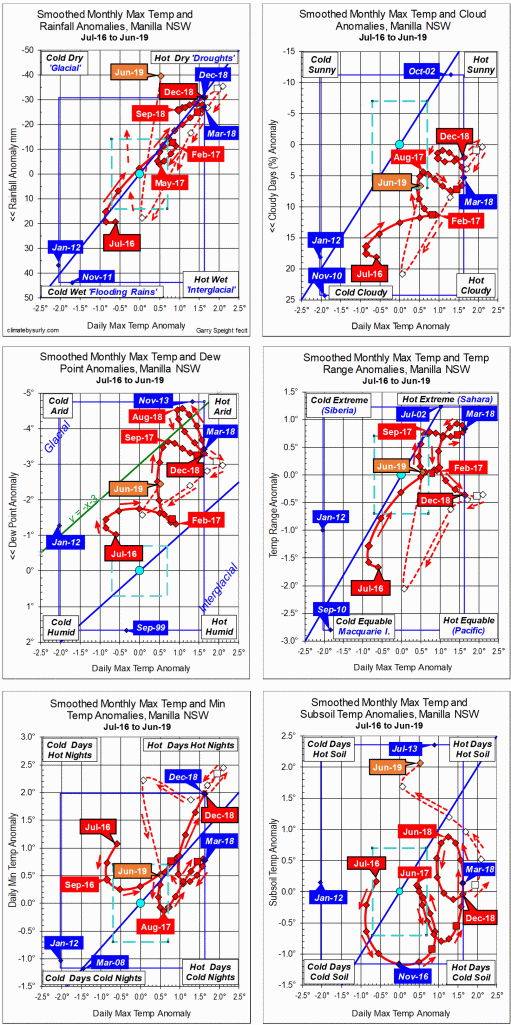
3-year trends to June 2019

June warm and dry

3-yeqr climate trends to June 2019

June raw anomaly data (orange)

Temperatures

Daily maximum temperature anomaly (all x-axes): near the upper limit of normal values.
Daily minimum temperature anomaly (lower left): near the upper limit of normal values.
Subsoil temperature anomaly (lower right): very high.

Moistures (moist is at the bottom)

Rainfall anomaly (upper left): very low.
Cloudiness anomaly (upper right): normal.
Dew point anomaly (middle left): low, like the other recent values.
Daily temperature range anomaly (middle right): normal.

 Latest fully smoothed data (red), December 2018

Temperatures

Daily maximum temperature equaled the record positive value of +1.62° set in March 2018.
Daily minimum temperature set a new record of +1.98°, beating +1.65° set the previous month.
Subsoil was normal due to phase lag.

Moistures (moist is at the bottom)

Rainfall smoothed anomaly was a new 136-year record value of -30.8 mm per month, breaking the record of -29.7 mm set the previous month.
Cloudiness was normal.
Dew point was low.
Daily temperature range was normal.


Notes:

January data points are marked by squares.

Smoothing

Smoothing uses Gaussian functions.
For fully smoothed data the function has a Standard Deviation of 2.5 months, it spans 13 monthly data points, and has a half-width of 6 months, which suppresses cycles shorter than 12 months. For partly smoothed data, the span of the function is reduced to 11 months, 9 months and so on.
Continue reading

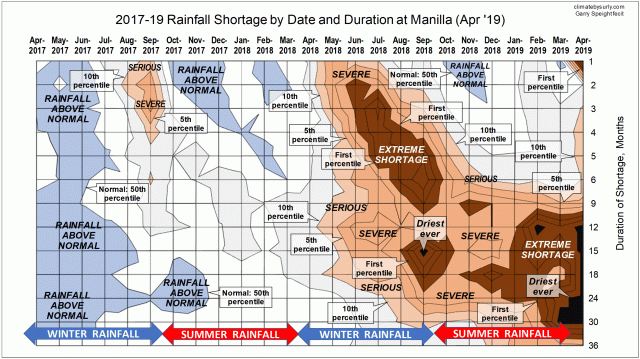
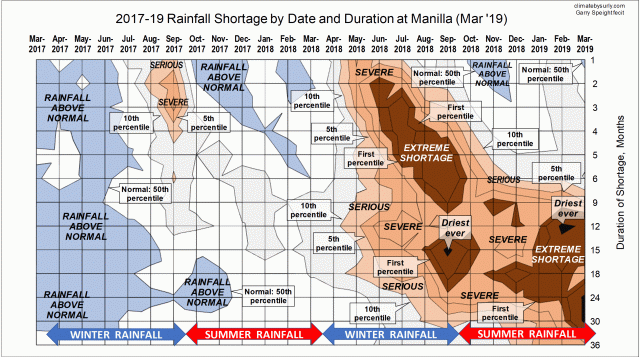
Rainfall shortage: series of contour plots

This graph is one of a series. All are copied here.

Sequence of rainfall shortages to May 2019

Twenty-five months to May 2019.

The above graph is described here.

Sequence of raiinfall shortages to April 2019

Twenty-five months to April 2019.

The above graph is described here.

Sequence of raiinfall shortages to March 2019

Twenty-five months to March 2019.

Continue reading

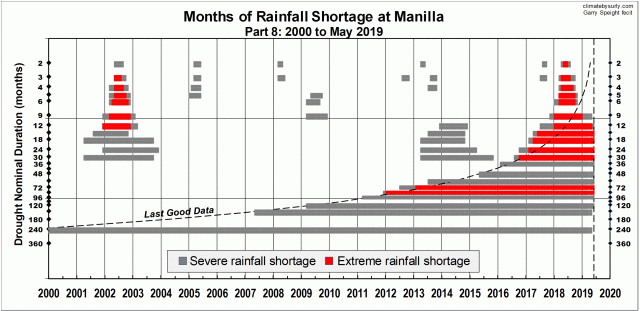
Rain Shortage Jan 2000 – May 2019

Record of rain shortages Jan 2000 May 2019

The current drought now has a severe rainfall shortage of 240 months duration that must have commenced in 1999.

[For explanation of this graph, see below: “About drought duration graphs”.]

[These graphs have been updated to October 2019, showing much worse shortages.]

Shortages at 2018

Shortages of rainfall became alarming in 2018. The winter months had extreme shortages of 2-month to 6-month duration. Earlier and later dry months contributed to longer-term extreme shortages from 9 months up to 30-months.
In months since November 2018 none of the short-term rainfall totals for durations from two months to six months has been even a severe shortage. In other respects, the drought has deepened. Because recent monthly rainfall values have seldom risen above normal, periods of severe or extreme shortage have become longer and longer. As at May 2019, extreme shortages prevail at 15-, 18-, 24-, 30-, 72- and 84-month durations.
Severe shortages have developed at even longer durations, at 96-, 120-, 150- and 240-months. As is clear from the graph, the 240-month severe shortage incorporates the 2002 drought into the 2018 drought. This was not evident until now.
As shown, the severe shortages of 150- and 240-month duration, current in April 2019, did not persist in observations for May. They could resume if later months do not have much rain. [Actually, this was a copy-down error.]
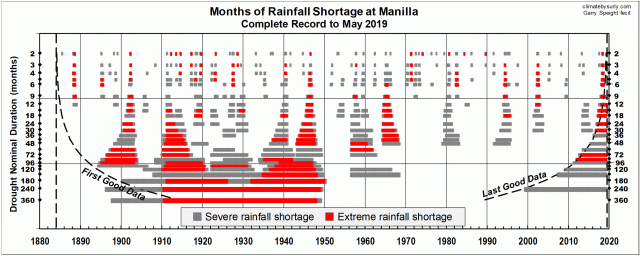
Drought record to May 2019

Compete record updated to May

When the graph of the complete record of months of rainfall shortage at Manilla is updated to May 2019 it is obvious that the current drought is one of the great droughts in history.
Although this drought seemed to have a sudden onset, shortages of longer duration actually began earlier: the longer the duration concerned, the earlier its time of onset.. The 2018 pattern is like the droughts of 1902, 1940 and 1946. Droughts that actually had a sudden onset were those of 1912, 1957 and 1965.


About drought duration graphs

These graphs show the onset, persistence, and breaking of episodes of extreme and severe rainfall shortage (droughts) at Manilla. The first shows detail since 2000. The second shows the complete historical record from 1884. The graph features and the data analysis are explained in the post “Rainfall Shortage History: Manilla”.

Extreme shortages, up to the 1st percentile, are shown in red and severe shortages, up to the 5th percentile, are shown in grey.
The dashed line labelled “Last Good Data” is a limitation of observed cumulative rainfall deficiency. Future observations may make any point to the right of this line more extreme.