Rainfall Deficiencies II: 12-months Duration

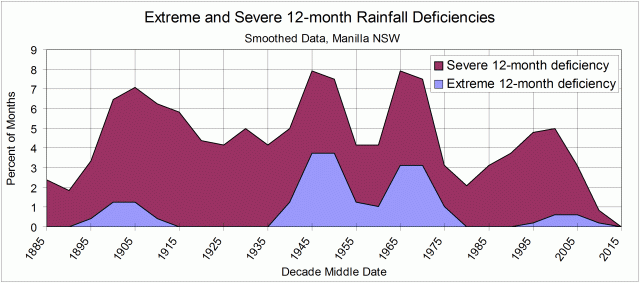
Log of severe and extreme rainfall deficiency of 12-month duration at Manilla

This is the second of four graphs that show Manilla’s history of rainfall deficiencies (rainfall droughts), for periods of duration 3 months, 12 months, 36 months, and 120 months.

This second graph includes those periods of severe or extreme rainfall deficiency that last twelve months. They are rainfall droughts that affect four successive seasons, sometimes making for two failures a year apart.
In Manilla’s climate, a time of severe 12-month rainfall deficiency has a rainfall total less than 400 mm, when it normally would be 640 mm.
The graph shows that such one-year droughts were very common around 1945-1950 and 1965-1970 (in 8% of months) and also 1905 (in 7% of months). They were not common (only 2% of months) around 1885, 1890, and 1980. Recently, around 2015, there have been none at all.
Remarkably, extreme 12-month rainfall droughts (in blue) were almost as common as severe ones in the long period from 1940 to 1975.

Note added June 2015

I have analysed a remarkable and unexpected relation between days of heavy rainfall and the frequency of year-long droughts at Manilla (as graphed here) in a series of posts:
More droughts After Heavier Rains I.
More droughts After Heavier Rains II.
More droughts After Heavier Rains III.

Areas shown on the graph

Rainfall deficiencies are called “severe” when they are lower than are recorded for five percent of the months. I have called deficiencies “extreme” when they are lower than are recorded for one percent of the months.
In this graph, I have coloured extreme deficiencies in blue. The maroon colour is deficiencies that are severe, but not extreme. The top edge of the maroon area marks the proportion of severe deficiencies including extreme deficiencies. As an average, this line is at five percent.
Data analysis

Continue reading

Rainfall Deficiencies I: 3-months Duration

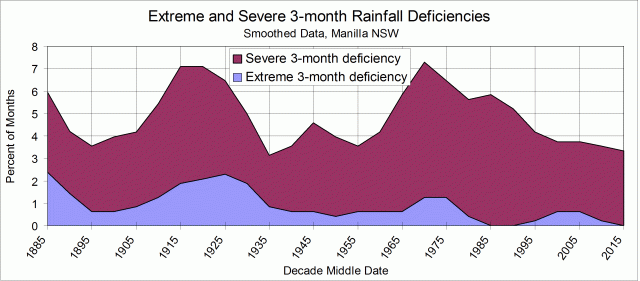
Log of severe and extreme rainfall deficiency  of 3-month duration at Manilla

This is the first of four graphs that show Manilla’s history of rainfall deficiencies (rainfall droughts), for periods of duration 3 months, 12 months, 36 months, and 120 months.

This first graph includes those short periods of severe or extreme rainfall deficiency that last only three months. They are rainfall droughts for one season rather than for a year or more. Crops and pastures may fail.
In Manilla’s climate, a time of severe 3-month rainfall deficiency has a rainfall total less than 50 mm, when it normally would be 150 mm.
The graph shows that such short-term droughts have occurred in every decade, but more often in some than in others. These brief droughts were most common (in 7% of months) around 1915, 1920 and 1970. They were least common (in only 3% of months) around 1895, 1935, 1940, 1955, and (more recently) in the twenty years since 1995.
Extreme short-term droughts (3-month total less than 26 mm) were more common near those times when severe short-term droughts were more common.

Areas shown on the graph

Rainfall deficiencies are called “severe” when they are lower than are recorded for five percent of the months. I have called deficiencies “extreme” when they are lower than are recorded for one percent of the months.
In this graph, I have coloured extreme deficiencies in blue. The maroon colour is deficiencies that are severe, but not extreme. The top edge of the maroon area marks the proportion of severe deficiencies including extreme deficiencies. As an average, this line is at five percent.
Data analysis

Continue reading

Extreme Droughts by Decade at Manilla

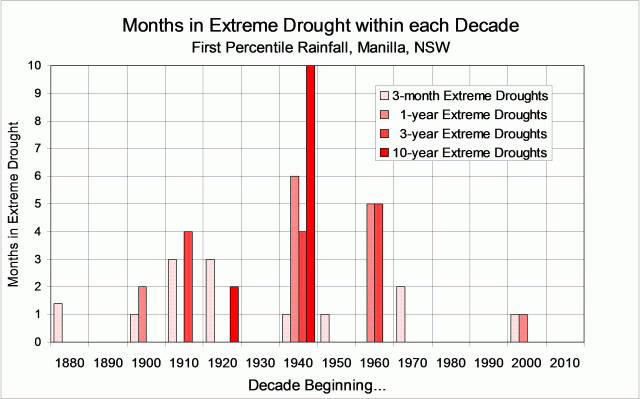
Extreme droughts per decade at Manilla NSW

The record of extreme droughts at Manilla, NSW, relates to the Southern Oscillation only now and then, and relates to global warming not at all.

This graph shows some of the same data as I presented earlier in the post “Manilla’s Record of Droughts”. The graph there showed precise dates, but it was hard to tell when extreme droughts were more or less frequent. This graph adds up the number of months of extreme drought in each decade. (See Note below: How I count drought months.)

There are separate columns (getting progressively redder) for extreme droughts of duration 3 months, 1 year, 3 years, and 10 years.
Extreme droughts of 10-year duration occurred only in the 1920’s and 1940’s.
Extreme droughts of 3-year duration occurred in the 1910’s, 1940’s, and 1960’s.
Extreme droughts of 1-year duration occurred in the 1900’s, 1940’s, 1960’s and 2000’s.
Extreme droughts of 3-month duration occurred in the 1880’s, 1900’s, 1910’s, 1920’s, 1940’s, 1970’s and 2000’s.
No extreme droughts at all occurred in five of the fourteen decades: the 1890’s, 1930’s, 1980’s, 1990’s, and 2010’s.

[Note added August 2019.

More data for the decade beginning 2010.
This post, dated December 2014, shows no extreme droughts in the decade beginning 2010. Extreme droughts did occurr in 2018 and 2019, as shown in the post “Rain Shortage Jan 2000 – May 2019”.
By August 2019, some months of extreme drought at 3-month and 1-year duration had occurred, and a month at 3-year duration was imminent.]

Relation to the Southern Oscillation Index

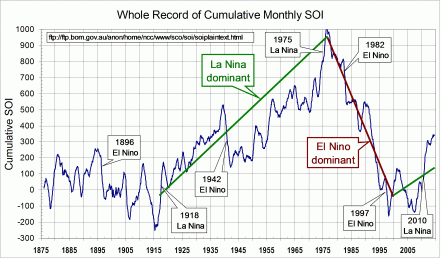
I posted this graph of cumulative values of the SOI earlier.

SOI CUSUM plot

The record of the Southern Oscillation Index relates to the Manilla record of extreme rainfall deficiency only now and then. Persistent El Niños from 1911 to 1915 seem to relate to four months in the decade of the 1910’s having extreme 3-year droughts, carrying forward to two months in the 1920’s having extreme 10-year droughts. Similarly, the catastrophic droughts of short to very long duration in the 1940’s relate to El Niños that persisted from 1939 to 1942.
Other major El Niño events did not produce extreme droughts at Manilla: those of 1896, 1982, and 1997.
Long term trends in the Southern Oscillation Index do not predict Manilla’s extreme droughts at all. The 1940’s droughts Continue reading

3-year trends to November 2014

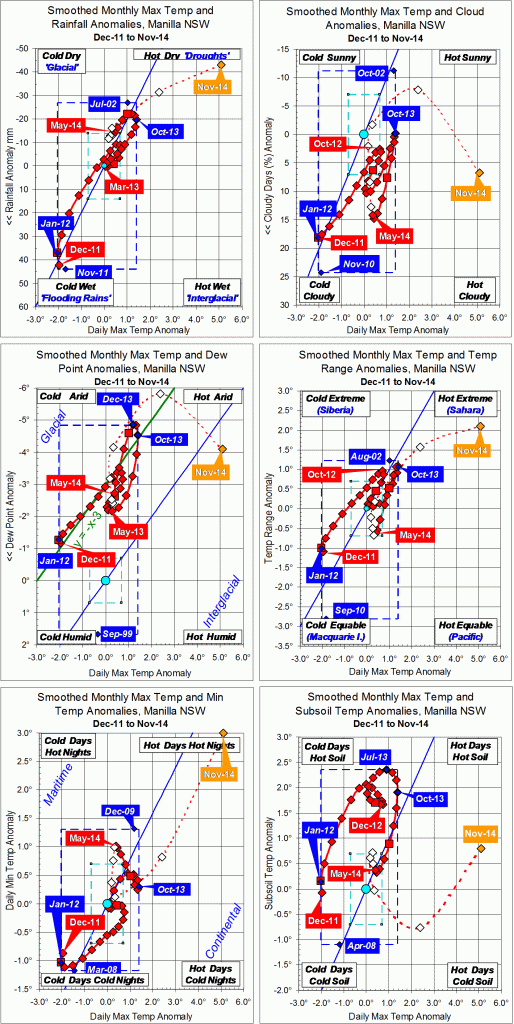
Parametric plots of smoothed climate variables at Manilla
“November 2014 more droughty”

Trends to November 2014

November data (orange)

The raw anomaly value for daily maximum temperature became extremely high: +5.1°. (The record positive anomaly was +5.6°, set in November 2009.) There were also extreme “droughts” values for high daily minimum temperature, high daily temperature range and low monthly rainfall. Values for cloudy days, dew point and subsoil temperature were near normal.

Fully smoothed data (red)

The latest fully-smoothed data (May 2014) complete the season of autumn 2014. The movement away from the mild drought of late 2013 ended in this month. Rainfall was rather low, skies rather cloudy, dew point low (near a new “normal”), temperature range and subsoil temperature normal.
Contrariwise, the smoothed anomaly of daily minimum temperature peaked in May 2014, showing a more maritime climatic episode.


Note:

Fully smoothed data – Gaussian smoothing with half-width 6 months – are plotted in red, partly smoothed data uncoloured, and raw data for the last data point in orange. January data points are marked by squares.
Blue diamonds and the dashed blue rectangle show the extreme values in the fully smoothed data record since September 1999.

Normal values are based on averages for the decade from March 1999.* They appear on these graphs as a turquoise (turquoise) circle at the origin (0,0). A range of anomalies called “normal” is shown by a dashed rectangle in aqua (aqua). For values in degrees, the assigned normal range is +/-0.7°; for cloudiness, +/-7%; for monthly rainfall, +/-14 mm.

 * Normal values for rainfall are based on averages for the 125 years beginning 1883.

Still hot and dry in November 2014

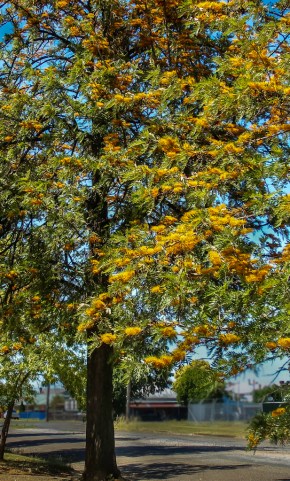
Silky oak trees in full bloom

November Silky Oaks

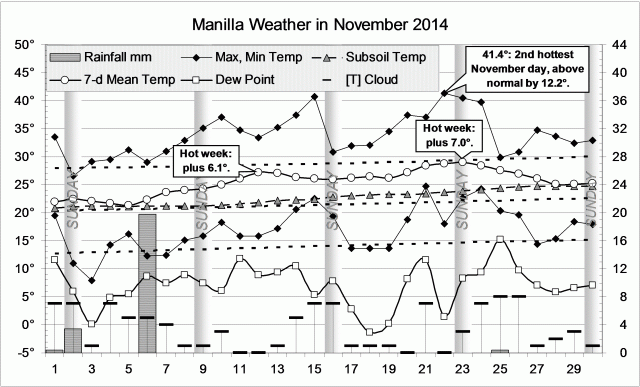
Although the month began near normal, with two rain days, the weather became hot and dry again. Saturday the 22nd reached 41.4°, to be the second hottest November day on this 15-year record.
There were two heat waves, with the average weekly temperature above normal by 6.1° on the 12th and by 7.0° on Sunday the 23rd. (November of 2009 had a worse heat wave, being above normal by 9.5°, and reaching 31.3°: the hottest week in any month.)
Most nights this month were warm, with low dew points. By contrast, many days were cloudy.

 Weather log November 2014

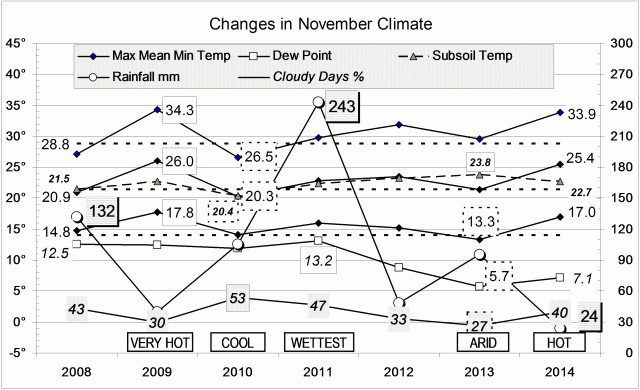
Comparing November months

On average, the month was not quite as hot as November 2009, the hottest this century. The air was again very dry, with an early morning dew point of 7.1°, a little higher than the lowest value (5.7°) recorded for November last year.
Following only three years after the wettest November on the 130-year record (242.9 mm), the total rainfall of only 24 mm was in the 15th percentile. That is, such low November rainfalls happen about one year in seven. However, the time since a lower November rainfall (15 mm in November 1990) is thirteen years: the longest gap ever.
For the third month in a row, little changed in rainfall totals for periods of more than one month. There is no longer a serious shortage in the 6-month total (now in the 10th percentile) but there are now serious shortages in the totals for 5 months (9th percentile), 9 months (8th percentile), 15 months (6th percentile), 18 months (6th percentile), and 30 months (9th percentile). There is one severe shortage: the total for 12 months (393 mm) is in the 4th percentile.

Climate fro November 2014


Data. Rainfall data is from Manilla Post Office, courtesy of Phil Pinch. Temperatures, including subsoil at 750 mm, and other data are from 3 Monash  Street, Manilla.