January Climate Anomalies Log

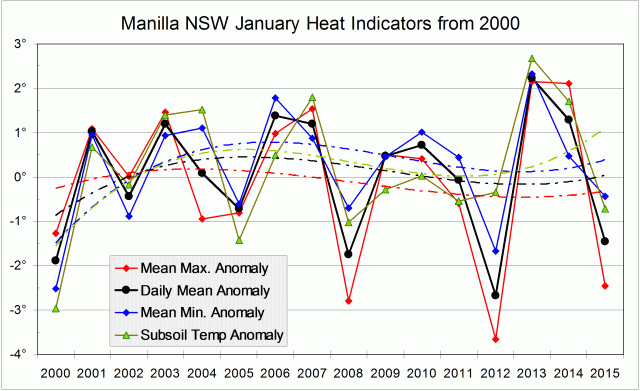
Heat indicators log for January

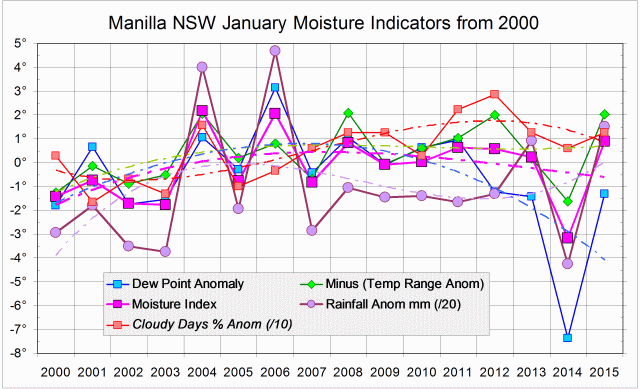
This post is the eleventh in a set for the 12 calendar months that began with March. Graphs are sixteen-year logs of the monthly mean anomaly values of nine climate variables for Manilla, NSW, with fitted trend lines. I have explained the method in notes at the foot of the page.

Raw anomaly values for January

Extreme values of January anomalies were as follows:

Daily Maximum Temperature Anomalies (1) -3.7 deg: January 2012;
Rainfall Anomalies (5) -70 mm: January 2002; -75 mm: January 2003; +80 mm: January 2004; +94 mm: January 2006; -85 mm: January 2014;
Dew Point Anomalies (2) +3.1 deg: January 2006; -7.4 deg: January 2014.

Trend lines for January

Heat Indicators

All heat indicator quartic trends began low and ended slightly high, and had a low peak in 2003, -05, or -06, and a shallow trough about 2012.

Moisture indicators log for January

Continue reading

3-year trends to January 2015

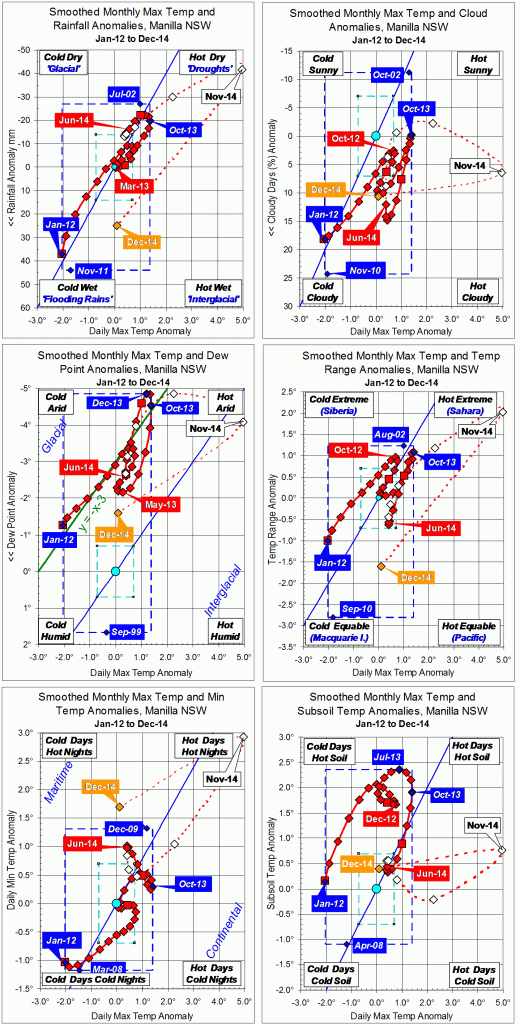
Parametric plots of smoothed climate variables at Manilla
“January 2015: rainy cool days”

Trends to January 2015


January raw anomaly data (orange)

Anomalies for all variables except subsoil temperature moved across the graphs, from “droughts” in November to “flooding rains” in January. Subsoil temperature had been normal from February to December (11 months!), then became cooler than normal in January.
Most raw anomaly values for January were close to the fully-smoothed anomaly values of the La Niña-affected cool summer of 2012. This month’s daily temperature range was even narrower, and the subsoil temperature lower, but the daily minimum temperature was not so low.

Fully smoothed data (red)

The latest fully-smoothed data anomalies (July 2014) were near normal. (Dew point, like most recent values of that variable, was 3° lower than normal.)


Note:

Fully smoothed data – Gaussian smoothing with half-width 6 months – are plotted in red, partly smoothed data uncoloured, and raw data for the last data point in orange. January data points are marked by squares.
Blue diamonds and the dashed blue rectangle show the extreme values in the fully smoothed data record since September 1999.

Normal values are based on averages for the decade from March 1999.* They appear on these graphs as a turquoise (turquoise) circle at the origin (0,0). A range of anomalies called “normal” is shown by a dashed rectangle in aqua (aqua). For values in degrees, the assigned normal range is +/-0.7°; for cloudiness, +/-7%; for monthly rainfall, +/-14 mm.

 * Normal values for rainfall are based on averages for the 125 years beginning 1883.

3-year trends to December 2014

Parametric plots of smoothed climate variables at Manilla
“December 2014 rain again”

Trends to December 2014

December data (orange)

From November to December, the raw anomaly value for daily maximum temperature returned to normal from extremely high. Rainfall anomaly moved from very dry to rather wet. Most other anomalies came back to near zero, where they had been (as smoothed values) in June 2014, six months earlier.
Temperature range became low while daily minimum temperature remained high. (Which causes which?)

Fully smoothed data (red)

The latest fully-smoothed data (June 2014) mainly show a renewed movement towards drought.


Note:

Fully smoothed data – Gaussian smoothing with half-width 6 months – are plotted in red, partly smoothed data uncoloured, and raw data for the last data point in orange. January data points are marked by squares.
Blue diamonds and the dashed blue rectangle show the extreme values in the fully smoothed data record since September 1999.

Normal values are based on averages for the decade from March 1999.* They appear on these graphs as a turquoise (turquoise) circle at the origin (0,0). A range of anomalies called “normal” is shown by a dashed rectangle in aqua (aqua). For values in degrees, the assigned normal range is +/-0.7°; for cloudiness, +/-7%; for monthly rainfall, +/-14 mm.

 * Normal values for rainfall are based on averages for the 125 years beginning 1883.

December Climate Anomalies Log

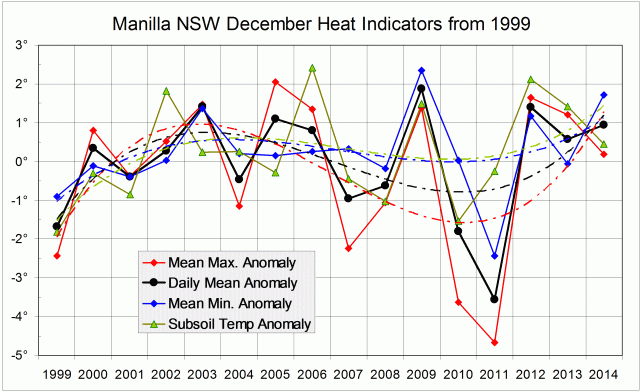
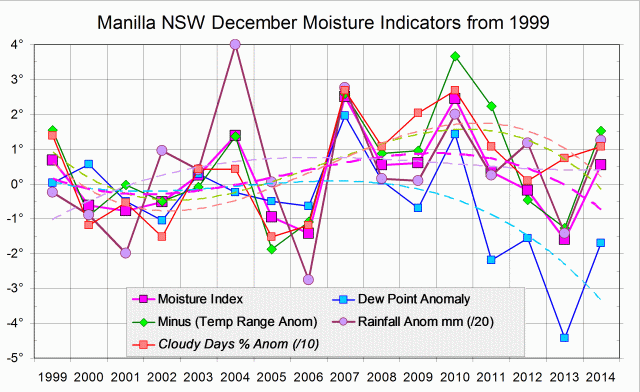
Heat indicators log for December

This post is the tenth in a set for the 12 calendar months that began with March. Graphs are sixteen-year logs of the monthly mean anomaly values of nine climate variables for Manilla, NSW, with fitted trend lines. I have explained the method in notes at the foot of the page.

Raw anomaly values for December

Extreme values of December anomalies were as follows:

Daily Maximum Temperature Anomalies (2) -3.6 deg:
December 2010; -4.7 deg: December 2011;
Rainfall Anomalies (1) +80 mm: December 2004;
Minus (Temperature Range Anomaly) (1) +3.7 deg: December
2010;
Dew Point Anomalies (1) -4.4 deg: December 2013.

Trend lines for December

Heat Indicators

All heat indicator quartic trends began low and ended high, and had a peak in 2003 or 2004 and a trough in 2010. The range from peak to trough was greatest for maximum anomalies and least for minimum and subsoil anomalies.

Moisture indicators log for December

Continue reading

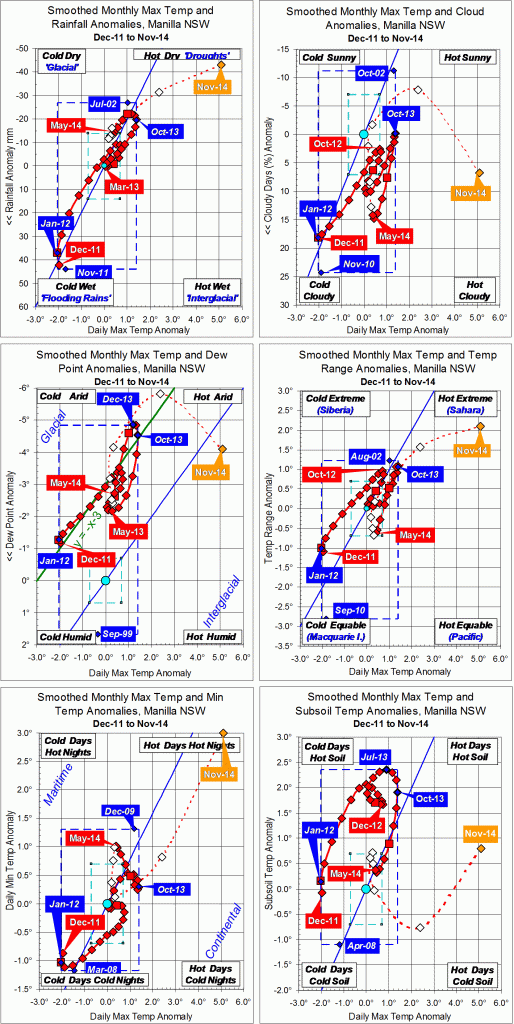
3-year trends to November 2014

Parametric plots of smoothed climate variables at Manilla
“November 2014 more droughty”
Trends to November 2014

November data (orange)

The raw anomaly value for daily maximum temperature became extremely high: +5.1°. (The record positive anomaly was +5.6°, set in November 2009.) There were also extreme “droughts” values for high daily minimum temperature, high daily temperature range and low monthly rainfall. Values for cloudy days, dew point and subsoil temperature were near normal.

Fully smoothed data (red)

The latest fully-smoothed data (May 2014) complete the season of autumn 2014. The movement away from the mild drought of late 2013 ended in this month. Rainfall was rather low, skies rather cloudy, dew point low (near a new “normal”), temperature range and subsoil temperature normal.
Contrariwise, the smoothed anomaly of daily minimum temperature peaked in May 2014, showing a more maritime climatic episode.


Note:

Fully smoothed data – Gaussian smoothing with half-width 6 months – are plotted in red, partly smoothed data uncoloured, and raw data for the last data point in orange. January data points are marked by squares.
Blue diamonds and the dashed blue rectangle show the extreme values in the fully smoothed data record since September 1999.

Normal values are based on averages for the decade from March 1999.* They appear on these graphs as a turquoise (turquoise) circle at the origin (0,0). A range of anomalies called “normal” is shown by a dashed rectangle in aqua (aqua). For values in degrees, the assigned normal range is +/-0.7°; for cloudiness, +/-7%; for monthly rainfall, +/-14 mm.

 * Normal values for rainfall are based on averages for the 125 years beginning 1883.