Drought Sixth Month: August 2018

Rainfall status, July and August 2018.

Graph of Rainfall Shortages

This graph shows all the present rainfall shortages at Manilla, short term and long term, in terms of percentile values. The latest values, as at the end of August, are shown by a black line with black circles. Those from one month earlier, at the end of July, are shown by a thinner line with smaller white circles.
The classes of rainfall shortage are:
• Serious shortage: below the 10th percentile;
• Severe shortage: below the 5th percentile;
• Extreme shortage: below the 1st percentile. [See note below on my usage “Extreme shortage”.]

Changes this month

Rain late in August raised the one month and two month rainfall totals out of the class of “serious shortage”. The total for August (28.2 mm) is at the 40th percentile for the month, and the total for July and August is at the 10th percentile. The three-month total, which had been an extreme shortage, fell to become only a severe shortage.

Extreme shortages

Extreme shortages, seen less than 1% of the time since 1883, are now seen for the durations of 4, 5, 6, and 15 months. Without last week’s rain, the 6 month total would have been one of the lowest ever recorded.
There is an extreme shortage at 15 months, due to low rainfall in mid-2017, in the months of July (13.2 mm), August (13.8 mm), and September (5.5 mm).

Long-term shortages

The 6-year rainfall total for August (3252 mm) is a severe shortage, only slightly above that of July (3234 mm). Both these values are lower than any 6-year rainfall totals since 1962. When rainfall shortages of such long duration persist, rainfall does not maintain the groundwater levels or river flows required for irrigation or town supply.

[A graph showing rainfall shortages to the end of September 2018 is in the later post: “Record 15-month Drought in 2018”.]


Note: The term “Extreme shortage”

I have adopted classes of rainfall shortage from the classes of “Rainfall deficiency” defined by the Bureau of Meteorology in their Climate Glossary as follows:

“Serious rainfall deficiency: rainfall lies above the lowest five per cent of recorded rainfall but below the lowest ten per cent (decile range 1) for the period in question,
“Severe rainfall deficiency: rainfall is among the lowest five per cent for the period in question.
“Areas where the rainfall is lowest on record for the given time period are also shown.”

The Manilla rainfall record allows me to be more exact than the Bureau. Because the record extends back 134 years, it includes more than 1200 cumulative monthly rainfall values. I can identify percentile ranks even below the 0.1th percentile.
To the Bureau’s two classes of deficiency I add a third:

“Extreme deficiency (or extreme shortage): rainfall lies below the lowest one percent for the period in question.”
Drought Fifth Month: July 2018

Rainfall status June and July 2018

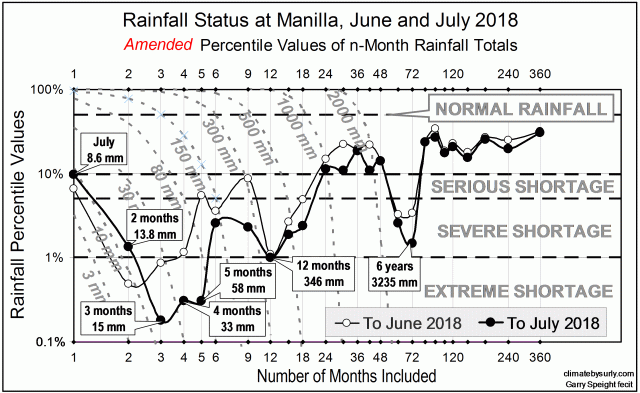
Rainfall shortages at June and July 2018.[Note 13/8/18. The large graph above is an  amended graph. Values in mm are unchanged, but percentile values have been recalculated. The 4-month and 5-month percentile values now plot as less extreme than before. The original graph is on the right.]
Graph of Rainfall Shortages

This graph shows all the present rainfall shortages at Manilla, short term and long term, in terms of percentile values. The latest values, as at the end of July, are shown by a black line with black circles. Those from one month earlier, at the end of June, are shown by a thinner line with smaller white circles.
The classes of rainfall shortage are:
• Serious shortage: below the 10th percentile;
• Severe shortage: below the 5th percentile;
• Extreme shortage: below the 1st percentile. [See note below on my usage “Extreme shortage”.]

[A graph showing shortages at the end of August is in a later post: “Drought Sixth Month; August 2018”.]

Extreme shortages

At Manilla, the drought is now extreme by several measures.
At the end of July 2018, rainfall shortages are extreme for 3 months (15 mm), 4 months (33 mm) and 5 months (58 mm). “Extreme shortage” means that Manilla has seen such shortages less than 1% of the time since 1883.
Since the end of June, rainfall totals have fallen lower for periods of 3, 4, 5, 6, and 9 months. The 5-month total fell most remarkably. It had been 121 mm, not even a “severe” shortage (below the 5th percentile), but merely a “serious” shortage (below the 10th percentile). It has now fallen to only 58 mm, which is an “extreme” shortage (below the 1st percentile). It is not much higher than the lowest ever 5-month rainfall total of 29 mm, a record set 130 years ago in 1888.

The graph makes it clear that we are now in the fifth month of an extreme drought.

Long-term shortages

At this date, there are no extreme rainfall shortages measured over periods longer than five months. However, there are some severe shortages below the fifth percentile rank. Should rainfall continue to be below average, these shortages could also become extreme. The current twelve-month total of 346 mm needs to fall only 19 mm (to 327 mm) to become an extreme shortage. The 6-year rainfall total (3234 mm) is a severe shortage lower than any since 1962. Rainfall shortages measured over periods of a year or more will not maintain groundwater levels or river flows.

[Note added July 2019.

This drought became very much worse with time. It is clearly one of the six worst droughts in history.
The rainfall status graph for June 2019 shows record-breaking low rainfall values at 15-, 18-, 24-, 30- and 72-month durations.]


Note: The term “Extreme shortage”

I have adopted classes of rainfall shortage from the classes of “Rainfall deficiency” defined by the Bureau of Meteorology in their Climate Glossary as follows:

“Serious rainfall deficiency: rainfall lies above the lowest five per cent of recorded rainfall but below the lowest ten per cent (decile range 1) for the period in question,
“Severe rainfall deficiency: rainfall is among the lowest five per cent for the period in question.
“Areas where the rainfall is lowest on record for the given time period are also shown.”

The Manilla rainfall record allows me to be more exact than the Bureau. Because the record extends back 134 years, it includes more than 1200 cumulative monthly rainfall values. I can identify percentile ranks even below the 0.1th percentile.
To the Bureau’s two classes of deficiency I add a third:

“Extreme deficiency (or extreme shortage): rainfall lies below the lowest one percent for the period in question.”


Rainfall Shortages up to June 2018

Rainfall shortage Manilla, June 2018

Since the twelve-month drought of 2002, Manilla has been free from extreme rainfall shortage until now. Such a long gap between extreme droughts has not been seen here before. [See Note below: Dry May 2006.]

Rainfall shortages now

On this graph the black line with black squares shows Manilla rainfall shortages at the end of June 2018. Shortages are shown for short terms down to one month, and for long terms up to 360 months (30 years).

[Shortages at the end of May are shown in a previous post.]

[A graph showing shortages at the end of July is in a later post: “Drought Fifth Month; July 2018”.]

Extreme shortages

Three extreme rainfall shortages have now developed, all below the 1st percentile rank:
Total for two months (May and June): 6 mm;
Total for three months (April, May and June): 24 mm;
Total for four months (March, April, May and June): 50 mm.

Severe shortages

There were five severe shortages in rainfall totals as follows:
Total for six months: 141 mm, at the 4th percentile;
Total for twelve months: 350 mm, at the 2nd percentile;
Total for fifteen months: 492 mm, at the 3rd percentile;
Total for sixty months: 2672 mm, at the 4th percentile;
Total for seventy-two months: 3317 mm, at the 4th percentile.

Serious shortages

Some other rainfall shortages were not severe, but serious:
Total for one month: 5.2 mm, at the 7th percentile;
Total for five months: 120 mm, at the 6th percentile;
Total for nine months: 464 mm, at the 10th percentile;
Total for eighteen months: 658 mm, at the 6th percentile.

Comparing June 2018 with the month before

Continue reading

Rainfall Shortages up to May 2018

Rainfall shortage Manilla May 2018

Rainfall shortages now

On this graph the black line with black squares shows Manilla rainfall shortages at the end of May 2018. Shortages are shown for short terms down to one month, and for long terms up to 360 months (30 years).

Extreme shortages

There were no extreme rainfall shortages at this date.

Severe shortages

There were severe shortages in rainfall totals as follows:
Total for one month (May): 1.2 mm, at the 2nd percentile;
Total for two months (April and May): 19 mm, at the 3rd percentile;
Total for three months (March, April and May): 45 mm, at the 4th percentile.

Serious shortages

Some other rainfall shortages were not severe, but serious:
Total for five months: 136 mm, at the 9th percentile;
Total for twelve months: 408 mm, at the 6th percentile;
Total for sixty months: 2765 mm, at the 8th percentile;
Total for seventy-two months: 3358 mm, at the 6th percentile.

General shortage

The first comment and reply below notes the fact that no rainfall total for any period reaches the 50th percentile. This has not happened for seventy years (1947).

[Later data

The following graph in this series is in the post: “Rainfall Shortages up to June 2018”. For the much worse situation in June 2019, see “June breaks more drought records”. ]

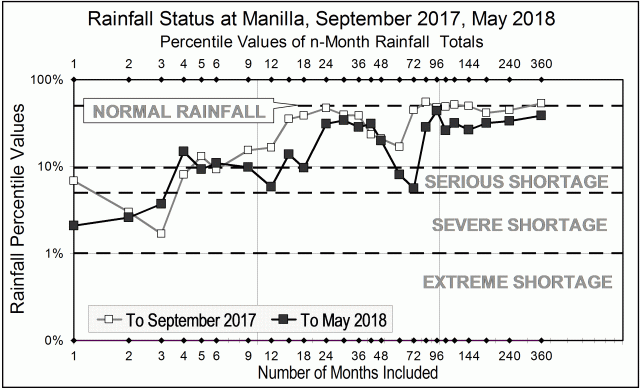
Comparing May 2018 with September 2017

The graph also has a grey line showing similar rainfall shortages at September 2017 (See the earlier post “A drought has begun”.). In the following month, October, there were no rainfall shortages, because the rainfall, 84 mm, was far above average. November, December and February also had rainfalls above average.
Since March 2018, shortages have appeared again. By comparing the black line (May 2018) with the grey line (September 2017), you can see that the rainfall totals are now lower for nearly all periods of time. Only four totals are now higher, including the 4-month total.

What are the classes of rainfall shortage?

We need to compare rainfall shortages. The best way is not by how far below normal the rainfall is, but by how rare it is. That is, not by the percentage of normal rainfall, but by the percentile value. As an example, when the rainfall is at the fifth percentile, that means that only five percent of all such rainfall measurements were lower than that.
Once the percentile values have been worked out for the rainfall record, each new reading can be given its percentile value. Percentile values of low rainfall are classed as extreme, severe, or serious.
For a rainfall shortage to be classed as extreme, its value must be at or below the 1st percentile.
A severe rainfall shortage is one that is below the 5th percentile.
A serious rainfall shortage is one that is below the 10th percentile.
A rainfall shortage that is above the 10th percentile is not counted as serious.

Long-lasting rainfall shortages

Rainfall shortages sometimes last a long time. The same classes of shortage are used for long periods, such as a year, as for short periods, such as a month. They depend on how rare such a shortage is on the average, and they all use the same percentile values to separate extreme, severe, and serious rainfall shortages.

A drought has begun

A year ago, I showed that Manilla was far from being in a drought. That is not true now. There are severe shortages of rain.

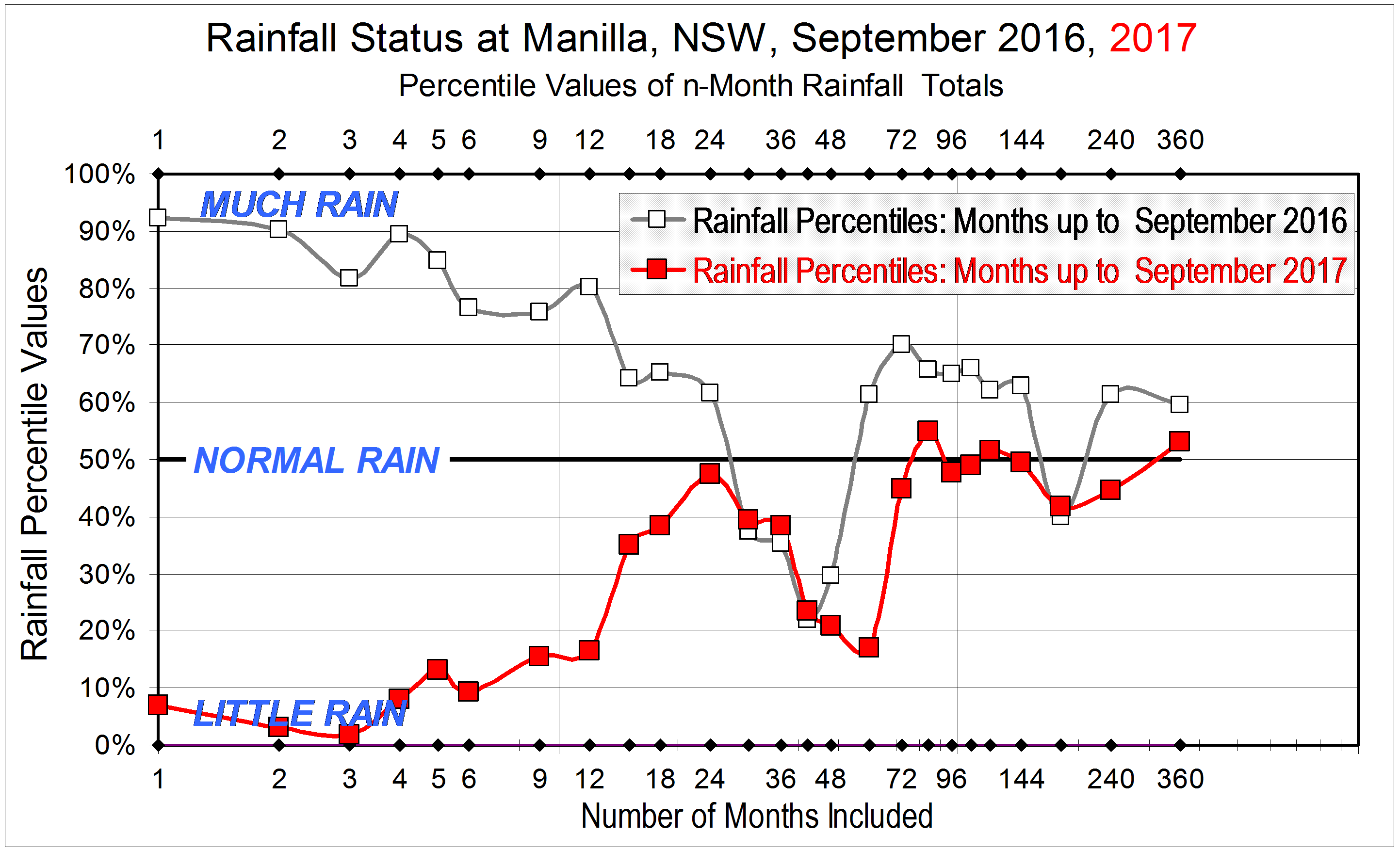
Rainfall status at Manilla, September 2016 and September 2017.

The first graph has rainfall totals up the left margin. They are not expressed in millimetres but as percentile values, Along the bottom margin is the number of months included in calculating each rainfall total.

On the graph, I have compared the rainfall situation today, September 2017, plotted in red with that of September 2016, plotted in grey. Much has changed.

Take, for example, the 12-month (one-year) rainfall total. Rainfall totals for 12 month periods are directly above the value “12” at the bottom of the graph, near the label “Number of Months included”. In data for the month of September 2016 (grey), the 12-month total (actually 802 mm) had been at the 80th percentile, which was very high. In up-to-date data for the month of September 2017 (red), the 12-month total (actually 484 mm) is at the 17th percentile, which is very low.
Although rainfall totals for  periods longer than 12 months have not fallen so much, nearly all of them have fallen. Three that have not are those for 30 months, 36 months and 42 months. They were already low, due to including in them some months of low rainfall several years ago, in 2013 and 2014.

So far, real shortages have occurred mainly within the last 12 months. Beyond that, the two-year rainfall total of 1285 mm, for example, is still near normal, plotting at the 48th percentile.

The second graph shows in detail how shortages that are serious or severe have developed during the last six months. These were the monthly rainfall amounts, with the normal amounts in brackets:

April: 24.0 mm (39.3);
May: 55.6 mm (40.3);
June: 62.8 mm (44.3);
July: 13.2 mm (41.4);
August: 13.8 mm (39.5);
September: 5.5 mm (41.2).

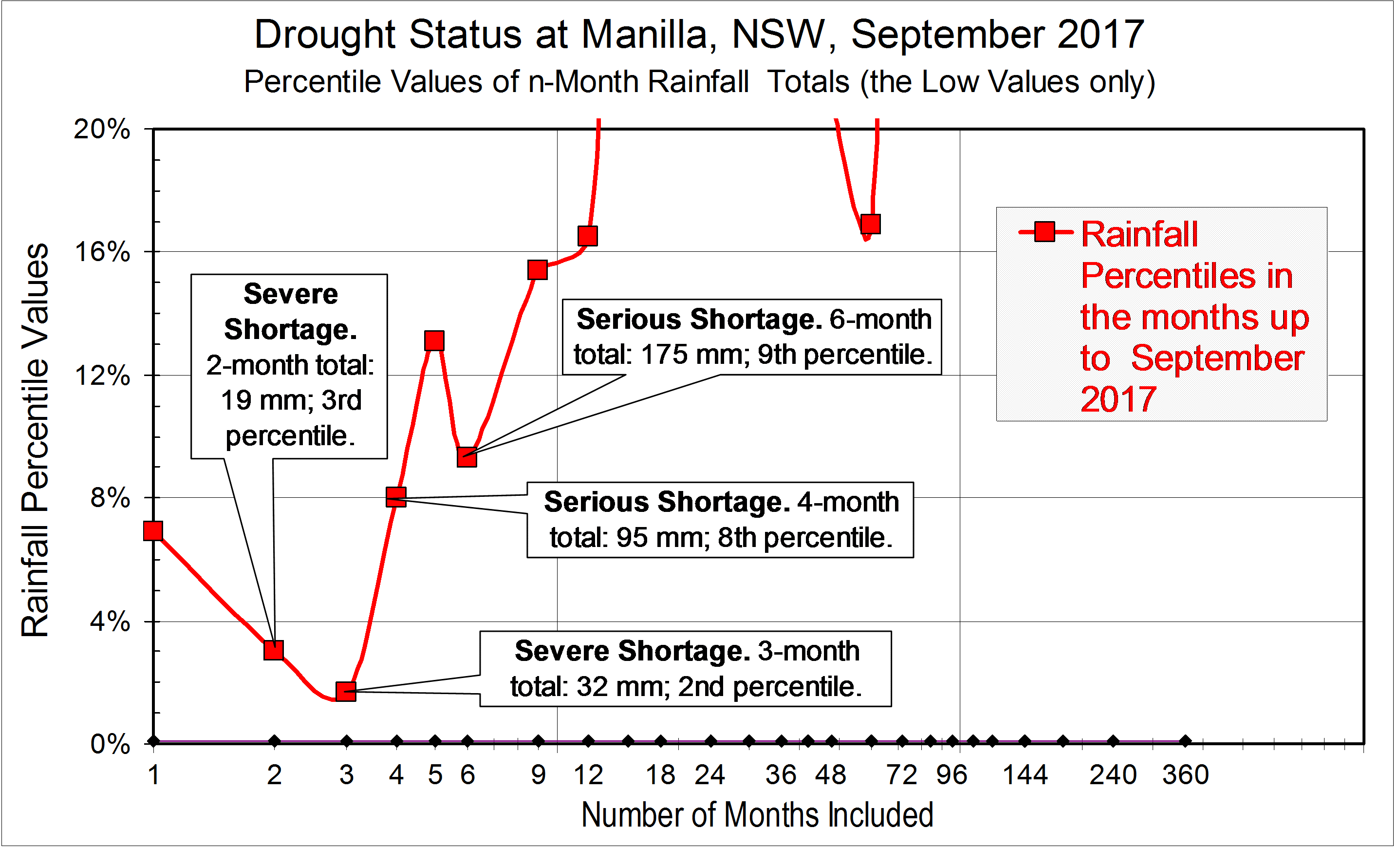
As a result, the current situation is as shown below. There are already severe rainfall shortages, at the 2nd or 3rd percentile, in the two-month and three-month totals to date. There are also serious shortages, at the 8th and 9th percentiles, in the four-month and six-month totals to date.

Drought status at Manilla in September 2017

I will update these graphs each month to show how the situation changes.

[Monthly updates were not posted because serious rainfall shortages did not occur in any following months up to March 2018. The next post with a graph and analysis like this one was “Rainfall Shortages up to May 2018” of 15/6/2018.]

[This 2018-19 drought became the worst ever experienced at Manilla. Records for the lowest-ever rainfall totals were broken repeatedly. See, for example (June 2019)  “June breaks more drought records”.]