June Climate Anomalies Log

Heat Indicators log for June months

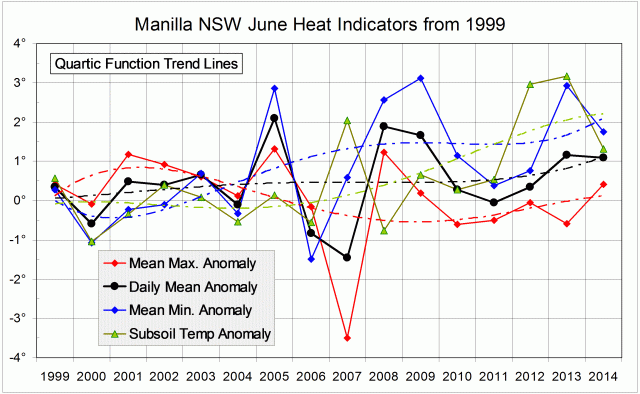
This post is the fourth in a set for the 12 calendar months. Graphs are sixteen-year logs of the monthly mean anomaly values of nine climate variables for Manilla, NSW, with fitted trend lines. I have explained the method in notes at the foot of the page.

Raw anomaly values for June

Extreme values of June anomalies in this period were:
Daily Maximum Temperature anomaly -3.5 deg: June 2007;
Daily Minimum Temperature anomaly +3.1 deg: June 2009;
Subsoil Temperature anomaly +3.2 deg: June 2013;
Rainfall Anomaly +65 mm: June 2005
Temperature range anomaly (minus) +4.1 deg: June 2007;
Temperature range anomaly (minus) +3.5 deg: June 2013;
Percent Cloudy Days +40%: June 2013.

Trend lines for June

Heat Indicators

The trend of mean temperature rose from zero at first to stay at 0.5 deg from 2004 to 2010, then rose again.
The trends of daily maximum and daily minimum temperature anomalies were mirror-reversed about the mean trend line. The maximum line reached a peak in 2003 and a trough in 2009, while the minimum line did the reverse. The subsoil temperature anomaly trend was slightly low in 2004 and was high in 2014.

Moisture Indicators log for June months

Continue reading

May Climate Anomalies Log

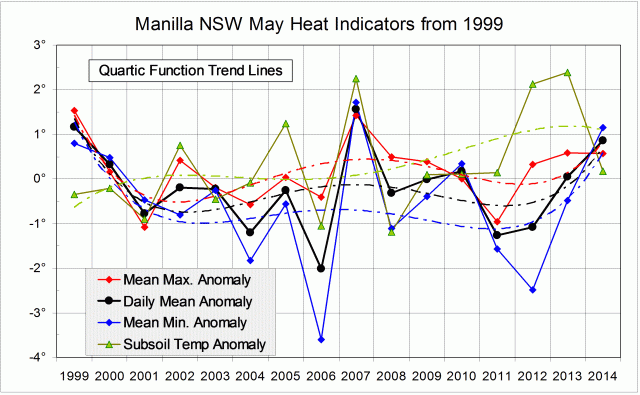
Heat Indicators log for May months

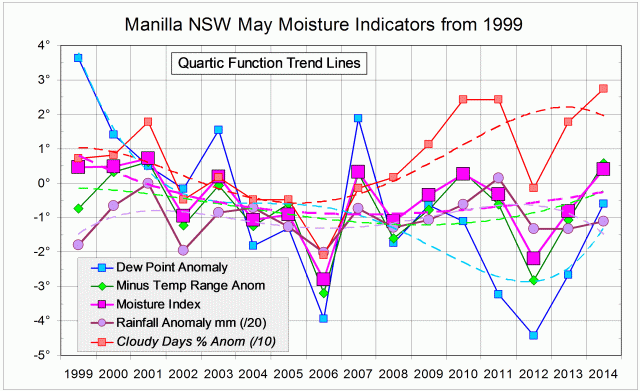
This post is the third in a set for the 12 calendar months. Graphs are sixteen-year logs of the monthly mean anomaly values of nine climate variables for Manilla, NSW, with fitted trend lines. I have explained the method in notes at the foot of the page.

Raw anomaly values for May

Extreme values of May anomalies in this period were:
Daily Minimum Temperature anomaly -3.6 deg: May 2006;
Morning Dew Point Anomaly +3.6 deg: May 1999;
Morning Dew Point Anomaly -3.9 deg: May 2006;
Morning Dew Point Anomaly -3.2 deg: May 2011;
Morning Dew Point Anomaly -4.4 deg: May 2012;
Temperature range anomaly (minus) -3.2 deg: May 2006.

Trend lines for May

Heat Indicators

The trends of all three air temperature anomalies were almost the same, except that anomalies of daily minimum temperature were more negative. All began high in 1999, reached a minimum in 2002, a maximum in 2007, and a minimum in 2011-12. The trend of subsoil temperature was contrary, and generally increasing.

Moisture Indicators log for May months Continue reading

April Climate Anomalies Log

Heat Indicators log for April months

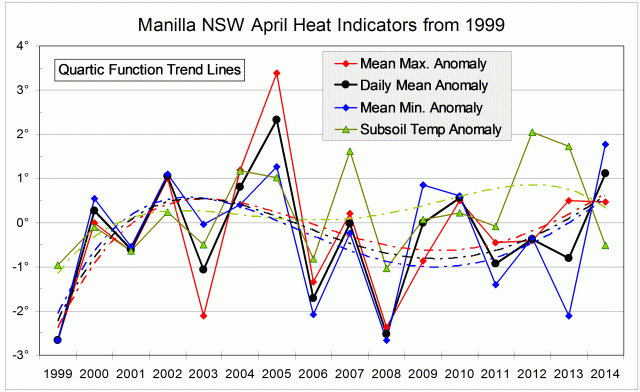
This post is the second in a set for the 12 calendar months. Graphs are sixteen-year logs of the monthly mean anomaly values of nine climate variables for Manilla, NSW, with fitted trend lines. I have explained the method in notes at the foot of the page.

Raw anomaly values for April

April anomalies had few extreme values in this period:
Daily Maximum Temperature anomaly +3.4°: April 2005;
Morning Dew Point Anomaly -3.3°: April 2008;
Morning Dew Point Anomaly -4.8°: April 2013;
Rainfall anomaly +79 mm: April 2003.

Trend lines for April

Heat Indicators

The trends of all three air temperature anomalies were almost the same. They began very low in 1999, reached a maximum in 2002-3 and a minimum in 2009-10. The trend of subsoil temperature began similarly, but with much less variation, and peaked in 2012.

Moisture Indicators log for April months

Continue reading

March Climate Anomalies Log

Heat Indicators log for March months

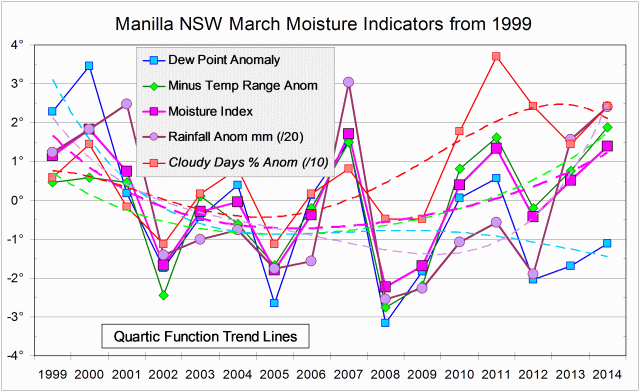
This post is the first in a set for the 12 calendar months. Graphs are sixteen-year logs of the monthly mean anomaly values of nine climate variables for Manilla, NSW, with fitted trend lines. I have explained the method in notes at the foot of the page.

Raw anomaly values for March

Extreme values for March anomalies in this period were:
Daily Minimum Temperature anomaly -2.9°: March 2008;
Morning Dew Point Anomaly +3.5°: March 2000;
Morning Dew Point Anomaly -3.2°: March 2008;
Rainfall anomaly +61 mm: March 2007;
Percent cloudy mornings anomaly +37%: March 2011.

Trend lines for March

Heat Indicators

Daily maximum temperature showed minima about -1 deg in 2001 and 2014, and a maximum about zero in 2007.
Daily minimum showed a minimum two years later, about 2003, then rose in parallel with daily maximum, but ended very high.
Subsoil temperature did not agree, and varied less. It had maxima in 2002 and 2012. It may show a lag of five years behind daily maximum.

Moisture Indicators log for March months

Continue reading

Manilla’s Hot Days

I have used my 13-year weather record to find the number of hot days in each year and in each month. Earlier I did the same for frosty mornings. Because the summer, which has the most hot days, crosses from one calendar year to the next, I have begun each year at July.
I have called days warmer than 35° “hot days”, and days warmer than 40° “very hot days”.

Total hot days

The first graph shows the number of hot and very hot days in each year. The most hot days were in the year ’09-’10, which had 44; the fewest were in the year ’11-’12, which had only 4. The 13-year average is 26, but the number of hot days is quite different from year to year.

Counting only the very hot days, ’03-’04 had the most (6), and four years had none at all. On the average, two days exceeded 40° in a year.
Hot days each year, and seasonal distribution.

Months with hot days

The second graph shows how the number of hot and very hot days peaks strongly in January, with very few earlier than November or later than March. On average, Manilla’s summer has about 22 days warmer than 35°, while spring has 3, and autumn only 1.


The other graphs show how each year had a different pattern of hot days. The highest monthly peaks, each 19 hot days, came in January 2003 (following drought) and January 2007. Annual peaks also came in January in 2008 and 2012, but these peaks were extremely low: only 4 and 3 hot days. Continue reading