June 2018 in drought

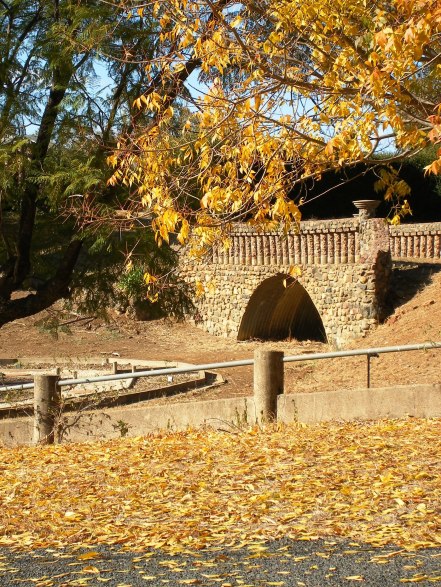
An ornamental stone bridge

Grantham’s Stone Bridge

As in the month before, temperatures remained near normal. The second week was warm. There were 13 frosts: the usual number. The early morning dew point on the 25th was a new low record for June.
There were only two rain days. The wetter registered 4.4 mm (estimated) on the 28th.
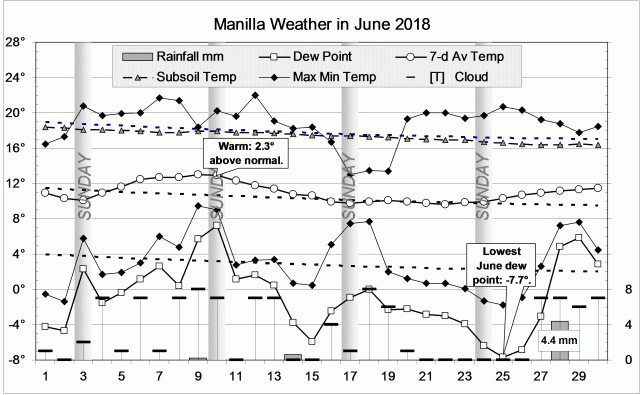
Weather log June 2018

Comparing June months

In recent June months, the mean temperature has hardly changed from 11°. However, moisture has varied a lot. June 2013 was very cloudy, and June 2016 very rainy. This month was very dry, not only with little rain, but also with the lowest June early morning dew point (-0.9°). Warm days (18.8°) and cool nights (3.1°) made for a wide daily temperature range (15.7°).

The rainfall total of 5.2 mm was at the 9th percentile. This very low value has carried rainfall totals for two months, three months, and four months down to become extreme shortages. Such shortages have not been seen here since 2002.
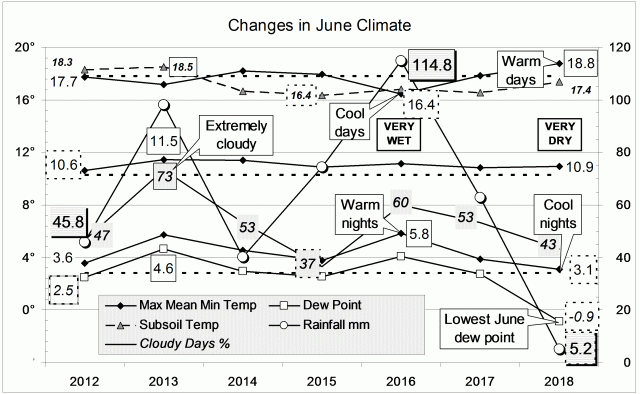
Climate in June months

Developing Drought

The rainfall shortages that have now become extreme are covered in other posts, such as “Rainfall Shortages up to June 2018”.


Data. A Bureau of Meteorology automatic rain gauge operates in the museum yard. From 17 March 2017, 9 am daily readings are published as Manilla Museum, Station 55312.  These reports use that rainfall data when it is available.  The gauge, which had last reported on 24 September 2017, came on line again on the 16th of March. During the month of June three daily readings were blank, including that on the wettest day. I have substituted my own gauge readings for those days.

All other data, including subsoil at 750 mm, are from 3 Monash Street, Manilla.
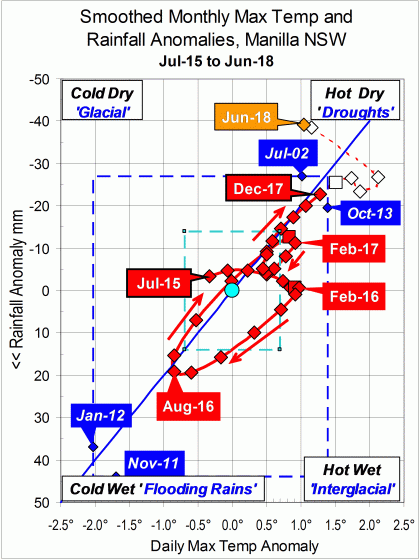
Cycling into drought

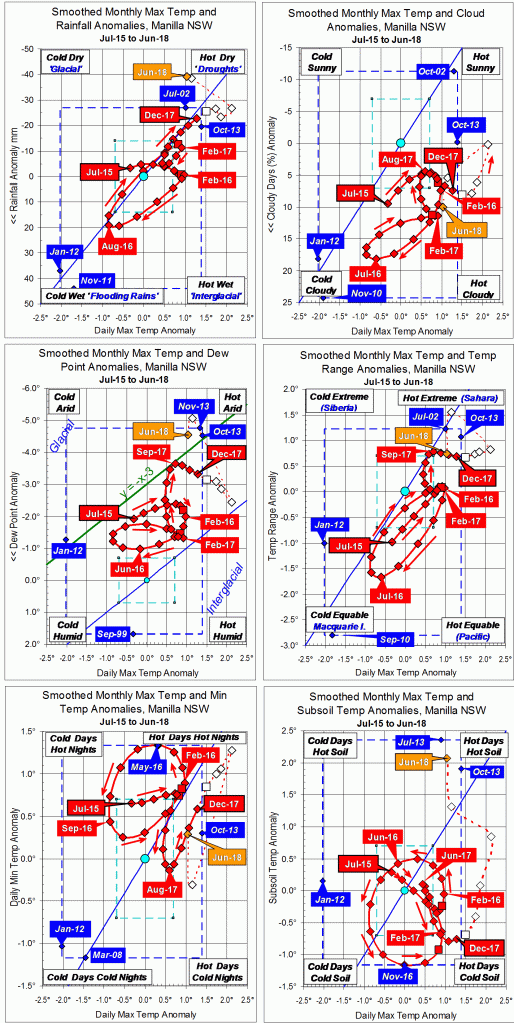
Graph of rainfall versus temperature at Manilla

In the last three years, the climate of Manilla has moved into drought. Rainfall has become lower than normal, and days have become warmer than normal.

The pattern of change

The pattern of change is clear on this graph only because the rainfall and temperature anomalies have been smoothed. Values for the last six months cannot yet be smoothed so well. Their pattern is ragged.
The first point on the graph, July 2015, is close to the Zero-Zero point of normal climate, marked by a circle in turquoise. Since then, the climate has cycled mainly along the blue line joining the two corners marked “Hot Dry ‘Droughts'” and “Cold Wet ‘Flooding Rains'”, as in Dorothea Mackellar’s poem “My Country”.
For the first seven months, to February 2016, while rainfall hardly changed, the temperature rose to above normal. Then, by August 2016, the climate became unusually cold and wet. This first cycle ended in January 2017 at the hot-dry limit of normal climate.
From February 2017, a second cycle began with movement towards cool and wet, but that ceased in May without getting as far as normal. Since May 2017, the movement has been persistently towards hot and dry.
The final smoothed data point, December 2017, is close to the 21st Century record for both low rainfall anomaly (minus 27.1 mm/month in July 2002) and high daily maximum temperature anomaly (plus 1.39 degrees in October 2013). New records seem likely to be set when values for 2018 can be smoothed.

Length of cycles

The cycles on this graph have a period close to one year. February had the highest smoothed daily maximum temperature anomaly in 2016 and in 2017. When smoothed, the same may be true in 2018.
Historically, the cycles cold-wet to hot-dry have a period of about two years (“quasi-biennial”) at Manilla and in Australia as a whole.
The climate cycles or climate trends associated with Global Warming have periods that are very much longer. They do not show on this graph. If they did, they would show as movement on the other diagonal, between the corners marked “Cold Dry ‘Glacial'” and “Hot Wet ‘Interglacial'”.

The 2002 drought

The most recent extreme drought was in 2002. A similar graph for that drought is in the post “Profile of an Extreme Drought”.

For context, see the post “Manilla’s Record of Droughts”.

Graphs of other variables

The graph in this post is one of a set of six, showing smoothed anomalies of variables versus smoothed daily maximum temperature. The variables are: rainfall, cloudiness, dew point, daily temperature range, daily minimum temperature, and subsoil temperature.
All six graphs, with further explanation, are in another post.

3-year trends to June 2018

Now in drought

Three year trends to June 2018

June raw anomaly data (orange)

The raw rainfall anomaly for June 2018 was very low (high on the graph), as was that of the month before. This placed June in drought, although the other moisture indicators were nearer to normal. Daily maximum and minimum temperatures were also not far above normal, but subsoil temperature was very high.

 Fully smoothed data (red)

The last fully-smoothed data is for December 2017. All variables, except subsoil temperature, continued trends set in the spring.

Daily maximum temperature anomaly approached a record high value.
Rainfall anomaly approached a record low value.
Cloudiness was static near its normal maximum.
Dew point anomaly was low but slowly rising.
Daily temperature range anomaly was high but slowly falling.
Daily minimum temperature anomaly was high and rising.
Subsoil temperature anomaly, which had been falling, began to rise.


Note:

Fully smoothed data – Gaussian smoothing with half-width 6 months – are plotted in red, partly smoothed data uncoloured, and raw data for the last data point in orange. January data points are marked by squares.
Blue diamonds and the dashed blue rectangle show the extreme values in the fully smoothed data record since September 1999.

Normal values are based on averages for the decade from March 1999.* They appear on these graphs as a turquoise (turquoise) circle at the origin (0,0). A range of anomalies called “normal” is shown by a dashed rectangle in aqua (aqua). For values in degrees, the assigned normal range is +/-0.7°; for cloudiness, +/-7%; for monthly rainfall, +/-14 mm.

 * Normal values for rainfall are based on averages for the 125 years beginning 1883.

Rainfall Shortages up to June 2018

Rainfall shortage Manilla, June 2018

Since the twelve-month drought of 2002, Manilla has been free from extreme rainfall shortage until now. Such a long gap between extreme droughts has not been seen here before. [See Note below: Dry May 2006.]

Rainfall shortages now

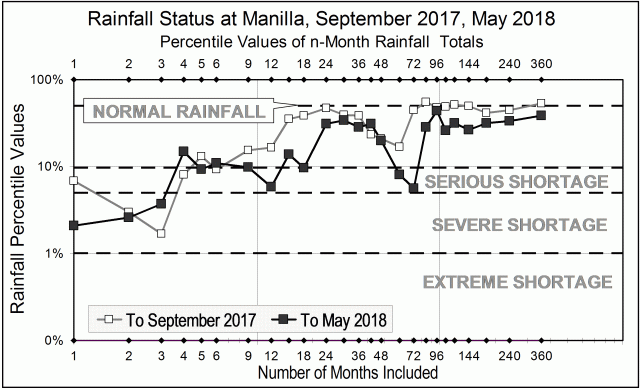
On this graph the black line with black squares shows Manilla rainfall shortages at the end of June 2018. Shortages are shown for short terms down to one month, and for long terms up to 360 months (30 years).

[Shortages at the end of May are shown in a previous post.]

[A graph showing shortages at the end of July is in a later post: “Drought Fifth Month; July 2018”.]

Extreme shortages

Three extreme rainfall shortages have now developed, all below the 1st percentile rank:
Total for two months (May and June): 6 mm;
Total for three months (April, May and June): 24 mm;
Total for four months (March, April, May and June): 50 mm.

Severe shortages

There were five severe shortages in rainfall totals as follows:
Total for six months: 141 mm, at the 4th percentile;
Total for twelve months: 350 mm, at the 2nd percentile;
Total for fifteen months: 492 mm, at the 3rd percentile;
Total for sixty months: 2672 mm, at the 4th percentile;
Total for seventy-two months: 3317 mm, at the 4th percentile.

Serious shortages

Some other rainfall shortages were not severe, but serious:
Total for one month: 5.2 mm, at the 7th percentile;
Total for five months: 120 mm, at the 6th percentile;
Total for nine months: 464 mm, at the 10th percentile;
Total for eighteen months: 658 mm, at the 6th percentile.

Comparing June 2018 with the month before

Continue reading

Rainfall Shortages up to May 2018

Rainfall shortage Manilla May 2018

Rainfall shortages now

On this graph the black line with black squares shows Manilla rainfall shortages at the end of May 2018. Shortages are shown for short terms down to one month, and for long terms up to 360 months (30 years).

Extreme shortages

There were no extreme rainfall shortages at this date.

Severe shortages

There were severe shortages in rainfall totals as follows:
Total for one month (May): 1.2 mm, at the 2nd percentile;
Total for two months (April and May): 19 mm, at the 3rd percentile;
Total for three months (March, April and May): 45 mm, at the 4th percentile.

Serious shortages

Some other rainfall shortages were not severe, but serious:
Total for five months: 136 mm, at the 9th percentile;
Total for twelve months: 408 mm, at the 6th percentile;
Total for sixty months: 2765 mm, at the 8th percentile;
Total for seventy-two months: 3358 mm, at the 6th percentile.

General shortage

The first comment and reply below notes the fact that no rainfall total for any period reaches the 50th percentile. This has not happened for seventy years (1947).

[Later data

The following graph in this series is in the post: “Rainfall Shortages up to June 2018”. For the much worse situation in June 2019, see “June breaks more drought records”. ]

Comparing May 2018 with September 2017

The graph also has a grey line showing similar rainfall shortages at September 2017 (See the earlier post “A drought has begun”.). In the following month, October, there were no rainfall shortages, because the rainfall, 84 mm, was far above average. November, December and February also had rainfalls above average.
Since March 2018, shortages have appeared again. By comparing the black line (May 2018) with the grey line (September 2017), you can see that the rainfall totals are now lower for nearly all periods of time. Only four totals are now higher, including the 4-month total.

What are the classes of rainfall shortage?

We need to compare rainfall shortages. The best way is not by how far below normal the rainfall is, but by how rare it is. That is, not by the percentage of normal rainfall, but by the percentile value. As an example, when the rainfall is at the fifth percentile, that means that only five percent of all such rainfall measurements were lower than that.
Once the percentile values have been worked out for the rainfall record, each new reading can be given its percentile value. Percentile values of low rainfall are classed as extreme, severe, or serious.
For a rainfall shortage to be classed as extreme, its value must be at or below the 1st percentile.
A severe rainfall shortage is one that is below the 5th percentile.
A serious rainfall shortage is one that is below the 10th percentile.
A rainfall shortage that is above the 10th percentile is not counted as serious.

Long-lasting rainfall shortages

Rainfall shortages sometimes last a long time. The same classes of shortage are used for long periods, such as a year, as for short periods, such as a month. They depend on how rare such a shortage is on the average, and they all use the same percentile values to separate extreme, severe, and serious rainfall shortages.