Rainfall Deficiencies II: 12-months Duration

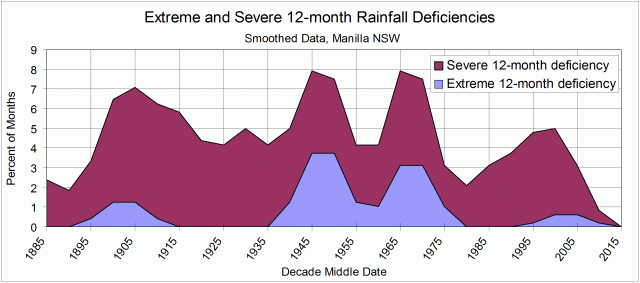
Log of severe and extreme rainfall deficiency of 12-month duration at Manilla

This is the second of four graphs that show Manilla’s history of rainfall deficiencies (rainfall droughts), for periods of duration 3 months, 12 months, 36 months, and 120 months.

This second graph includes those periods of severe or extreme rainfall deficiency that last twelve months. They are rainfall droughts that affect four successive seasons, sometimes making for two failures a year apart.
In Manilla’s climate, a time of severe 12-month rainfall deficiency has a rainfall total less than 400 mm, when it normally would be 640 mm.
The graph shows that such one-year droughts were very common around 1945-1950 and 1965-1970 (in 8% of months) and also 1905 (in 7% of months). They were not common (only 2% of months) around 1885, 1890, and 1980. Recently, around 2015, there have been none at all.
Remarkably, extreme 12-month rainfall droughts (in blue) were almost as common as severe ones in the long period from 1940 to 1975.

Note added June 2015

I have analysed a remarkable and unexpected relation between days of heavy rainfall and the frequency of year-long droughts at Manilla (as graphed here) in a series of posts:
More droughts After Heavier Rains I.
More droughts After Heavier Rains II.
More droughts After Heavier Rains III.

Areas shown on the graph

Rainfall deficiencies are called “severe” when they are lower than are recorded for five percent of the months. I have called deficiencies “extreme” when they are lower than are recorded for one percent of the months.
In this graph, I have coloured extreme deficiencies in blue. The maroon colour is deficiencies that are severe, but not extreme. The top edge of the maroon area marks the proportion of severe deficiencies including extreme deficiencies. As an average, this line is at five percent.
Data analysis

Continue reading

Rainfall Deficiencies I: 3-months Duration

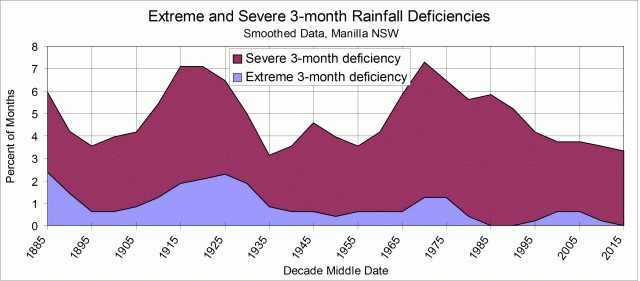
Log of severe and extreme rainfall deficiency  of 3-month duration at Manilla

This is the first of four graphs that show Manilla’s history of rainfall deficiencies (rainfall droughts), for periods of duration 3 months, 12 months, 36 months, and 120 months.

This first graph includes those short periods of severe or extreme rainfall deficiency that last only three months. They are rainfall droughts for one season rather than for a year or more. Crops and pastures may fail.
In Manilla’s climate, a time of severe 3-month rainfall deficiency has a rainfall total less than 50 mm, when it normally would be 150 mm.
The graph shows that such short-term droughts have occurred in every decade, but more often in some than in others. These brief droughts were most common (in 7% of months) around 1915, 1920 and 1970. They were least common (in only 3% of months) around 1895, 1935, 1940, 1955, and (more recently) in the twenty years since 1995.
Extreme short-term droughts (3-month total less than 26 mm) were more common near those times when severe short-term droughts were more common.

Areas shown on the graph

Rainfall deficiencies are called “severe” when they are lower than are recorded for five percent of the months. I have called deficiencies “extreme” when they are lower than are recorded for one percent of the months.
In this graph, I have coloured extreme deficiencies in blue. The maroon colour is deficiencies that are severe, but not extreme. The top edge of the maroon area marks the proportion of severe deficiencies including extreme deficiencies. As an average, this line is at five percent.
Data analysis

Continue reading

Extreme Droughts by Decade at Manilla

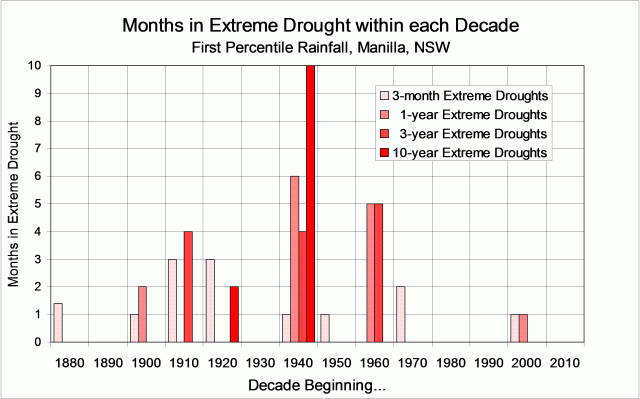
Extreme droughts per decade at Manilla NSW

The record of extreme droughts at Manilla, NSW, relates to the Southern Oscillation only now and then, and relates to global warming not at all.

This graph shows some of the same data as I presented earlier in the post “Manilla’s Record of Droughts”. The graph there showed precise dates, but it was hard to tell when extreme droughts were more or less frequent. This graph adds up the number of months of extreme drought in each decade. (See Note below: How I count drought months.)

There are separate columns (getting progressively redder) for extreme droughts of duration 3 months, 1 year, 3 years, and 10 years.
Extreme droughts of 10-year duration occurred only in the 1920’s and 1940’s.
Extreme droughts of 3-year duration occurred in the 1910’s, 1940’s, and 1960’s.
Extreme droughts of 1-year duration occurred in the 1900’s, 1940’s, 1960’s and 2000’s.
Extreme droughts of 3-month duration occurred in the 1880’s, 1900’s, 1910’s, 1920’s, 1940’s, 1970’s and 2000’s.
No extreme droughts at all occurred in five of the fourteen decades: the 1890’s, 1930’s, 1980’s, 1990’s, and 2010’s.

[Note added August 2019.

More data for the decade beginning 2010.
This post, dated December 2014, shows no extreme droughts in the decade beginning 2010. Extreme droughts did occurr in 2018 and 2019, as shown in the post “Rain Shortage Jan 2000 – May 2019”.
By August 2019, some months of extreme drought at 3-month and 1-year duration had occurred, and a month at 3-year duration was imminent.]

Relation to the Southern Oscillation Index

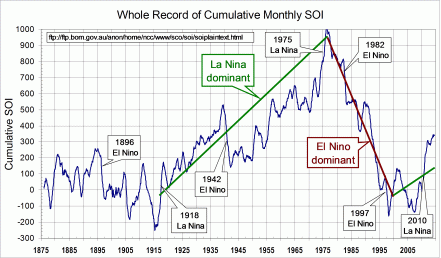
I posted this graph of cumulative values of the SOI earlier.

SOI CUSUM plot

The record of the Southern Oscillation Index relates to the Manilla record of extreme rainfall deficiency only now and then. Persistent El Niños from 1911 to 1915 seem to relate to four months in the decade of the 1910’s having extreme 3-year droughts, carrying forward to two months in the 1920’s having extreme 10-year droughts. Similarly, the catastrophic droughts of short to very long duration in the 1940’s relate to El Niños that persisted from 1939 to 1942.
Other major El Niño events did not produce extreme droughts at Manilla: those of 1896, 1982, and 1997.
Long term trends in the Southern Oscillation Index do not predict Manilla’s extreme droughts at all. The 1940’s droughts Continue reading

House Thermal Mass Works in Summer Too

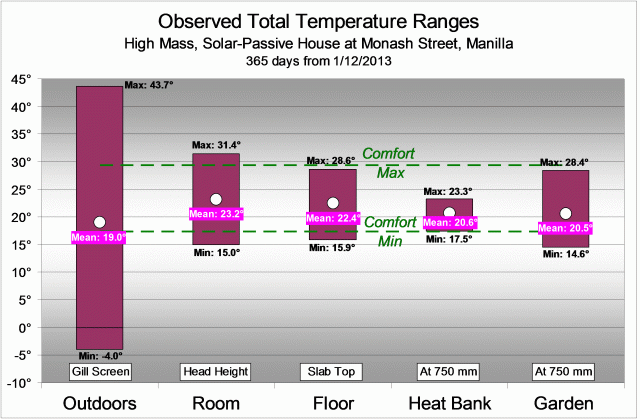
House temperature ranges diagram

My house at Manilla, NSW, is in a climate with temperatures that are extreme, but comfortable on the average. To reduce extreme temperatures indoors, the house contains more than a hundred tonnes of thermal mass within a shell of insulation.
The “thermal mass” is the materials, such as bricks, stones, concrete, earth or water, that have high thermal capacity (See Notes below): they take in and give out a lot of heat.
Many people, who can see that having thermal mass inside a house will help to keep it warm in winter, think that the thermal mass will make it hard to keep the house cool in summer. They see many brick and brick-veneer houses in which thermal mass is exposed to the intense heat of the summer sun. In that case, thermal mass material does no good.

In this graph, I have used my last twelve months of temperature data to show the benefit of well-insulated thermal mass in summer as well as in winter.
Outdoor temperature in this year went as low as minus 4.0° Celsius and as high as plus 43.7°: a range of 47.7°. Continue reading

Spring 2014 dry and hotter

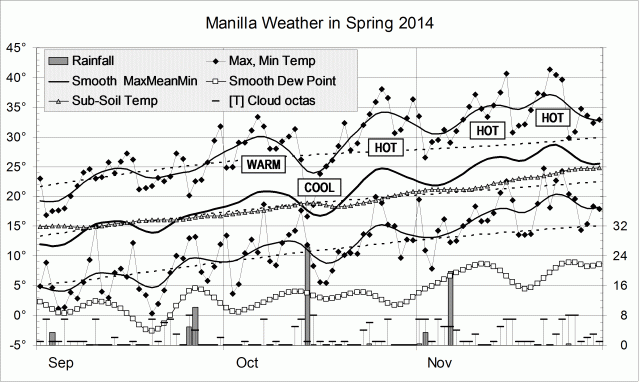
Weather log for spring 2014

Warm weather developed in early October, followed by a cool spell with one rain day of 26.4 mm. After that came three hot spells. There were showers and storms in the district, but little more rain fell at Manilla.
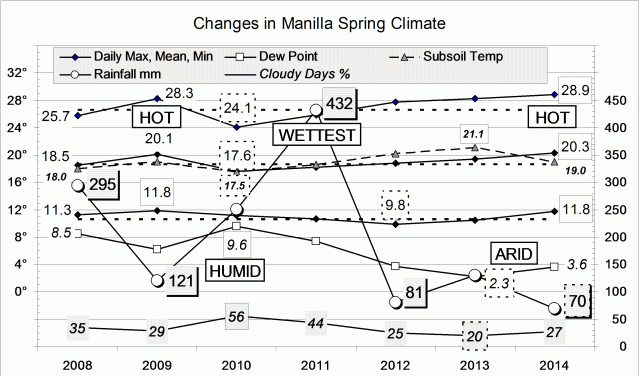
This spring was slightly hotter than spring 2013 and spring 2009, but not as hot as spring 2002. The air was not as extremely arid (dew point 3.6°) as in last spring (dew point 2.3°), and skies were a little more cloudy.
The total rainfall of 69.8 mm was in the 8th percentile: the 10th lowest spring rainfall. (Spring 2002 had been equal 5th lowest at 66 mm, and spring 1957 the lowest at 23 mm.) Rain fell on 11 days: more than in spring of 2002 (9 days), but fewer than in 2013 (13).

Climate for spring 2014


Data. Rainfall data is from Manilla Post Office, courtesy of Phil Pinch. Temperature, including subsoil at 750 mm, and other data are from 3 Monash Street, Manilla.