Drought worse in July.

At Manilla, most rainfall totals just got lower.
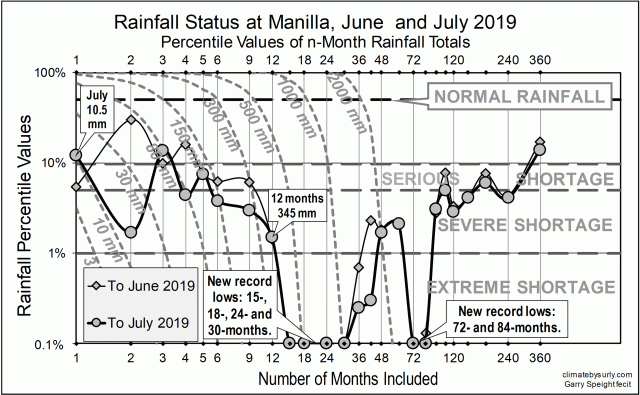
Rainfall status June and July 2019

Graph of Rainfall Shortages

This graph shows all the present rainfall shortages at Manilla, short term and long term, as percentile values. The latest values, as at the end of July, are shown by a thick black line with large circles. Those from one month earlier are shown by a thinner line with small diamonds. [The method is described in “Further Explanation” below.]

Results for July

Rainfall totals for months to July 2019 are the lowest ever registered here for six of the twenty-five chosen rainfall durations: 15-, 18-, 24-, 30-, 72- and 84-months.
Only three of the chosen durations do not have serious rainfall shortages below the 10th percentile: 1-month, 3-months and 360-months. Even those three values are far below normal, at the 12th, 14th, and 14th percentiles.

Weatherzone forum closed

I posted a provisional version of this graph to catch the final deadline for posting to the weatherzone forum. My first post was nearly 16 years ago.
That forum is now closed to postings and will close completely in November. It closed due to lack of public interest in climate and weather in Australia.


Further Explanation

The following notes explain aspects of this work under these listed headings:

Data analysis

Cumulative rainfall totals
Percentile values
Severity of rainfall shortages

Limitations of this analysis

Monthly rainfalls form a single population
Observations are not retrospective
The rain gauge failed

Data analysis

Continue reading

21-C Climate: Mackellar cycles

At Manilla, NSW, the anomaly of daily maximum temperature has continued to track, in the opposite sense, that of monthly rainfall.

Graphical log of smoothed rainfall and temperature.

The values shown are anomalies from normal values, smoothed to suppress cycles shorter than 12 months. (See notes below on Normals and Smoothing.)

The pattern is of quasi-biennial cycles that express the insight of Dorothea Mackellar that this is a land “of droughts and flooding rains*. Hot dry times alternate with cool wet times. For temperature, I have chosen the mean daily maximum, as it best matches the rainfall.

This post updates others in the Menu Category “Manilla NSW/21st century climate/Anomalies smoothed”, such as “17 years of ‘Droughts and Flooding Rains’ at Manilla” (29/06/2014).

“Droughts” (hot dry times)

Winter-spring 2002. The drought of 2002 was extreme, having rainfall in the lowest 1% in history. Lowest rainfall anomaly was in the winter and highest temperature anomaly in the spring.

Spring 2009. The temperature anomaly in spring 2009 was as high as in 2002, but the rainfall (as smoothed) barely qualified as “drought”.

Spring-summer 2013. The maximum temperature anomaly in spring 2013 was again like that in 2002 and 2009. This time, the rainfall minimum came later, in the summer. The drought was severe but not extreme.

Autumn-winter 2018. The temperature anomaly peak was higher than the earlier peaks. The minimum rainfall anomaly that followed in the winter was again extreme.

Summer 2018-19. At this time, the temperature anomaly was the highest, and the rainfall anomaly the lowest on this graph.

“Flooding Rains” (cool wet times)

Spring 2005. The spring of 2005 was wet, but the temperature was not cool but rather warm.

Summer 2007-8. Although the summer of 2007-8 was cool, rainfall was normal. Continue reading

June breaks more drought records

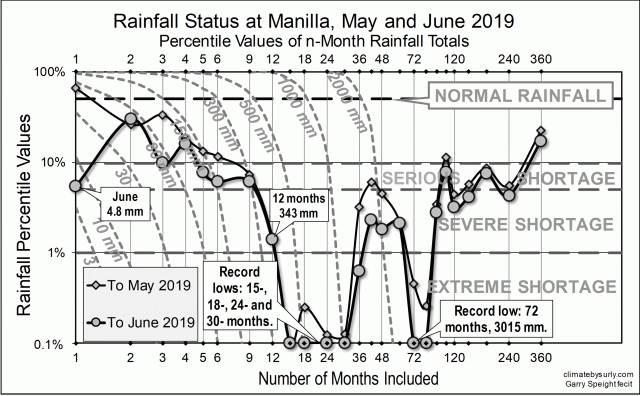
Rainfall status May-June 2019

Graph of Rainfall Shortages

This graph shows all the present rainfall shortages at Manilla, short term and long term, as percentile values. The latest values, as at the end of June, are shown by a thick black line with large circles. Those from one month earlier are shown by a thinner line with small diamonds. [The method is described in “Further Explanation” below.]

Changes from May to June

The June rainfall of only 4.8 mm took Manilla’s rainfall status curve back to where it was in April.
Five records for low rainfall totals have been broken yet again: the totals for 15-, 18-, 24-, 30-and 72-months. The 84-month total at June (3660 mm) is also extremely low, but ranks second-driest to April 2019.
The record for a 15-month dry spell, which had stood at 404 mm since 1912, has been broken four times in this drought, and now stands at 367 mm. That is down by 37 mm, or nearly 10% below the 1912 figure. The 24-month record had stood at 766 mm since 1966 when it was broken this April, May, and June. It now stands 73 mm lower, at 693 mm.


Further Explanation

The following notes explain aspects of this work under these listed headings:

Data analysis

Cumulative rainfall totals
Percentile values
Severity of rainfall shortages

Limitations of this analysis

Monthly rainfalls form a single population
Observations are not retrospective
The rain gauge failed

Data analysis

Continue reading

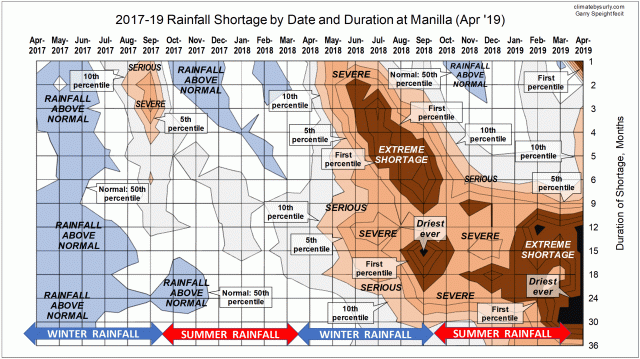
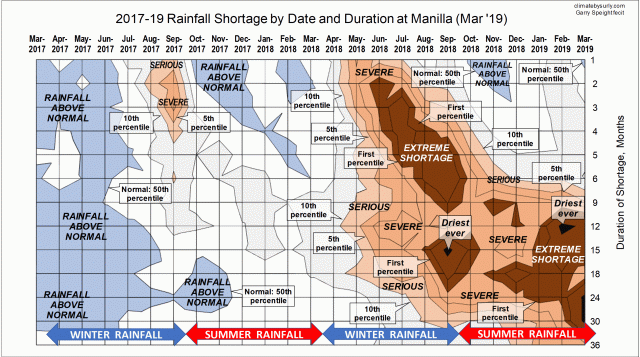
Rainfall shortage: series of contour plots

This graph is one of a series. All are copied here.

Sequence of rainfall shortages to May 2019

Twenty-five months to May 2019.

The above graph is described here.

Sequence of raiinfall shortages to April 2019

Twenty-five months to April 2019.

The above graph is described here.

Sequence of raiinfall shortages to March 2019

Twenty-five months to March 2019.

Continue reading

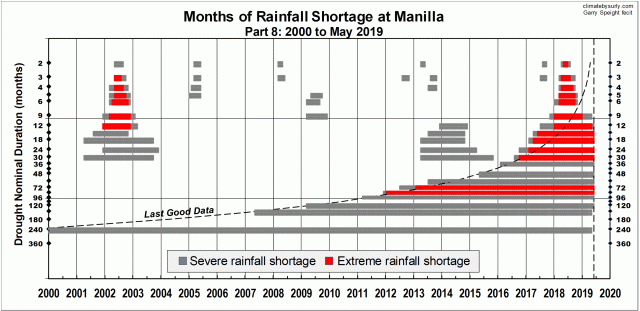
Rain Shortage Jan 2000 – May 2019

Record of rain shortages Jan 2000 May 2019

The current drought now has a severe rainfall shortage of 240 months duration that must have commenced in 1999.

[For explanation of this graph, see below: “About drought duration graphs”.]

[These graphs have been updated to October 2019, showing much worse shortages.]

Shortages at 2018

Shortages of rainfall became alarming in 2018. The winter months had extreme shortages of 2-month to 6-month duration. Earlier and later dry months contributed to longer-term extreme shortages from 9 months up to 30-months.
In months since November 2018 none of the short-term rainfall totals for durations from two months to six months has been even a severe shortage. In other respects, the drought has deepened. Because recent monthly rainfall values have seldom risen above normal, periods of severe or extreme shortage have become longer and longer. As at May 2019, extreme shortages prevail at 15-, 18-, 24-, 30-, 72- and 84-month durations.
Severe shortages have developed at even longer durations, at 96-, 120-, 150- and 240-months. As is clear from the graph, the 240-month severe shortage incorporates the 2002 drought into the 2018 drought. This was not evident until now.
As shown, the severe shortages of 150- and 240-month duration, current in April 2019, did not persist in observations for May. They could resume if later months do not have much rain. [Actually, this was a copy-down error.]

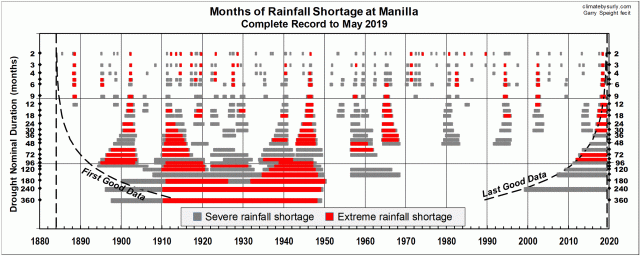
Drought record to May 2019

Compete record updated to May

When the graph of the complete record of months of rainfall shortage at Manilla is updated to May 2019 it is obvious that the current drought is one of the great droughts in history.
Although this drought seemed to have a sudden onset, shortages of longer duration actually began earlier: the longer the duration concerned, the earlier its time of onset.. The 2018 pattern is like the droughts of 1902, 1940 and 1946. Droughts that actually had a sudden onset were those of 1912, 1957 and 1965.


About drought duration graphs

These graphs show the onset, persistence, and breaking of episodes of extreme and severe rainfall shortage (droughts) at Manilla. The first shows detail since 2000. The second shows the complete historical record from 1884. The graph features and the data analysis are explained in the post “Rainfall Shortage History: Manilla”.

Extreme shortages, up to the 1st percentile, are shown in red and severe shortages, up to the 5th percentile, are shown in grey.
The dashed line labelled “Last Good Data” is a limitation of observed cumulative rainfall deficiency. Future observations may make any point to the right of this line more extreme.