Manilla in Global Warming Context: II

Logs of smoothed world and local temperatures. (25/7/14)

This post updates a similar post that was based on data available in July 2011. I now have data from three more years.

World surface air temperature

The blue line shows how the air has warmed and cooled during the 21st century. It is based on GISS, which is one of three century-long records that estimate the surface air temperature of the whole earth. The other two are HadCRUT and NCDC.
Monthly values of GISS vary wildly, and I have smoothed them with a 37-month moving average. Ole Humlum uses 37-month smoothing in many graphs on his website.

The 37-month smoothing allows plotting only up to 18 months ago, in December 2012. As you see, the GISS air temperature anomaly (See Note 1.), when smoothed in this way, moves rather steadily in one direction for years at a time.

The world’s surface air warmed rapidly from early 2000 to late 2002, then warmed slowly to a peak in early 2006. This is the warmest the world surface air has been in hundreds of years. After that peak, the air cooled rapidly by two-thirtieths of a degree to a trough in late 2007. It warmed again slowly to a lower peak in early 2010, steadied for a year, then fell to a trough in January 2012 that was like the previous trough. The air warmed rapidly through 2012. Continue reading
June Climate Anomalies Log

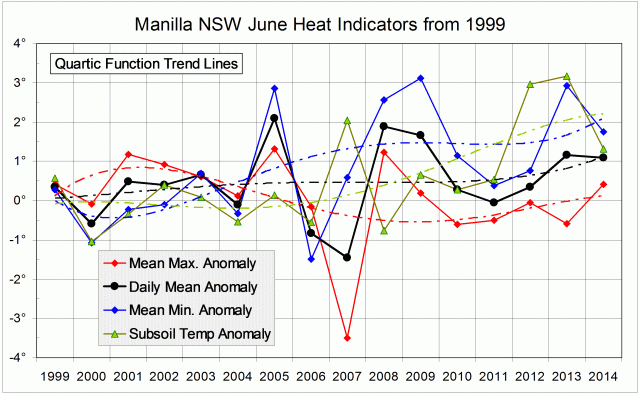
Heat Indicators log for June months

This post is the fourth in a set for the 12 calendar months. Graphs are sixteen-year logs of the monthly mean anomaly values of nine climate variables for Manilla, NSW, with fitted trend lines. I have explained the method in notes at the foot of the page.

Raw anomaly values for June

Extreme values of June anomalies in this period were:
Daily Maximum Temperature anomaly -3.5 deg: June 2007;
Daily Minimum Temperature anomaly +3.1 deg: June 2009;
Subsoil Temperature anomaly +3.2 deg: June 2013;
Rainfall Anomaly +65 mm: June 2005
Temperature range anomaly (minus) +4.1 deg: June 2007;
Temperature range anomaly (minus) +3.5 deg: June 2013;
Percent Cloudy Days +40%: June 2013.

Trend lines for June

Heat Indicators

The trend of mean temperature rose from zero at first to stay at 0.5 deg from 2004 to 2010, then rose again.
The trends of daily maximum and daily minimum temperature anomalies were mirror-reversed about the mean trend line. The maximum line reached a peak in 2003 and a trough in 2009, while the minimum line did the reverse. The subsoil temperature anomaly trend was slightly low in 2004 and was high in 2014.

Moisture Indicators log for June months

Continue reading

May Climate Anomalies Log

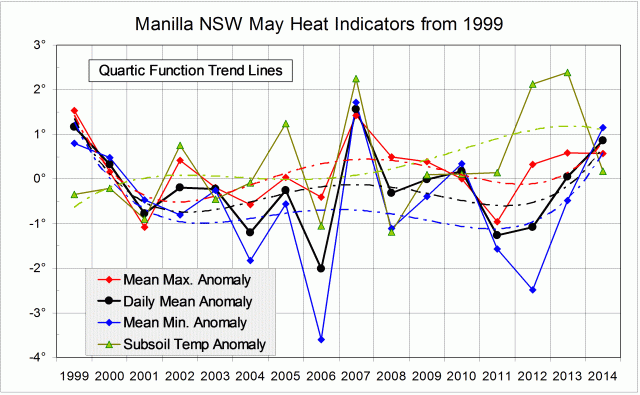
Heat Indicators log for May months

This post is the third in a set for the 12 calendar months. Graphs are sixteen-year logs of the monthly mean anomaly values of nine climate variables for Manilla, NSW, with fitted trend lines. I have explained the method in notes at the foot of the page.

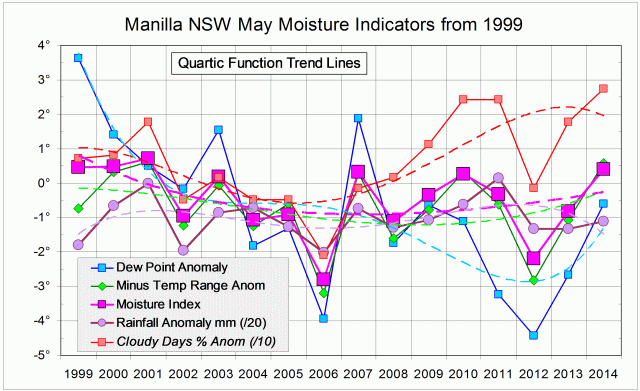
Raw anomaly values for May

Extreme values of May anomalies in this period were:
Daily Minimum Temperature anomaly -3.6 deg: May 2006;
Morning Dew Point Anomaly +3.6 deg: May 1999;
Morning Dew Point Anomaly -3.9 deg: May 2006;
Morning Dew Point Anomaly -3.2 deg: May 2011;
Morning Dew Point Anomaly -4.4 deg: May 2012;
Temperature range anomaly (minus) -3.2 deg: May 2006.

Trend lines for May

Heat Indicators

The trends of all three air temperature anomalies were almost the same, except that anomalies of daily minimum temperature were more negative. All began high in 1999, reached a minimum in 2002, a maximum in 2007, and a minimum in 2011-12. The trend of subsoil temperature was contrary, and generally increasing.

Moisture Indicators log for May months Continue reading

17 Years of “Droughts and Flooding Rains” at Manilla

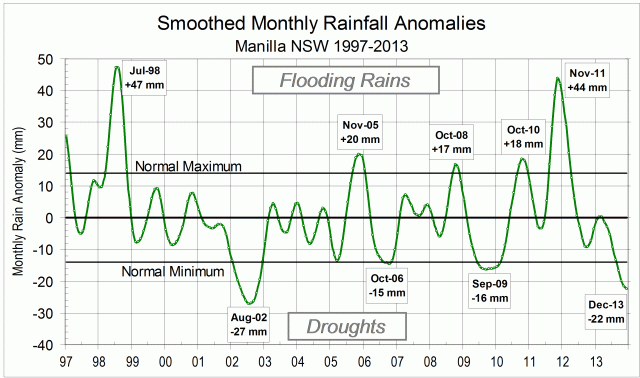
Manilla 17-year smoothed rainfall anomaly record

Times when Dorothea Mackellar’s “droughts and flooding rains”* affected Manilla in the years from 1997 are shown by the wavy line on this graph. The climate swings in and out of times of high and low rainfall.

Peaks or troughs were often a year or two apart, but most of them were not very far from the normal rainfall value. Only two of the troughs were so far below normal that they were severe droughts: August 2002, and December 2013 (or maybe later). Milder droughts came in October 2006 and September 2009.
The rainfall in these 17 years was not below the long-term average, but slightly above it. As well as droughts there were two peaks of extremely high rainfall: in July 1998 (when the new Split-Rock reservoir suddenly filled) and in November 2011. These “deluges” had rainfall that was further from normal than the low rainfall in the droughts. Other rainfall peaks came in November 2005, October 2008, and October 2010.
In total, there were nine peaks and troughs with rainfall outside the normal range. Six of them came in the spring months of September, October or November.
Peaks and troughs in rainfall at Manilla quite often come near times of La Niña and El Niño. These are events in the record of Pacific Ocean temperatures called ENSO (El Niño – Southern Oscillation). The ENSO record for the last 17 years is shown in the second graph.

Continue reading

April Climate Anomalies Log

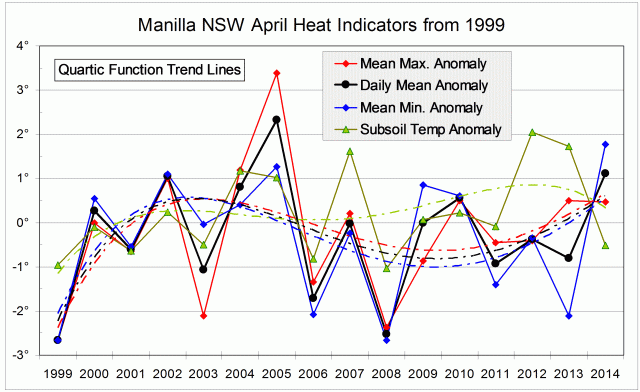
Heat Indicators log for April months

This post is the second in a set for the 12 calendar months. Graphs are sixteen-year logs of the monthly mean anomaly values of nine climate variables for Manilla, NSW, with fitted trend lines. I have explained the method in notes at the foot of the page.

Raw anomaly values for April

April anomalies had few extreme values in this period:
Daily Maximum Temperature anomaly +3.4°: April 2005;
Morning Dew Point Anomaly -3.3°: April 2008;
Morning Dew Point Anomaly -4.8°: April 2013;
Rainfall anomaly +79 mm: April 2003.

Trend lines for April

Heat Indicators

The trends of all three air temperature anomalies were almost the same. They began very low in 1999, reached a maximum in 2002-3 and a minimum in 2009-10. The trend of subsoil temperature began similarly, but with much less variation, and peaked in 2012.

Moisture Indicators log for April months

Continue reading