Extreme Droughts by Decade at Manilla

Extreme droughts per decade at Manilla NSW

The record of extreme droughts at Manilla, NSW, relates to the Southern Oscillation only now and then, and relates to global warming not at all.

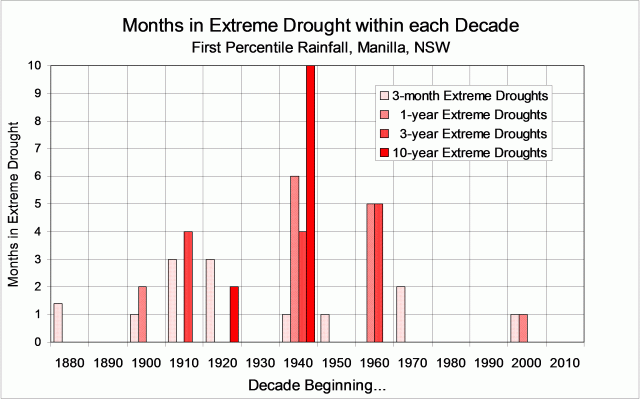
This graph shows some of the same data as I presented earlier in the post “Manilla’s Record of Droughts”. The graph there showed precise dates, but it was hard to tell when extreme droughts were more or less frequent. This graph adds up the number of months of extreme drought in each decade. (See Note below: How I count drought months.)

There are separate columns (getting progressively redder) for extreme droughts of duration 3 months, 1 year, 3 years, and 10 years.
Extreme droughts of 10-year duration occurred only in the 1920’s and 1940’s.
Extreme droughts of 3-year duration occurred in the 1910’s, 1940’s, and 1960’s.
Extreme droughts of 1-year duration occurred in the 1900’s, 1940’s, 1960’s and 2000’s.
Extreme droughts of 3-month duration occurred in the 1880’s, 1900’s, 1910’s, 1920’s, 1940’s, 1970’s and 2000’s.
No extreme droughts at all occurred in five of the fourteen decades: the 1890’s, 1930’s, 1980’s, 1990’s, and 2010’s.

[Note added August 2019.

More data for the decade beginning 2010.
This post, dated December 2014, shows no extreme droughts in the decade beginning 2010. Extreme droughts did occurr in 2018 and 2019, as shown in the post “Rain Shortage Jan 2000 – May 2019”.
By August 2019, some months of extreme drought at 3-month and 1-year duration had occurred, and a month at 3-year duration was imminent.]

Relation to the Southern Oscillation Index

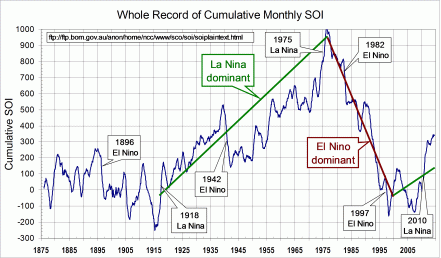
I posted this graph of cumulative values of the SOI earlier.
SOI CUSUM plot

The record of the Southern Oscillation Index relates to the Manilla record of extreme rainfall deficiency only now and then. Persistent El Niños from 1911 to 1915 seem to relate to four months in the decade of the 1910’s having extreme 3-year droughts, carrying forward to two months in the 1920’s having extreme 10-year droughts. Similarly, the catastrophic droughts of short to very long duration in the 1940’s relate to El Niños that persisted from 1939 to 1942.
Other major El Niño events did not produce extreme droughts at Manilla: those of 1896, 1982, and 1997.
Long term trends in the Southern Oscillation Index do not predict Manilla’s extreme droughts at all. The 1940’s droughts Continue reading
November Climate Anomalies Log

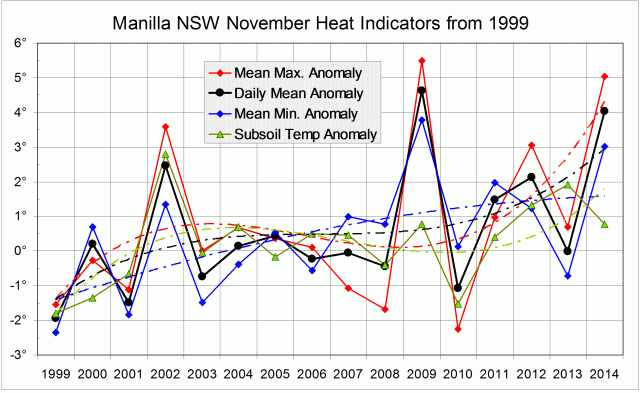
Heat indicators log for November

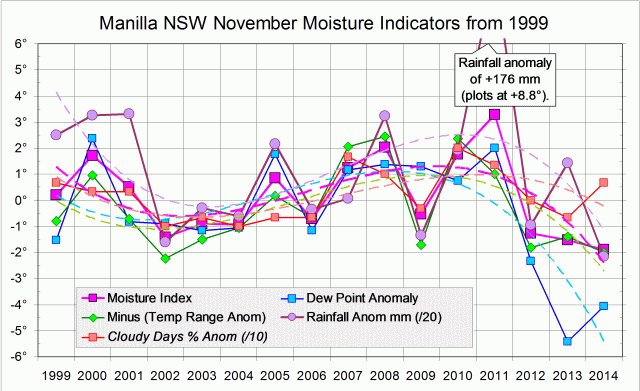
This post is the ninth in a set for the 12 calendar months that began with March. Graphs are sixteen-year logs of the monthly mean anomaly values of nine climate variables for Manilla, NSW, with fitted trend lines. I have explained the method in notes at the foot of the page.

Raw anomaly values for November

Extreme values of November anomalies were as follows:

Daily Maximum Temperature Anomalies (4) +3.6 deg: November 2002; +5.5 deg: November 2009; +3.0 deg: November 2012; +5.0 deg: November 2014;
Daily Mean Temperature Anomalies (2) +4.6 deg: November 2009; +4.0 deg: November 2014;
Daily Minimum Temperature Anomalies (1) +3.8 deg: November 2009;
Rainfall Anomalies (4) +65 mm: November 2000; +66 mm: November 2001; +65 mm: November 2008: +176 mm!: November 2011;
Dew Point Anomalies (2) -5.4 deg: November 2013; -4.1 deg: November 2014;
Moisture Index (1) +3.3 deg: November 2011.

Trend lines for November

Heat Indicators

All heat indicator quartic trends began low and ended high. The trends for daily maximum and for subsoil had a peak in 2003 or 2004 and a trough in 2008 or 2010. The trend for daily mean was constant from 2004 to 2008, while the trend for daily minimum persistently rose, at a reducing rate.

Moisture indicators log for November

Continue reading

Manilla’s Record of Droughts

Graph of droughts versus time

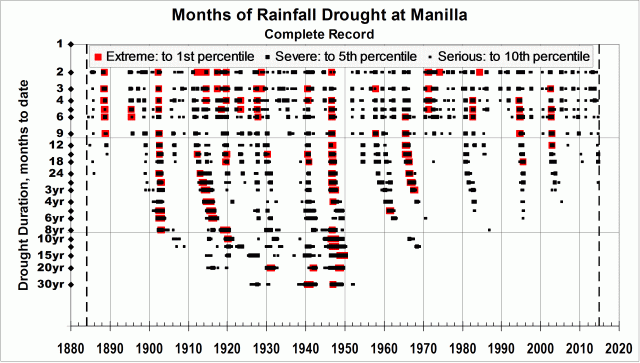
In terms of rainfall alone, Manilla, NSW, had droughts between 1900 and 1950 that were more severe, and lasted very much longer than those of recent years.

Comparing droughts

It is hard to say how bad one drought is compared to another because some droughts last longer than others. A drought that lasts two months, and has only 10 mm of rain when it would normally have 100 mm, qualifies as “extreme”. In such a very short drought, rainfall as low as 10% of normal just qualifies as extreme. For a drought lasting twelve months, when there is normally 652 mm of rainfall at Manilla, there has never been a case of a twelve-month rainfall as low as 10% of that (65 mm). (The lowest ever was 288 mm, in 1964-65.) Clearly, using 10% of normal rainfall will not do to define longer-term droughts.
I find the severity of each drought, whether it is long or short, by its percentile rank.
The Bureau of Meteorology defines “Rainfall Deficiency” as:

Lowest on record – lowest since at least 1900 when the data analysed begin.
Severe deficiency – rainfalls in the lowest 5% of historical totals.
Serious deficiency – rainfalls in the lowest 10% of historical totals, but not in the lowest 5%.

On the graph, I use this code:

Extreme rainfall shortage: rainfall in the 1st percentile only.
Severe rainfall shortage: rainfall in the 2nd to 4th percentiles.
Serious rainfall shortage: rainfall in the 5th to 9th percentiles.

Major droughts

All of Manilla’s extreme rainfall droughts that lasted for six years or more happened in the first half of the 20th century. Extreme droughts lasting for thirty years ended during 1940, 1941 and 1947.
Since 1950, the longest extreme drought lasted only five years, ending in 1961. The next longest lasted three years, ending in 1968. The last forty-four years have brought only six extreme droughts, all of less than two years duration: 1971, 1974, 1982, 1984 (2 months!), 1994 and 2002. The twelve years since 2002 may be the longest period without an extreme drought in the whole record since 1883.
Extreme droughts had also been few and short in the earliest years, from 1883 to 1902.

Similar, but much improved graphs

[This graph gives the misleading impression that the longer the duration of rainfall shortage, the later it occurs. That is an artefact.

A shortage of a given duration observed in a particular month must have commenced earlier: earlier by the number of months of its duration, less one.
Graphs that remove this defect, and plot correctly the dates of onset, persistence, and breaking of rainfall shortages are “Rainfall Shortage History: Manilla” and “Rainfall Shortage Jan 2000 – Mar 2019”.

Droughts Elsewhere

At Lake George, in the southern highlands of NSW, extreme droughts of long duration were similarly restricted to the first half of the 20th century, as shown by rainfall records and lake levels.
The “Millennial Drought of southeastern Australia” was not a drought of long duration at either Manilla or Lake George.

[Note added May 2016

Graphical log of droughts, 1884 to 1916The post “Manilla’s Droughts, 1884 to 1916” has an enlarged graph showing more detail. Of the catastrophic droughts of 1902 (“Federation Drought”) and 1912-16, the first had a sudden termination but the second had a sudden onset.]

This blog has many more posts about drought (or rainfall deficiency) at Manilla, NSW. Please use the “Search” function at the top right.

Continue reading

October Climate Anomalies Log

Heat Indicators log for October months

This post is the eighth in a set for the 12 calendar months that began with March. Graphs are sixteen-year logs of the monthly mean anomaly values of nine climate variables for Manilla, NSW, with fitted trend lines. I have explained the method in notes at the foot of the page.

This series of posts gets more than its share of views. This is strange, as they contain little information. Comparing graphs for adjacent months shows widely different values and trends. In due course, I will compare all twelve months with each other. Perhaps that will yield interesting results, or perhaps not.

Raw anomaly values for October

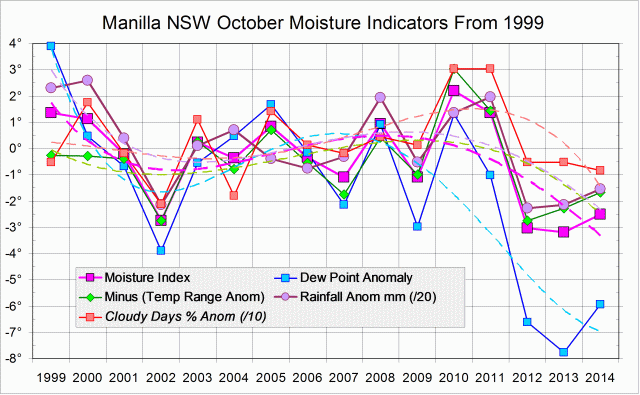
Extreme values of October anomalies in this period were all in the “Moisture Indicators” group:

Cloudy days % anomalies (2) +31%: October 2010, 2011;
Dew Point Anomalies (5) +3.9°: October 1999, -3.9°: October 2002, -6.6°: October 2012, -7.8°: October 2013, -5.9°: October 2014.
Moisture Index (2) -3.1°: October 2012, -3.2°: October 2013.

Trend lines for October

Heat Indicators

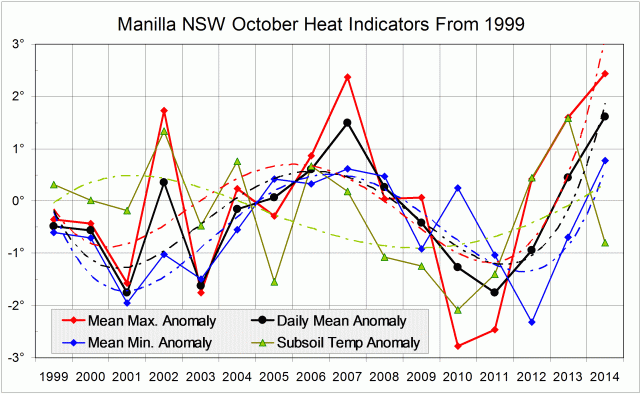
The trend lines of daily maximum, mean and minimum temperature anomalies all had an early trough in 2001, a peak near 2006, and a trough near 2011. The daily minimum trend had the longer period and the larger amplitude. The subsoil temperature trend peaked early, in 2001, and had a very broad trough around 2009.

Moisture Indicators log for October months

Continue reading

Decadal and Inter-decadal changes in rainfall: III.

Summer rainfall anomalies and trends

Part 3 of 3: A growth and collapse model for summer rainfall

(See Notes below for data and plotting details.)

I have put this October 2014  post up on the front page as a “sticky” (5/1/15) because I have just found a relevant scientific article. See “Note added January 2015” below.

A linear trend

In Part II, I showed that a linear trend fits well (R-squared = 0.54) to smoothed summer rainfall at Manilla, NSW from 1897 to 1976. This trend-line rises extremely steeply: 156 mm per century.
(See also the Duodecadal Means graph below.)

Implications of the extreme trend

Such an extreme trend cannot extend more than a short time into the past or the future without reaching physical limits. Extremely high values must be followed by lower values and vice versa. The oscillation between higher and lower values in nature is often modeled as a smooth harmonic curve. That does not fit well here. Not only does the rise from 1897 to 1976 fail to curve down approaching the final peak, the falls from 1892 to 1900 and from 1975 to 1987 are extremely sharp. They are collapses.
It seems to me that a model of steady growth followed by sudden collapse may perhaps reflect the processes involved. On the graph I have added speculative trend lines of the same rising slope as that observed for 1897 to 1976. The constant for the first speculative trend line is 130 mm higher and leads to a 130 mm collapse from 1896 to 1899. A 90 mm collapse from 1978 to 1981 then leads to a renewed rising trend that is 90 mm lower.


Note added January 2015.

The sudden collapse in summer rainfall here at the beginning of the twentieth century was studied sixty years ago by E.B. Kraus (Snowy Mountains Authority!): “Secular changes of east-coast rainfall regimes” (1955).
“The mean rainfall along the east coasts of North America and Australia is shown to have decreased abruptly at the end of the 19th century… A simultaneous decrease of the rainfall in the Continue reading