2019 new hottest and driest year

At Manilla, NSW, in the twenty years from 2000, the year 2019 was the hottest and the driest, overtaking the year 2018.
Climate logs Manilla 20-years

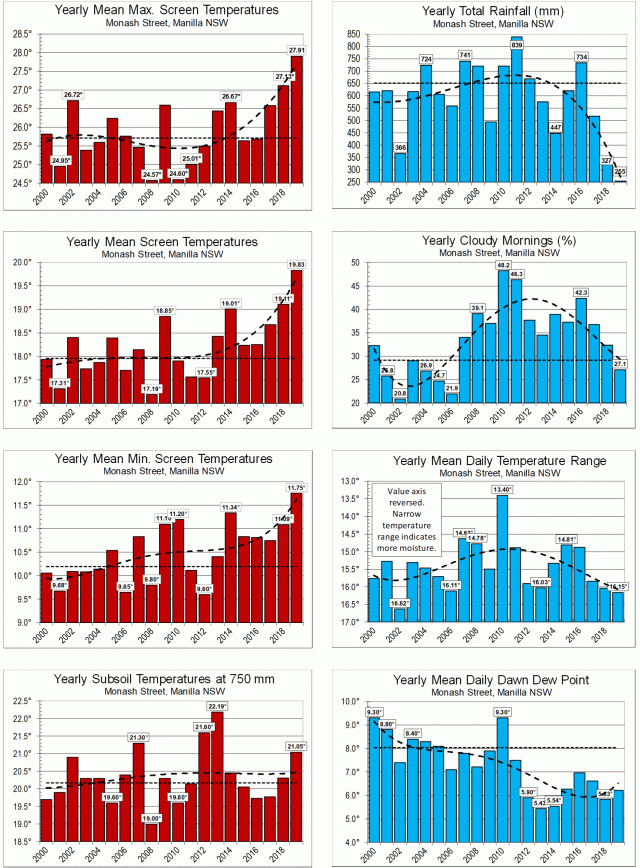
Climate records kept at 3 Monash Street, Manilla from April 1999 yield these eight graphs of climate variables. The graphs on the left (red) show heat and those on the right (blue) show moisture.
These graphs show the figures for calendar years, not for seasons.
In general, the temperatures in this 20-year record rose, with a pause between 2004 and 2012. Moisture peaked about 2010.
At Manilla, a sudden rise in temperature and fall in rainfall happened after 2017, having been much slower before that.
Dashed horizontal lines mark the normals for the decade from April 1999.

Left column graphs (red)

Yearly Mean Maximum Screen Temperatures

Day temperatures are shown by the mean maximum temperature in the Gill-type thermometer screen. The year 2019, at 27.91°, had the hottest days by far. The year 2018 had 27.13°, and 2002 and 2014 were almost as warm.The coldest days were in 2008 (24.57°) and 2010 (24.60°), followed by 2001 and 2011.
The 4th-order trend line shows a minimum about 2010, followed by a rapid rise.

Yearly Mean Screen Temperatures

This graph shows warmth in general, as in the study of global warming. Daily maximum and daily minimum temperatures are averaged. The year 2019 was the warmest (19.83°), followed by 2018, 2014, and 2009. The coolest year in this century was 2008 (17.19°), followed by 2001, 2011, and 2012.
The 4th-order trend line shows near-constant temperature from 2000 to 2011, followed by a rapid rise.

Yearly Minimum Screen Temperatures

Night temperatures are shown by the mean minimum temperature in the thermometer screen. While 2018 had not had very warm nights, 2019, at 11.75°, had warmest nights as well as days. The next warmest were in 2014, 2010 and 2009. Years with nights cooler than 10° on average were 2012, 2008, 2006 and 2001.
The 4th-order trend line shows a rise from 2000 to 2008, then near-constant temperature to 2014, followed by a rapid rise.

Yearly Subsoil Temperatures

Yearly temperatures in the subsoil (at 750 mm depth) hardly related at all to air temperatures read in the Gill Screen. The best match is in 2008, when the subsoil temperature was lowest (19.00°), as were the screen mean (17.19°) and the screen maximum (24.57°).
[Note that world temperature was low late in 2007.]
Continue reading

January 2020: still 5 drought records

Rainfall status Dec-19, Jan-20

Changing shortages

January rainfall of 46.8 mm further reduced short-term shortages, bringing the 9-month total (212 mm) out of the “extreme shortage” class. Most longer-duration totals remained in that class, however.

Fewer record low rainfalls

By December 2019, there had been 10 new record low rainfalls. Records were set not only for 12-months duration, but for every one of the 9 chosen durations from 24-months to 96-months. In January 2020 there were only 5 new records, although there were 4 2nd-lowest values that also plotted on the 0.1th percentile line. The 5 new records were:

36-months duration: 1098 mm;
48-months duration: 11775 mm;
60-months duration: 2384 mm;
84-months duration: 3419 mm;
96-months duration: 4132 mm.

How to read the graph

This graph shows all the present rainfall shortages at Manilla, short term and long term, as percentile values. The latest values, as at the end of January 2020, are shown by a thick black line with large circles. Those from one month earlier are shown by a thinner line with small diamonds. [The method is described in “Further Explanation” below.]


Further Explanation

The following notes explain aspects of this work under these listed headings:

Data analysis

Cumulative rainfall totals
Percentile values
Severity of rainfall shortages

Limitations of this analysis

Monthly rainfalls form a single population
Observations are not retrospective
The rain gauge failed

Data analysis

Continue reading

December 2019: 10 new drought records

Rainfall status Nov-Dec 2019

Changing shortages

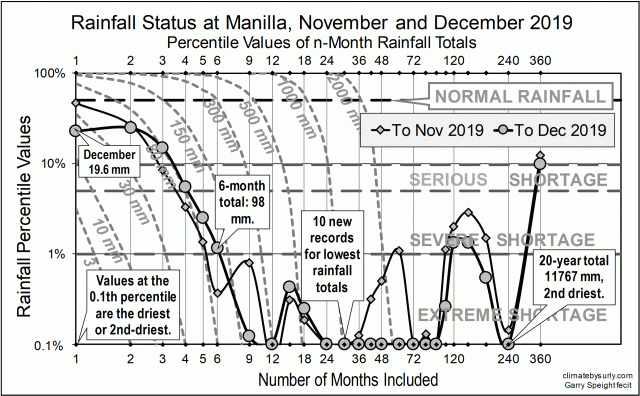
December rainfall of 19.6 mm, added to November rainfall of 40.2 mm, reduced the shortages for durations up to six months, but it did not prevent the drought becoming worse at nearly all longer durations. The shortage was extreme (1st percentile) at every duration beyond 6-months, except at 120-, and 144-months (severe shortage) and at 360-months (serious shortage).Although the 360-month total of 18,596 mm, being at the 10th percentile, is merely a “serious” shortage, this is the lowest 360-month rainfall total since 1952!

Record low rainfalls

New record low rainfall totals were set in December 2019 as follows:

12-months duration: 255 mm;
24-months duration: 582 mm;
30-months duration: 791 mm;
36-months duration: 1099 mm;
42-months duration: 1477 mm;
48-months duration: 1833 mm;
60-months duration: 2455 mm;
72-months duration: 2901 mm;
84-months duration: 3477 mm;
96-months duration: 4146 mm.

For most of these durations, the record had already been broken several times in this drought. However, three of these records had stood for over a century:

42-month duration: 1477 mm beats (by 43 mm) the record of 1520 mm set in September 1914;
48-month duration: 1833 mm beats (by 3 mm) the record of 1836 mm set in February 1915;
60-month duration: 2455 mm beats (by 11 mm) the record of 2466 mm set in February 1916.

How to read the graph

This graph shows all the present rainfall shortages at Manilla, short term and long term, as percentile values. The latest values, as at the end of November 2019, are shown by a thick black line with large circles. Those from one month earlier are shown by a thinner line with small diamonds. [The method is described in “Further Explanation” below.]


Further Explanation

The following notes explain aspects of this work under these listed headings:

Data analysis

Cumulative rainfall totals
Percentile values
Severity of rainfall shortages

Limitations of this analysis

Monthly rainfalls form a single population
Observations are not retrospective
The rain gauge failed

Data analysis

Continue reading

January 2020 more humid

Rain in the main street

It rained!

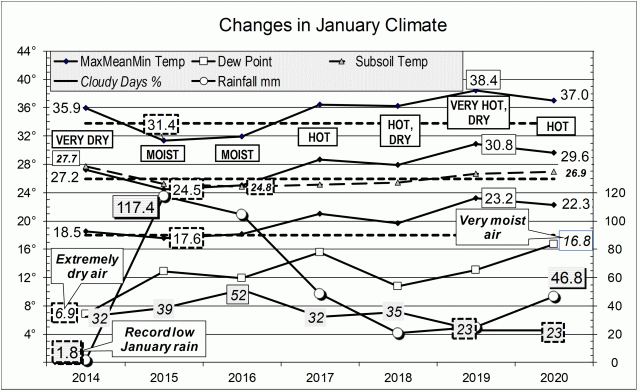
Weekly average temperatures were 7 deg high early in the month, normal in the third week, then 6 deg high at the end. In these hot weeks, ten days went over 40 deg.
The night of the 11th, at 28.1 deg, was extremely warm. It was the 2nd warmest on record, after 28.2 on 14/01/17.
Although the wettest day had only 22.8 mm of rain, there were 11 rain days. Other signs of moisture included 11 days with half cloud cover or more, and 9 mornings with dew points over 20 deg.

Weather log January 2020

Comparing January months

Mean temperatures this month are the 2nd highest for January, being lower than last year. Subsoil temperature is normal.
All moisture indicators are higher. The early morning dew point, at 16.8 deg, is remarkably high, exceeded only in January 2006.
The rainfall total of 46.8 mm is at the 28th percentile for January, well below the average of 87 mm.

January climae

Drought

I will report separately on the on-going drought that continues to break low-rainfall records at durations of 15-months and longer.


Data. A Bureau of Meteorology automatic rain gauge operates in the museum yard. From 17 March 2017, 9 am daily readings are published as Manilla Museum, Station 55312.  These reports use that rainfall data when it is available. Recording resumed on 20 July 2019.
My estimates of early morning dew point have drifted anomalously low. From August 2019, I use data from the Tamworth Airport published graphs.
All other data, including subsoil at 750 mm, are from 3 Monash Street, Manilla.

3-year trends to January 2020

January much more humid

3-year climate trends to Jan 2020

January raw anomaly data (orange)

Temperatures

Daily maximum temperature anomaly (all x-axes) high, but not now extreme: now only three degrees above 21st century normal.
Daily minimum temperature anomaly (lower left): extremely high, twice as high as the record smoothed value
Subsoil temperature anomaly (lower right): still near normal.

Moistures (moist is at the bottom)

Rainfall anomaly (upper left): no longer extremely low.
Cloudiness anomaly (upper right): back to normal.
Dew point anomaly (middle left): suddenly rather high (humid).
Daily temperature range anomaly (middle right): suddenly narrow, due to cloud.

 Fully smoothed data values (red) 

Smoothed anomaly values now include July of 2019. From the rather static values of the autumn, nearly all smoothed values for June began to move in the direction towards drought that seems to have persisted through spring.
There were two exceptions. Daily minimum temperature anomaly continued to fall. Subsoil temperature anomaly reached a peak value in June.


Notes:

January data points are marked by squares.

Smoothing Continue reading