3-year trends to August 2014

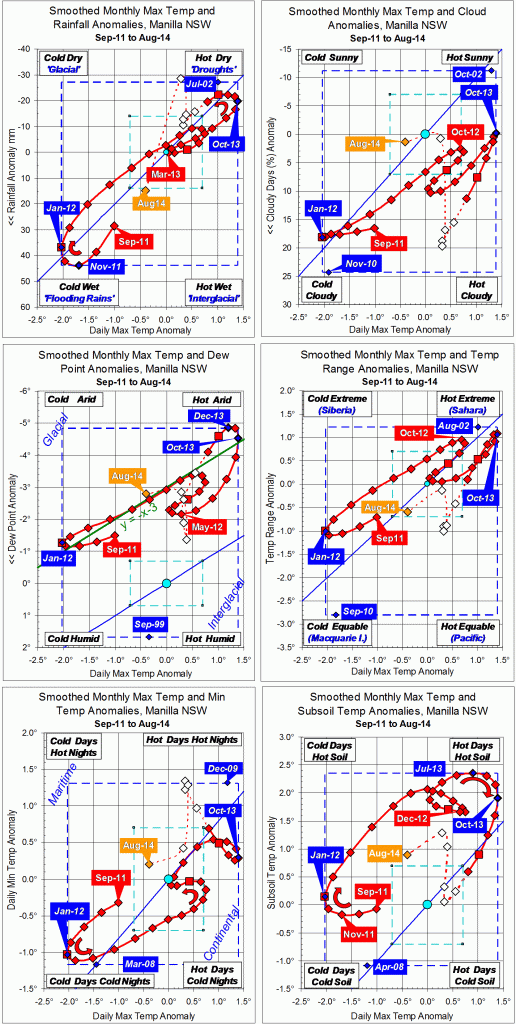
Parametric plots of smoothed climate variables at Manilla
“August 2014 back to normal”
Trends to August 2014

 August data (orange)

Most raw anomaly values for August have returned to near normal. The daily maximum temperature anomaly has finally fallen below normal and rainfall has risen above normal. The dew point anomaly remains well below normal, but its value is on the (green) trend line that has applied during the last three years.

Fully smoothed data (red)

Fully-smoothed data is now available for the summer season ending in February 2014. During the summer all variables except daily minimum temperature moved decisively away from drought. Rainfall increased rather slowly, but cloudiness increased very rapidly, and daily temperature range fell very rapidly.

The hot-arid climatic peak (drought) of spring 2013

Extreme anomaly values of climate variables came in the following order:

Highest minimum temperature (not high): July;
Highest subsoil temperature (extreme): July;
Widest temperature range (very wide): October;
Highest maximum temperature (extreme): October;
Least cloudiness (normal): October;
Lowest dew point (extreme): December;
Lowest rainfall (very low): December-January.

This is not the order that is typical in recent extreme episodes. The smoothed rainfall anomaly minimum of -22.3 mm (not nearly as low as the -27.1 mm of July 2002) came much later than the peak of daily maximum temperature. On the top left graph the trace curved anti-clockwise, which is unusual.


Note:

Fully smoothed data – Gaussian smoothing with half-width 6 months – are plotted in red, partly smoothed data uncoloured, and raw data for the last data point in orange. January data points are marked by squares.
Blue diamonds and the dashed blue rectangle show the extreme values in the fully smoothed data record since September 1999.

Normal values are based on averages for the decade from March 1999. They appear on these graphs as a turquoise (turquoise) circle at the origin (0,0). A range of anomalies called “normal” is shown by a dashed rectangle in aqua (aqua). For values in degrees, the assigned normal range is +/-0.7°; for cloudiness, +/-7%; for monthly rainfall, +/-14 mm.
 

August 2014 normal but with dry air

The daily weather log

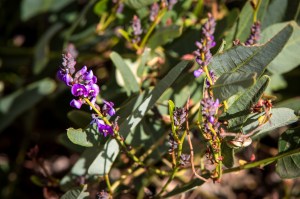
Purple flowers

Early-blooming Hardenbergia

The weekly temperature was normal throughout, but the first half of the month had sunny warm days, cold nights and very dry air. The night of the 3rd (-4.0°) was the coldest August night this century, and the early morning of the 12th had the lowest August dew point (-8.7°). Two brief overcast and rainy spells began on the 16th and 26th, yielding 54.4 mm in five rain days. The reading of 26.6 mm on the 17th was one of the highest for August in recent years.
The number of frosts (12) was a little below normal (15).

Weather log August 2014

 Comparing August months

While August 2008 had been the coolest, and August 2009 the warmest in the 21st century, nearly all averages this month were near normal. As exceptions, the daily maximum temperature was slightly low and the dew point (as in the two previous August months) was very low. Few mornings had dew on the grass.
The total rainfall of 54.4 mm is in the 75th percentile, well above the August average (40 mm). This rain also raised the rainfall totals for periods of more than one month, so that only the 18-month total of 691 mm now remains as a serious shortage (9th percentile).

Climate August 2014  


Data. Rainfall data is from Manilla Post Office, courtesy of Phil Pinch. Temperatures, including subsoil at 750 mm, and other data are from 3 Monash  Street, Manilla.

August Climate Anomalies Log

Heat Indicators log for August months

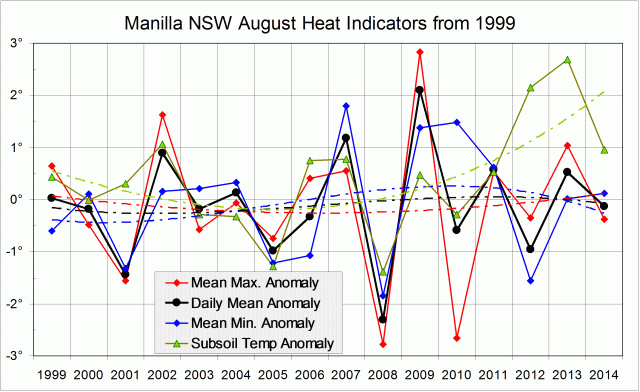
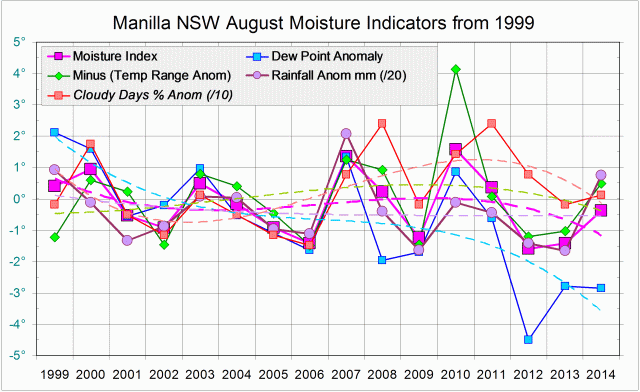
This post is the sixth in a set for the 12 calendar months. Graphs are sixteen-year logs of the monthly mean anomaly values of nine climate variables for Manilla, NSW, with fitted trend lines. I have explained the method in notes at the foot of the page.

Raw anomaly values for August

Extreme values of August anomalies in this period were:

Temperature range anomaly (minus) +4.1 deg: August 2010;
Dew Point Anomaly -4.5 deg: August 2012.

Trend lines for August

Heat Indicators

The trend of mean temperature anomalies was almost constant. The trend of daily maximum temperature anomalies was almost constant, but had a weak minimum at 2007. The trend of minimum temperature anomaly had a weak minimum in 2001 and a weak maximum in 2010. The subsoil temperature anomaly trend ended very high, after a weak minimum in 2005.

Moisture Indicators log for August months

Continue reading